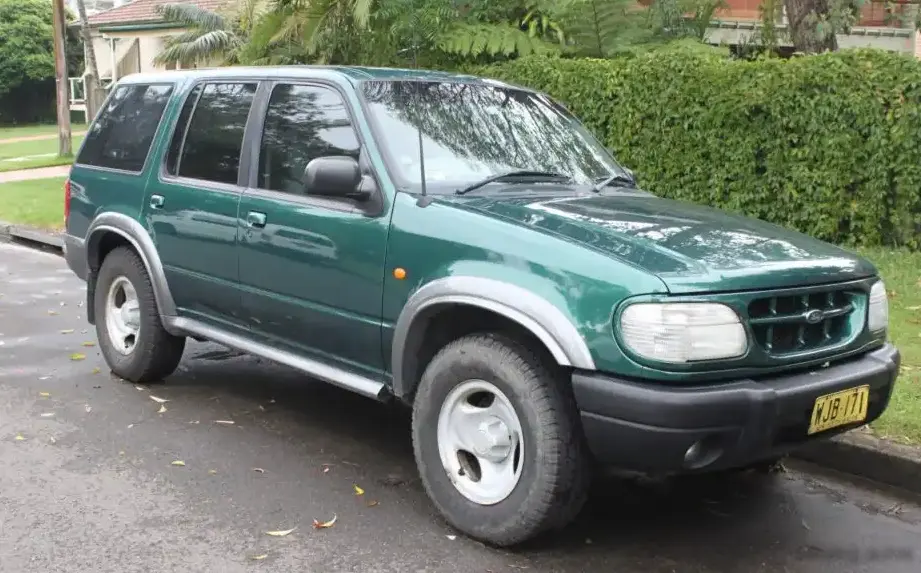
The Ford Explorer VI, specifically the 2.3 EcoBoost 4WD Automatic variant introduced with the 2024 facelift, represents a significant evolution in Ford’s popular SUV lineup. Launched in February 2024, this iteration builds upon the sixth-generation Explorer (introduced in 2019) with updated styling, enhanced technology, and a refined powertrain. Positioned as a mid-range offering within the Explorer family, the 2.3 EcoBoost 4WD balances performance, capability, and fuel efficiency, appealing to a broad spectrum of buyers seeking a versatile three-row SUV. It slots in between the base 2.3L rear-wheel drive model and the more powerful, performance-oriented ST and Platinum trims.
Technical Specifications
| Brand | Ford |
| Model | Explorer |
| Generation | Explorer VI (facelift 2024) |
| Type (Engine) | 2.3 EcoBoost (300 Hp) 4WD Automatic |
| Start of production | February, 2024 |
| Powertrain Architecture | Internal Combustion engine |
| Body type | SUV |
| Seats | 6-7 |
| Doors | 5 |
| Fuel Type | Petrol (Gasoline) |
| Power | 300 Hp |
| Power per litre | 132.7 Hp/l |
| Torque | 420 Nm / 309.78 lb.-ft. |
| Engine layout | Front, Longitudinal |
| Engine Model/Code | EcoBoost |
| Engine displacement | 2261 cm3 / 137.97 cu. in. |
| Number of cylinders | 4 |
| Engine configuration | Inline |
| Cylinder Bore | 84 mm / 3.31 in. |
| Piston Stroke | 102 mm / 4.02 in. |
| Compression ratio | 10.6:1 |
| Number of valves per cylinder | 4 |
| Fuel injection system | Direct injection and Multi-port manifold injection |
| Engine aspiration | Turbocharger, Intercooler |
| Valvetrain | DOHC, TI-VCT |
| Engine oil capacity | 4.7 l / 4.97 US qt | 4.14 UK qt |
| Coolant | 12.8 l / 13.53 US qt | 11.26 UK qt |
| Trunk (boot) space – minimum | 462 l / 16.32 cu. ft. |
| Trunk (boot) space – maximum | 2430 l / 85.81 cu. ft. |
| Fuel tank capacity | 68 l / 17.96 US gal | 14.96 UK gal |
| Permitted trailer load with brakes (12%) | 2268 kg / 5000.08 lbs. |
| Length | 5047 mm / 198.7 in. |
| Width | 2004 mm / 78.9 in. |
| Width with mirrors folded | 2101 mm / 82.72 in. |
| Width including mirrors | 2268 mm / 89.29 in. |
| Height | 1768-1783 mm / 69.61 – 70.2 in. |
| Wheelbase | 3025 mm / 119.09 in. |
| Front track | 1699 mm / 66.89 in. |
| Rear (Back) track | 1699 mm / 66.89 in. |
| Front overhang | 853 mm / 33.58 in. |
| Rear overhang | 1169 mm / 46.02 in. |
| Ride height (ground clearance) | 193-208 mm / 7.6 – 8.19 in. |
| Approach angle | 19.7-20.5° |
| Departure angle | 21.1-21.5° |
| Ramp-over (brakeover) angle | 16.5-17.6° |
| Drivetrain Architecture | The Internal combustion engine (ICE) drives the rear wheels permanently, and the front wheels are driven through an electrically or mechanically operated clutch if necessary. |
| Drive wheel | All wheel drive (4×4) |
| Number of gears and type of gearbox | 10 gears, automatic transmission |
| Front brakes | Ventilated discs |
| Rear brakes | Ventilated discs |
| Assisting systems | ABS (Anti-lock braking system) |
| Steering type | Steering rack and pinion |
| Power steering | Electric Steering |
| Tires size | 255/65 R18; 255/55 R20; 275/45 R21 |
| Wheel rims size | 18; 20; 21 |
Powertrain & Engine Architecture
At the heart of the 2024 Explorer 2.3 EcoBoost 4WD lies the 2.3-liter turbocharged inline-four cylinder engine. This engine, part of Ford’s EcoBoost family, utilizes a combination of direct injection and multi-port fuel injection to optimize combustion efficiency and power delivery. The engine code is generally consistent with previous iterations of this engine, though specific calibrations may differ. The engine features a twin-scroll turbocharger with an integrated intercooler, enhancing responsiveness and minimizing turbo lag. The DOHC (Double Overhead Camshaft) cylinder head incorporates Ford’s Ti-VCT (Twin Independent Variable Camshaft Timing) technology, allowing for precise control of valve timing to maximize performance across the engine’s operating range. The 10-speed automatic transmission, co-developed with General Motors, is a key component of this powertrain. Its wide gear ratio spread contributes to both improved acceleration and enhanced fuel economy. The transmission is electronically controlled and features selectable drive modes, including Normal, Sport, and Tow/Haul.
Driving Characteristics
The 2.3 EcoBoost engine delivers a respectable 300 horsepower and 420 Nm (309.78 lb-ft) of torque, providing ample power for everyday driving and occasional towing. While not as exhilarating as the Explorer ST’s 3.0-liter V6, the 2.3L offers a smooth and refined driving experience. The 10-speed automatic transmission is generally responsive, although some drivers may notice occasional hunting for the optimal gear, particularly during highway cruising. The 4WD system provides enhanced traction in inclement weather and on loose surfaces, making it a capable all-season vehicle. Compared to the rear-wheel-drive version, the 4WD model offers increased stability and confidence, especially when towing. The gear ratios are tuned for a balance between acceleration and fuel efficiency, with lower gears providing quick off-the-line response and higher gears optimizing fuel economy at highway speeds.
Equipment & Trim Levels
The 2.3 EcoBoost 4WD trim typically includes standard features such as Ford’s SYNC 3 infotainment system with an 8-inch touchscreen, Apple CarPlay and Android Auto compatibility, and a suite of driver-assistance technologies including automatic emergency braking, lane-keeping assist, and blind-spot monitoring. Interior upholstery is typically cloth, with available upgrades to leather. Optional extras include a larger 10.1-inch touchscreen, a premium sound system, heated and ventilated front seats, and a panoramic sunroof. The 2024 facelift brought updated interior trim options and a more modern dashboard layout.
Chassis & Braking
The Explorer VI utilizes a steel unibody construction with independent front and rear suspension. The front suspension features MacPherson struts, while the rear suspension employs a multi-link design. The 2.3 EcoBoost 4WD model typically features ventilated disc brakes on all four wheels, providing adequate stopping power for its weight class. Anti-lock braking system (ABS) is standard, along with electronic stability control. Stabilizer bars are fitted to both the front and rear axles to reduce body roll during cornering. The suspension tuning is geared towards comfort and ride quality, prioritizing a smooth and compliant ride over sporty handling.
Market Reception & Comparison
The 2.3 EcoBoost 4WD Explorer has generally received positive reviews from automotive critics, who praise its blend of performance, fuel efficiency, and practicality. It’s often seen as a sweet spot in the Explorer lineup, offering a good balance of features and value. Compared to the base 2.3L RWD model, the 4WD version offers superior traction and all-weather capability. Compared to the more expensive ST and Platinum trims, the 2.3 EcoBoost 4WD provides a more affordable entry point into the Explorer range without sacrificing too much in terms of performance or features. Fuel economy is rated at around 21 mpg city and 28 mpg highway, which is competitive for its class.
Legacy
The 2.3 EcoBoost engine has proven to be a reliable and durable powertrain in various Ford vehicles. While long-term reliability data for the 2024 facelifted Explorer is still emerging, the engine itself has a solid track record. The 10-speed automatic transmission has also demonstrated good reliability, although some owners have reported minor issues with software glitches. In the used car market, the 2.3 EcoBoost 4WD Explorer is expected to hold its value reasonably well, due to its popularity and versatility. Regular maintenance, including oil changes and transmission fluid flushes, is crucial to ensuring the longevity of this powertrain.