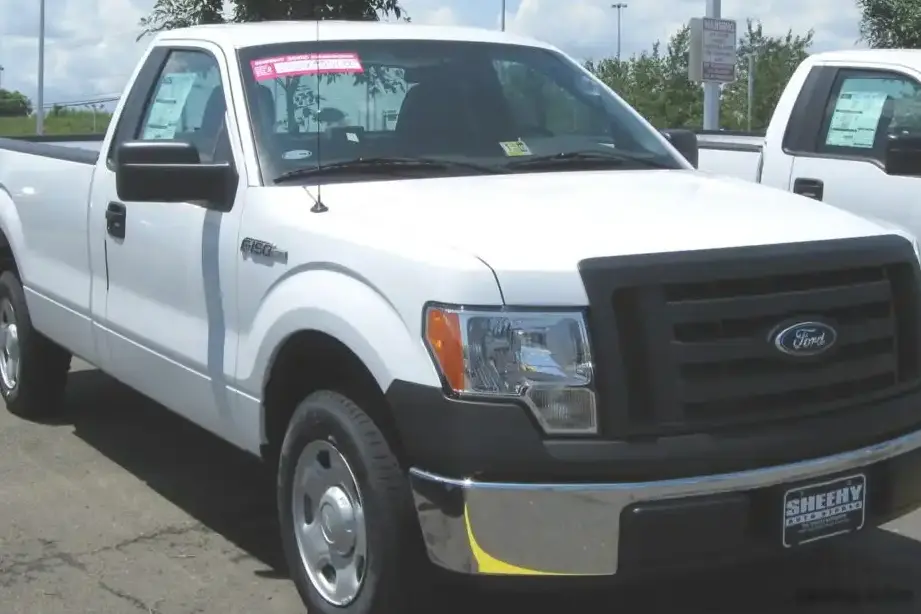
The Ford F-150, consistently a best-selling vehicle in the United States, entered its twelfth generation with the 2011 model year. This generation marked a significant shift for the F-150, introducing a new frame, updated styling, and a suite of new engine options, most notably the EcoBoost series. The F-150 XII Regular Cab 3.5L V6 EcoBoost with the automatic transmission, produced from 2011 to 2014, represented a compelling blend of power, efficiency, and capability within the expansive F-150 lineup. This configuration aimed to provide buyers with a strong performer suitable for both work and everyday use, without the higher price tag of the larger displacement engines.
Technical Specifications
| Brand | Ford |
| Model | F-Series F-100/F-150 |
| Generation | F-Series F-150 XII Regular Cab |
| Type (Engine) | 3.5 V6 EcoBoost (365 Hp) Automatic |
| Start of production | 2011 |
| End of production | 2014 |
| Powertrain Architecture | Internal Combustion engine |
| Body type | Pick-up |
| Seats | 3 |
| Doors | 2 |
| Fuel consumption (urban) | 14.7 l/100 km (16 US mpg, 19.2 UK mpg, 6.8 km/l) |
| Fuel consumption (extra urban) | 10.7 l/100 km (22 US mpg, 26.4 UK mpg, 9.3 km/l) |
| Fuel consumption (combined) | 13.1 l/100 km (18 US mpg, 21.6 UK mpg, 7.6 km/l) |
| Fuel Type | Petrol (Gasoline) |
| Weight-to-power ratio | 6.1 kg/Hp, 162.9 Hp/tonne |
| Weight-to-torque ratio | 3.9 kg/Nm, 254 Nm/tonne |
| Power | 365 Hp @ 5000 rpm |
| Power per litre | 104.1 Hp/l |
| Torque | 569 Nm @ 2500 rpm (419.67 lb.-ft. @ 2500 rpm) |
| Engine layout | Front, Longitudinal |
| Engine displacement | 3507 cm3 (214.01 cu. in.) |
| Number of cylinders | 6 |
| Engine configuration | V-engine |
| Compression ratio | 10:1 |
| Number of valves per cylinder | 4 |
| Fuel injection system | Direct injection |
| Engine aspiration | Twin-Turbo, Intercooler |
| Valvetrain | DOHC, Ti-VCT |
| Engine oil capacity | 5.7 l (6.02 US qt | 5.02 UK qt) |
| Coolant capacity | 15.6 l (16.48 US qt | 13.73 UK qt) |
| Kerb Weight | 2240-2306 kg (4938.35 – 5083.86 lbs.) |
| Max. weight | 3719 kg (8198.99 lbs.) |
| Max load | 1413-1479 kg (3115.13 – 3260.64 lbs.) |
| Fuel tank capacity | 98 l (25.89 US gal | 21.56 UK gal) |
| Permitted trailer load with brakes (12%) | 5126 kg (11300.9 lbs.) |
| Length | 5890 mm (231.89 in.) |
| Width | 2012 mm (79.21 in.) |
| Width including mirrors | 2464 mm (97.01 in.) |
| Height | 1905 mm (75 in.) |
| Wheelbase | 3670 mm (144.49 in.) |
| Front track | 1702 mm (67.01 in.) |
| Rear track | 1702 mm (67.01 in.) |
| Minimum turning circle | 14.3 m (46.92 ft.) |
| Drivetrain | Rear wheel drive |
| Number of gears | 6 |
| Gearbox type | Automatic transmission |
| Front suspension | Double wishbone |
| Rear suspension | Leaf spring |
| Front brakes | Ventilated discs, 351×34 mm |
| Rear brakes | Ventilated discs, 348×25 mm |
| Assisting systems | ABS (Anti-lock braking system) |
| Steering type | Steering rack and pinion |
| Power steering | Electric |
| Tires size | 255/70 R17; 265/60 R18; 275/55 R20 |
| Wheel rims size | 7.5J x 17; 7.5J x 18; 8.5J x 20 |
INTRODUCTION
The 2011-2014 Ford F-150 Regular Cab equipped with the 3.5L EcoBoost V6 and automatic transmission occupied a significant middle ground in the F-150 lineup. Positioned above the base 3.7L V6 and the 5.0L V8, it offered a substantial power increase and improved fuel economy compared to those options, while remaining more affordable than the top-tier 6.2L V8. Built on the 1HX0 platform, this variant catered to buyers who needed a capable truck for work or recreational use, but didn’t necessarily require the ultimate towing or hauling capacity of the larger engines. The Regular Cab configuration further emphasized its work-truck appeal, offering a no-frills, functional interior and a lower price point.
Powertrain & Engine Architecture
The heart of this F-150 variant is the 3.5L EcoBoost V6, internally designated as the 3.5L Ti-VCT. This engine utilizes a 60-degree V-configuration with twin turbochargers and direct fuel injection. The twin-turbo setup, featuring electronically controlled wastegates, provides a broad torque curve and minimizes turbo lag. The direct injection system precisely meters fuel into the cylinders, improving combustion efficiency and power output. The engine also features Ford’s Ti-VCT (Twin Independent Variable Camshaft Timing) technology, allowing for optimized valve timing based on engine load and speed. The 6-speed automatic transmission (6R80E) was specifically tuned to handle the EcoBoost engine’s torque output. This transmission features a wide gear ratio spread, optimizing both acceleration and fuel economy. The automatic transmission was a popular choice for buyers prioritizing ease of use and convenience.
Driving Characteristics
The 3.5L EcoBoost-equipped F-150 delivered a noticeably different driving experience compared to the naturally aspirated engines. The twin turbos provide strong low-end torque, making it feel more powerful than its horsepower rating suggests. Acceleration is brisk, and the engine pulls strongly even when fully loaded. The 6-speed automatic transmission shifts smoothly and efficiently, although some drivers noted a slight hesitation during downshifts. Compared to the 5.0L V8, the EcoBoost offered comparable power but with better fuel economy. The EcoBoost’s torque curve also made it feel more responsive in everyday driving situations. While not as refined as the 6.2L V8, the 3.5L EcoBoost provided a compelling balance of performance and efficiency for the majority of F-150 buyers.
Equipment & Trim Levels
The F-150 Regular Cab 3.5L EcoBoost was available in several trim levels, including XL, XLT, and Lariat. The base XL trim offered a basic level of equipment, including air conditioning, a basic audio system, and vinyl upholstery. The XLT trim added features such as power windows and locks, keyless entry, and an upgraded audio system. The Lariat trim offered a more luxurious experience, with leather upholstery, heated front seats, and a premium audio system. Optional extras included a trailer brake controller, a navigation system, and a power moonroof. The interior design was functional and durable, with a focus on practicality rather than luxury, especially in the lower trims.
Chassis & Braking
The F-150 XII utilized a fully boxed frame, providing a solid foundation for the truck. The front suspension featured an independent double wishbone design, while the rear suspension utilized leaf springs. This configuration provided a comfortable ride and good handling characteristics. Braking duties were handled by ventilated disc brakes on all four wheels, with ABS (Anti-lock Braking System) standard. The braking system was adequately sized for the truck’s weight and performance. The rear leaf spring suspension was chosen for its durability and load-carrying capacity, making it well-suited for work-truck applications.
Market Reception & Comparison
The 3.5L EcoBoost engine was widely praised by automotive critics for its innovative technology and impressive performance. It quickly became a popular choice among F-150 buyers, offering a compelling alternative to the traditional V8 engines. Compared to the 5.0L V8, the EcoBoost offered similar power but with better fuel economy, making it an attractive option for buyers concerned about running costs. However, some critics noted that the EcoBoost engine was more complex than the V8s, potentially leading to higher maintenance costs in the long run. The F-150 as a whole continued to dominate the full-size pickup truck market, and the EcoBoost engine played a significant role in its success.
Legacy
The 3.5L EcoBoost engine has proven to be a reliable and durable powertrain, with many examples exceeding 200,000 miles with proper maintenance. The 6R80E automatic transmission is also known for its robustness. On the used car market, the 2011-2014 F-150 Regular Cab 3.5L EcoBoost represents a good value proposition, offering a capable and efficient truck at an affordable price. The EcoBoost engine’s popularity has continued to grow in subsequent F-150 generations, and it remains a key component of Ford’s truck lineup today. The introduction of the EcoBoost engine marked a turning point for the F-150, demonstrating Ford’s commitment to innovation and fuel efficiency in the full-size pickup truck segment.