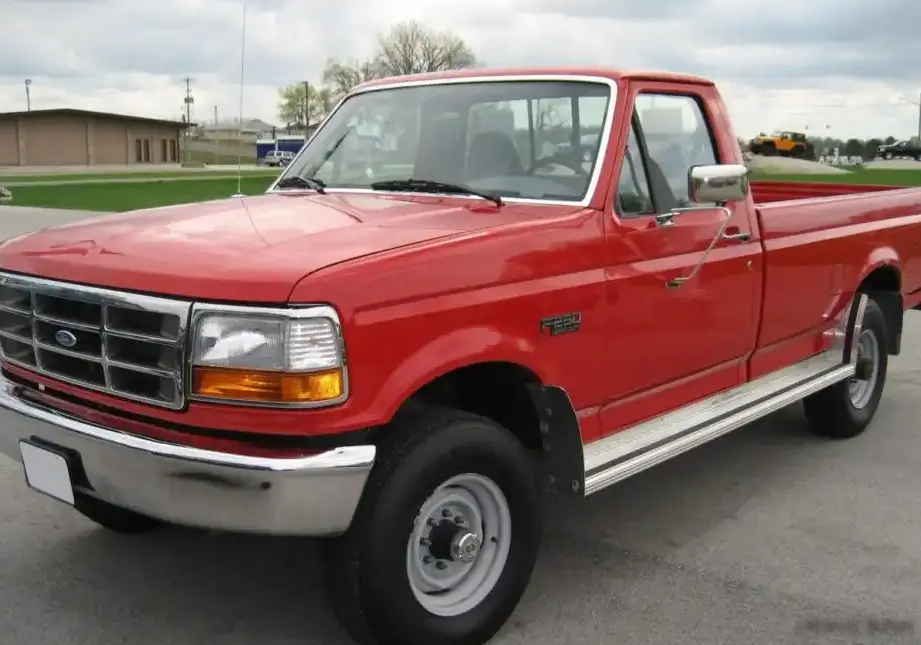
The Ford F-Series F-250 IX Regular Cab, equipped with the 5.8-liter V8 engine and automatic transmission, was a mainstay of Ford’s heavy-duty truck lineup from 1991 through 1997. This configuration represented a work-focused variant within the ninth generation of the F-Series (1987-1991, with updates continuing through 1997). Positioned as a robust, no-frills option, the F-250 IX catered to buyers needing substantial towing and hauling capacity without the added cost of higher trim levels or more powerful engines. It served as a crucial component of Ford’s dominance in the North American full-size truck market, appealing to farmers, ranchers, and tradespeople.
Technical Specifications
| Brand | Ford |
| Model | F-Series F-250 |
| Generation | F-Series F-250 IX Regular Cab |
| Type (Engine) | 5.8 V8 (210 Hp) Automatic |
| Start of production | August, 1991 |
| End of production | 1997 |
| Powertrain Architecture | Internal Combustion engine |
| Body type | Pick-up |
| Seats | 3 |
| Doors | 2 |
| Fuel Type | Petrol (Gasoline) |
| Power | 210 Hp |
| Power per litre | 36.5 Hp/l |
| Torque | 427 Nm / 314.94 lb.-ft. |
| Engine layout | Front, Longitudinal |
| Engine displacement | 5752 cm3 / 351.01 cu. in. |
| Number of cylinders | 8 |
| Engine configuration | V-engine |
| Fuel injection system | Multi-port manifold injection |
| Engine aspiration | Naturally aspirated engine |
| Engine oil capacity | 4.7 l / 4.97 US qt | 4.14 UK qt |
| Coolant | 15.5 l / 16.38 US qt | 13.64 UK qt |
| Max. weight | 2994 kg / 6600.64 lbs. |
| Fuel tank capacity | 141 l / 37.25 US gal | 31.02 UK gal |
| Length | 5418 mm / 213.31 in. |
| Width | 1778 mm / 70 in. |
| Height | 1864 mm / 73.39 in. |
| Wheelbase | 3378 mm / 132.99 in. |
| Wading depth | 826 mm / 32.52 in. |
| Drivetrain Architecture | The Internal combustion engine (ICE) drives the rear wheels of the vehicle. |
| Drive wheel | Rear wheel drive |
| Number of gears and type of gearbox | 4 gears, automatic transmission |
| Front suspension | Independent coil spring |
| Rear suspension | Leaf spring |
| Front brakes | Disc |
| Rear brakes | Drum |
| Power steering | Electric Steering |
| Tires size | 215/85 R16 |
| Wheel rims size | 16 |
Powertrain & Engine Architecture
The heart of the F-250 IX was the 351 Windsor engine, a 5.8-liter (351 cubic inch) V8. This engine, a Ford stalwart for decades, utilized a cast iron block and cylinder heads. The 5.8L engine featured a 90-degree V configuration, with a relatively simple overhead valve (OHV) valvetrain. Fuel delivery was managed by a multi-port fuel injection system, a significant upgrade from the carbureted engines of earlier F-Series trucks. This system improved fuel efficiency and responsiveness. The engine produced 210 horsepower and 315 lb-ft of torque. The automatic transmission paired with this engine was typically a four-speed unit, the AOD (Automatic Overdrive) or the C6, depending on the specific application and year. The C6 was a heavier-duty transmission often found in trucks intended for more demanding work. The transmission was selected to provide a balance between durability and usability for everyday driving and towing.
Driving Characteristics
The F-250 IX with the 5.8L V8 and automatic transmission offered a practical, if not exhilarating, driving experience. Acceleration was adequate for most tasks, but the truck wasn’t designed for speed. The automatic transmission, while convenient, did rob some power compared to the available manual transmissions. The gear ratios were optimized for towing and hauling, meaning lower gearing for strong low-end torque but less emphasis on top-end performance. Compared to the more powerful 7.5L V8 option, the 5.8L felt noticeably less potent, especially when heavily loaded. However, the 5.8L offered better fuel economy and was generally considered more reliable. The leaf spring rear suspension provided a firm ride, particularly when the bed was empty, but it excelled at handling heavy loads without excessive body roll.
Equipment & Trim Levels
The F-250 IX Regular Cab, in its base form, was fairly spartan. Standard equipment typically included a basic vinyl bench seat, a simple dashboard with essential gauges, and manual windows and locks. Air conditioning was often an optional extra, as was an upgraded stereo system. The interior trim was primarily focused on durability rather than luxury. The exterior featured minimal brightwork, with a focus on functionality. Options included various bed configurations (styleside or flareside), different axle ratios, and heavy-duty suspension packages. The “IX” designation generally indicated a mid-range trim level, offering a slight step up from the absolute base model but still prioritizing work-truck practicality.
Chassis & Braking
The F-250 IX utilized a robust body-on-frame construction, typical of trucks of this era. The front suspension employed independent coil springs, providing a reasonable level of ride comfort. The rear suspension consisted of leaf springs, designed to handle heavy payloads. Braking duties were handled by disc brakes at the front and drum brakes at the rear. Power steering was standard, making maneuvering the large truck easier. The tires were typically 215/85R16, chosen for their durability and load-carrying capacity. The chassis was designed to withstand the stresses of heavy-duty use, with a reinforced frame and robust axles.
Market Reception & Comparison
The F-250 IX with the 5.8L V8 and automatic transmission was generally well-received by buyers seeking a capable and affordable work truck. Critics acknowledged its strong towing and hauling capabilities, but noted its lack of refinement compared to some competitors. Compared to the higher-output 7.5L V8, the 5.8L offered better fuel economy (though still relatively poor by modern standards) and was considered more reliable. The automatic transmission was praised for its convenience, but some reviewers preferred the responsiveness of the manual transmission. The F-250 IX competed primarily with the Chevrolet C2500 and GMC C2500, as well as the Dodge Ram 2500. Ford consistently outsold its competitors in the heavy-duty truck segment during this period, largely due to its reputation for durability and value.
Legacy
The 5.8L Windsor V8 and the accompanying automatic transmissions proved to be remarkably durable powertrains. Many F-250 IX trucks from the early 1990s are still in service today, a testament to their robust construction. While not known for exceptional fuel efficiency, the 5.8L engine is relatively simple to maintain and repair. In the used car market, these trucks are often sought after by those needing a reliable and affordable workhorse. Parts availability remains good, and the relatively straightforward mechanical design makes them appealing to DIY mechanics. The F-250 IX represents a classic example of a no-nonsense, American-made truck that prioritized functionality and durability over luxury and performance.