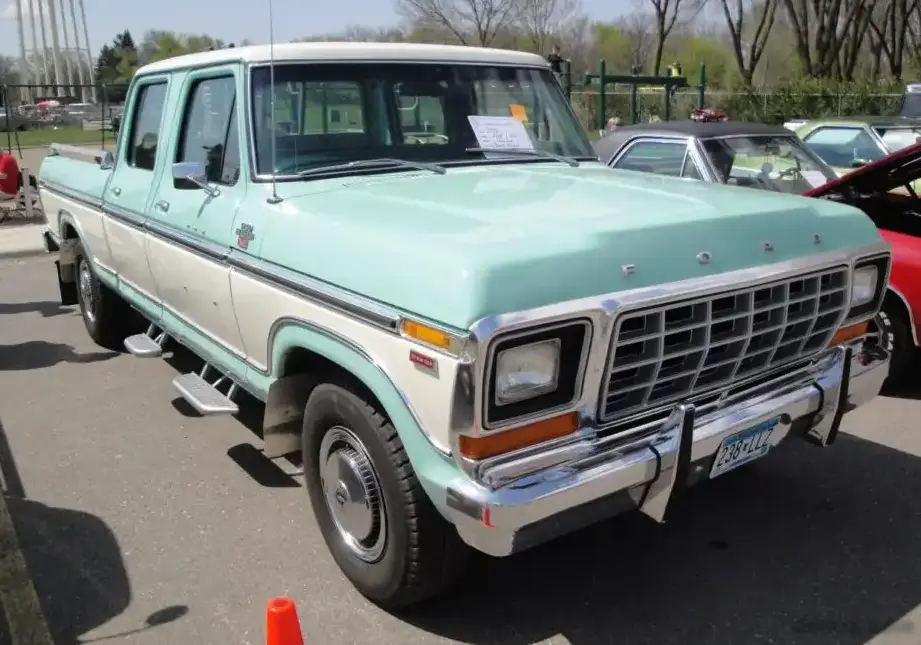
The Ford F-Series F-250 VI Crew Cab, equipped with the 6.6-liter (400 cubic inch) 400 V8 engine producing 169 horsepower, represents a significant iteration in the long and storied history of Ford’s heavy-duty pickup trucks. Produced from 1977 to 1979, this variant occupied a middle ground within the sixth generation (1973-1979) F-Series lineup, offering a balance between capability and affordability. The introduction of the Crew Cab body style during this generation broadened the F-250’s appeal, catering to buyers needing both work truck functionality and passenger space. This particular configuration, with the 400 V8 and a three-speed manual transmission, was aimed at customers who required substantial towing and hauling capacity but didn’t necessarily need the higher performance or fuel economy of smaller engine options.
Technical Specifications
| Brand | Ford |
| Model | F-Series F-250 |
| Generation | F-Series F-250 VI Crew Cab |
| Type (Engine) | 6.6 400 V8 (169 Hp) |
| Start of production | 1977 |
| End of production | 1979 |
| Powertrain Architecture | Internal Combustion engine |
| Body type | Pick-up |
| Seats | 6 |
| Doors | 4 |
| Fuel Type | Petrol (Gasoline) |
| Power | 169 Hp |
| Power per litre | 25.8 Hp/l |
| Engine displacement | 6555 cm3 / 400.01 cu. in. |
| Number of cylinders | 8 |
| Engine configuration | V-engine |
| Number of valves per cylinder | 2 |
| Fuel injection system | Carburettor |
| Engine aspiration | Naturally aspirated engine |
| Max. weight | 3493 kg / 7700.75 lbs. |
| Trunk (boot) space – minimum | 1727 l / 60.99 cu. ft. |
| Fuel tank capacity | 73 l / 19.28 US gal | 16.06 UK gal |
| Length | 5652 mm / 222.52 in. |
| Wheelbase | 3810 mm / 150 in. |
| Wading depth | 673 mm / 26.5 in. |
| Drivetrain Architecture | The Internal combustion engine (ICE) drives the rear wheels of the vehicle. |
| Drive wheel | Rear wheel drive |
| Number of gears and type of gearbox | 3 gears, manual transmission |
| Front suspension | Independent coil spring, Transverse stabilizer |
| Rear suspension | Transverse stabilizer, Leaf spring |
| Front brakes | Disc |
| Rear brakes | Drum |
| Power steering | Electric Steering |
| Tires size | 215/85 R16.5 |
| Wheel rims size | 6J x 16.5 |
Powertrain & Engine Architecture
The heart of this F-250 variant is the 400 cubic inch (6.6-liter) Ford 400 V8 engine. This engine, part of the 335-series Ford V8 family, was known for its substantial low-end torque, making it well-suited for heavy-duty applications. The 169 horsepower output was achieved through a two-valve per cylinder design and a single carburetor. While not the most powerful engine available in the F-250 lineup (larger displacement engines were offered), the 400 V8 provided a good balance of power and reliability. The engine’s longitudinal mounting and rear-wheel-drive configuration were standard for Ford trucks of this era. The three-speed manual transmission, while basic by modern standards, was a durable and proven unit, providing adequate gear ratios for both on-road driving and demanding work tasks. The transmission’s simplicity contributed to its robustness, making it a reliable component in a work-oriented vehicle.
Driving Characteristics
Behind the wheel, the 1977-1979 F-250 with the 400 V8 and manual transmission offered a distinctly analog driving experience. The engine’s torque peak was relatively low in the rev range, providing strong pulling power from a standstill. However, acceleration was not its strong suit; the 169 horsepower meant that passing maneuvers required careful planning. The three-speed manual transmission, while robust, had relatively wide gear spacing. This meant that the engine could feel strained at higher speeds, and fuel economy suffered. Compared to the available automatic transmissions, the manual offered more driver control and potentially better fuel efficiency, but at the cost of convenience. Compared to the larger 460 cubic inch V8, this engine felt less powerful, but it was also lighter, which improved handling slightly. The steering, while power-assisted, still required considerable effort, typical of trucks from this era. Overall, the driving experience prioritized functionality and durability over refinement and speed.
Equipment & Trim Levels
The F-250 Crew Cab was positioned as a more premium offering within the Ford truck lineup. Standard equipment for this variant typically included a basic interior with vinyl upholstery, a functional dashboard layout, and a heavy-duty suspension. The Crew Cab configuration provided seating for up to six passengers, making it ideal for work crews or families. Optional extras included air conditioning, an upgraded radio, and various trim packages that added features like chrome exterior accents and more comfortable interior materials. The level of trim could vary significantly depending on the buyer’s preferences and budget. Features like a sliding rear window and a tilt steering wheel were also available as options, enhancing comfort and convenience. The base models were fairly spartan, focusing on essential functionality, while higher trim levels offered a more comfortable and aesthetically pleasing experience.
Chassis & Braking
The F-250’s chassis was built for durability and heavy-duty use. It featured a robust ladder frame construction and a solid rear axle. The front suspension utilized independent coil springs and a transverse stabilizer bar, providing a relatively comfortable ride for a heavy-duty truck. The rear suspension employed leaf springs, which were well-suited for carrying heavy loads. Braking duties were handled by disc brakes at the front and drum brakes at the rear. Power steering was standard, making maneuvering the large truck easier. The tires, typically 215/85 R16.5 size, were designed for both on-road and off-road use, providing adequate traction in a variety of conditions. The robust chassis and suspension components were designed to withstand the stresses of frequent hauling and towing.
Market Reception & Comparison
The F-250 Crew Cab with the 400 V8 and manual transmission was generally well-received by buyers who needed a capable and spacious work truck. Critics praised its robust construction and ample interior space. However, some reviewers noted that the 400 V8 was not as refined or powerful as some of its competitors. Fuel economy was also a concern, particularly during the late 1970s when gasoline prices were rising. Compared to the F-250 models equipped with the larger 460 V8, this variant offered a lower price point but sacrificed some performance. Compared to the smaller six-cylinder engines, the 400 V8 provided significantly more power and towing capacity. Chevrolet and Dodge offered competing trucks in this segment, but the F-Series consistently held a strong market share due to its reputation for reliability and durability.
Legacy
The 1977-1979 Ford F-250 Crew Cab with the 400 V8 remains a popular choice among classic truck enthusiasts today. The 400 V8 engine, while not known for its longevity compared to some other Ford engines, is generally considered reliable when properly maintained. Parts availability is good, and the truck’s simple mechanical design makes it relatively easy to repair. These trucks are often sought after for restoration projects or as daily drivers. The Crew Cab body style, in particular, has become highly collectible, as it represents a unique and versatile configuration from a bygone era of American truck design. The combination of rugged capability, spaciousness, and classic styling ensures that this F-250 variant will continue to be appreciated for years to come. The truck represents a pivotal point in Ford’s truck history, bridging the gap between older, more utilitarian designs and the more modern trucks that followed.