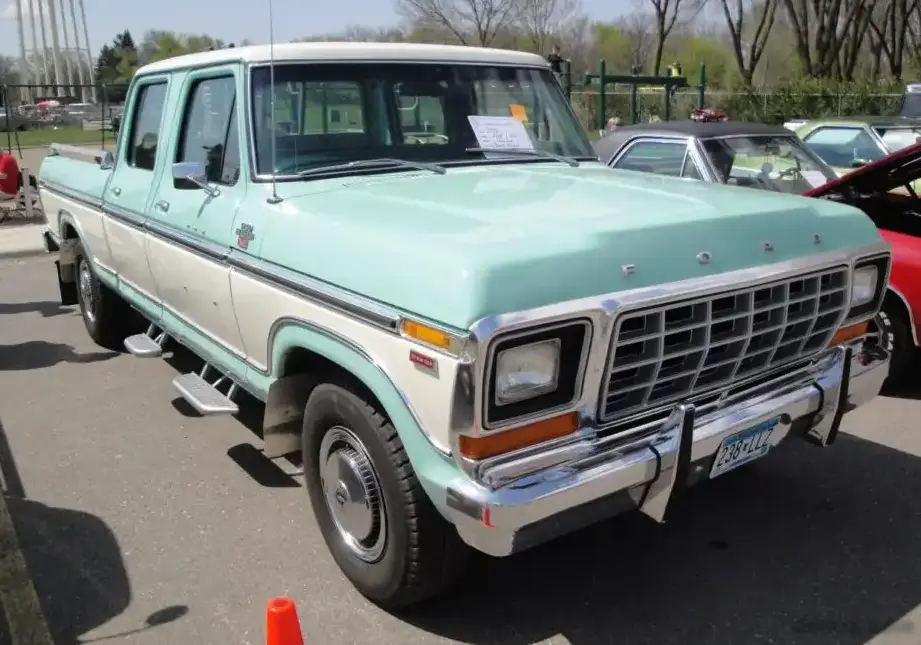
The Ford F-250 VI Crew Cab, equipped with the 6.6-liter (400 cubic inch) V8 engine producing 169 horsepower and paired with an automatic transmission, represents a notable iteration in Ford’s enduring F-Series pickup truck lineage. Produced from 1977 through 1979, this variant occupied a middle ground within the F-250 range, balancing capability with relative affordability. It was part of the sixth generation (1973-1979) of the F-Series, a generation characterized by its increased size and enhanced comfort compared to previous models. The Crew Cab configuration, though less common than standard or SuperCab models, offered expanded passenger space, appealing to families or work crews.
Technical Specifications
| Brand | Ford |
| Model | F-Series F-250 |
| Generation | F-Series F-250 VI Crew Cab |
| Engine Type | 6.6 400 V8 (169 Hp) Automatic |
| Start of production | 1977 |
| End of production | 1979 |
| Powertrain Architecture | Internal Combustion engine |
| Body type | Pick-up |
| Seats | 6 |
| Doors | 4 |
| Fuel Type | Petrol (Gasoline) |
| Power | 169 Hp |
| Power per litre | 25.8 Hp/l |
| Engine displacement | 6555 cm3 / 400.01 cu. in. |
| Number of cylinders | 8 |
| Engine configuration | V-engine |
| Number of valves per cylinder | 2 |
| Fuel injection system | Carburettor |
| Engine aspiration | Naturally aspirated engine |
| Max. weight | 3493 kg / 7700.75 lbs. |
| Trunk (boot) space – minimum | 1727 l / 60.99 cu. ft. |
| Fuel tank capacity | 73 l / 19.28 US gal | 16.06 UK gal |
| Length | 5652 mm / 222.52 in. |
| Wheelbase | 3810 mm / 150 in. |
| Wading depth | 673 mm / 26.5 in. |
| Drivetrain Architecture | The Internal combustion engine (ICE) drives the rear wheels of the vehicle. |
| Drive wheel | Rear wheel drive |
| Number of gears and type of gearbox | 4 gears, automatic transmission Cruise-O-Matic |
| Front suspension | Independent coil spring, Transverse stabilizer |
| Rear suspension | Transverse stabilizer, Leaf spring |
| Front brakes | Disc |
| Rear brakes | Drum |
| Power steering | Electric Steering |
| Tires size | 215/85 R16.5 |
| Wheel rims size | 6J x 16.5 |
Powertrain & Engine Architecture
The core of this F-250 variant is Ford’s 400 cubic inch (6.6-liter) V8 engine. This engine, designated as the 335-series, was a durable and relatively uncomplicated design. It featured a cast iron block and cylinder heads, with a two-valve-per-cylinder configuration. Fuel delivery was managed by a two-barrel carburetor, a standard setup for the period. While not renowned for high-revving performance, the 400 V8 generated substantial low-end torque, making it well-suited for hauling and towing. The 169 horsepower output was typical for a large-displacement V8 in the late 1970s, but was increasingly limited by stricter emissions standards. The engine was mounted longitudinally in the chassis, powering the rear wheels. The automatic transmission was a Ford Cruise-O-Matic, a three-speed unit known for its durability and smooth operation. This transmission was a popular choice for truck buyers who valued the convenience of an automatic over a manual gearbox.
Driving Characteristics
The F-250 with the 400 V8 and Cruise-O-Matic offered a driving experience centered on capability rather than speed. Acceleration was adequate, but not quick, prioritizing sufficient power for towing and hauling heavy loads. The automatic transmission’s gear ratios were optimized for torque multiplication, enabling the truck to handle challenging terrain or steep inclines with ease. Compared to the available manual transmissions, the Cruise-O-Matic provided a more relaxed driving experience, especially in city traffic. However, it resulted in a slight decrease in fuel economy and a minor reduction in direct control. Compared to the larger 460 cubic inch V8 option, the 400 offered more manageable fuel consumption, albeit at the expense of peak power. The leaf spring rear suspension provided a firm ride, particularly when unladen, but contributed to the truck’s impressive load-carrying capacity.
Equipment & Trim Levels
The F-250 Crew Cab, even in its base configuration, offered a relatively comfortable interior for the time. Standard features typically included a vinyl bench seat, basic instrumentation (speedometer, fuel gauge, temperature gauge), and a heater. The Crew Cab configuration provided significantly more rear seat legroom than standard cab models, making it a practical choice for families or work crews. Optional extras included air conditioning, an upgraded AM/FM radio, power steering, and a tilt steering wheel. Interior trim levels varied, with higher-end models offering cloth upholstery and additional sound insulation. The exterior typically featured bright trim around the windows and along the body sides. The specific trim level (Custom, Ranger, etc.) determined the level of exterior and interior appointments.
Chassis & Braking
The F-250 chassis was a robust body-on-frame design, built to withstand the stresses of heavy-duty use. The front suspension utilized independent coil springs and a transverse stabilizer bar, providing a reasonable level of ride comfort and handling. The rear suspension employed leaf springs, which were well-suited for supporting heavy loads. Braking was provided by disc brakes at the front and drum brakes at the rear. Power steering was often an optional extra, but became increasingly common over time. The tires, typically 215/85R16.5 size, were designed for durability and load-carrying capacity rather than high-performance handling.
Market Reception & Comparison
The F-250 Crew Cab with the 400 V8 and automatic transmission was generally well-received by buyers who needed a capable and comfortable pickup truck with ample passenger space. Critics praised the truck’s robust construction and its ability to handle heavy loads. However, some noted the engine’s relatively low horsepower output compared to competitors, and the automatic transmission’s impact on fuel economy. Compared to the F-250 models equipped with the larger 460 V8, the 400 V8 offered a more affordable entry point, but at the cost of some performance. Compared to the smaller six-cylinder engines, the 400 V8 provided significantly more power and torque, making it a better choice for demanding applications.
Legacy
The Ford F-250 VI Crew Cab with the 400 V8 and automatic transmission has become a popular choice among collectors and enthusiasts of classic Ford trucks. The 400 V8 engine, while not the most powerful option, is known for its durability and relative simplicity, making it a relatively easy engine to maintain and repair. The Cruise-O-Matic transmission is also considered a reliable unit. Today, well-maintained examples of this truck command respectable prices in the used car market. Its enduring appeal lies in its combination of classic Ford styling, robust construction, and practical functionality. While fuel economy is a concern by modern standards, the truck remains a capable and enjoyable vehicle for those who appreciate the charm and character of classic American trucks.