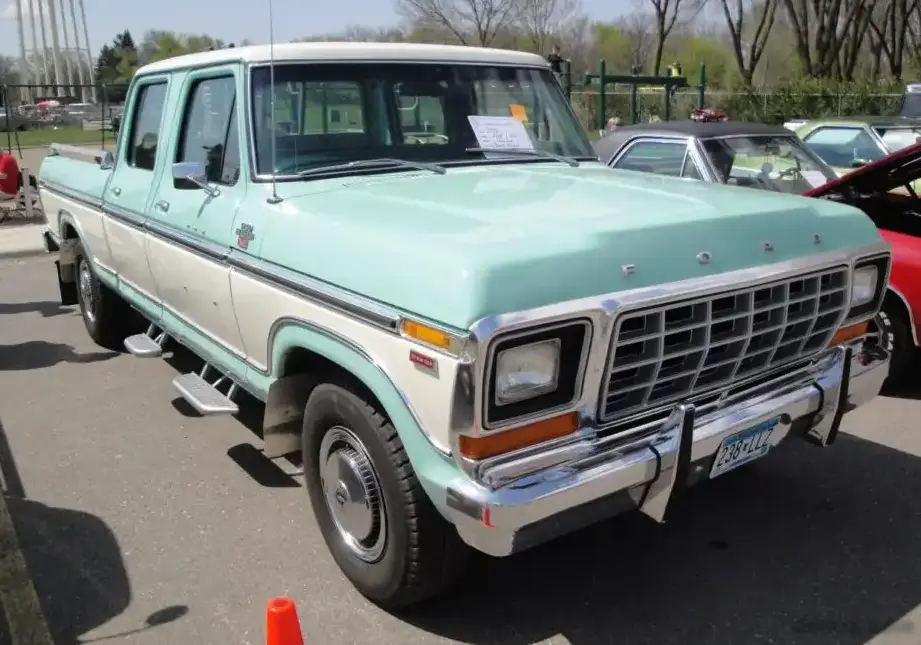
The Ford F-250 VI Crew Cab, produced from 1975 to 1976, represented a significant offering in Ford’s heavy-duty truck lineup. Part of the sixth generation of the F-Series (1973-1979), this variant combined the robust capabilities expected of a Ford truck with the added space and comfort of a crew cab configuration. The 7.5-liter 460 cubic inch V8 engine paired with an automatic transmission was a popular choice for buyers needing substantial towing and hauling capacity, while also desiring a more comfortable ride for passengers. This configuration positioned the F-250 Crew Cab as a versatile work truck and family vehicle, bridging the gap between purely utilitarian models and more luxurious pickups.
Technical Specifications
| Brand | Ford |
| Model | F-Series F-250 |
| Generation | F-Series F-250 VI Crew Cab |
| Type (Engine) | 7.5 460 V8 (245 Hp) Automatic |
| Start of production | 1975 |
| End of production | 1976 |
| Powertrain Architecture | Internal Combustion engine |
| Body type | Pick-up |
| Seats | 6 |
| Doors | 4 |
| Fuel Type | Petrol (Gasoline) |
| Power | 245 Hp |
| Power per litre | 32.5 Hp/l |
| Engine displacement | 7538 cm3 / 460 cu. in. |
| Number of cylinders | 8 |
| Engine configuration | V-engine |
| Piston Stroke | 97.79 mm / 3.85 in. |
| Number of valves per cylinder | 4 |
| Fuel injection system | Carburettor |
| Engine aspiration | Naturally aspirated engine |
| Max. weight | 3402 kg / 7500.13 lbs. |
| Trunk (boot) space – minimum | 1727 l / 60.99 cu. ft. |
| Length | 5652 mm / 222.52 in. |
| Wheelbase | 3810 mm / 150 in. |
| Wading depth | 673 mm / 26.5 in. |
| Drivetrain Architecture | The Internal combustion engine (ICE) drives the rear wheels of the vehicle. |
| Drive wheel | Rear wheel drive |
| Number of gears and type of gearbox | automatic transmission Cruise-O-Matic |
| Front suspension | Independent coil spring |
| Rear suspension | Leaf spring |
| Front brakes | Disc |
| Rear brakes | Drum |
| Power steering | Electric Steering |
| Tires size | 215/85 R16.5 |
| Wheel rims size | 6J x 16.5 |
Powertrain & Engine Architecture
The heart of the 1975-1976 Ford F-250 Crew Cab was the 7.5-liter (460 cubic inch) Ford 385 series V8 engine. This engine, a mainstay of Ford’s truck and large car offerings for many years, was known for its substantial torque output. The 460 V8 utilized a cast iron block and cylinder heads, and featured a two-barrel carburetor for fuel delivery. While not particularly sophisticated by modern standards, the carbureted system was reliable and relatively easy to maintain. The engine produced 245 horsepower, but its real strength lay in its low-end torque, making it well-suited for hauling heavy loads. The automatic transmission was a Ford Cruise-O-Matic, a three-speed unit designed to handle the engine’s power and the truck’s weight. This transmission was a common choice for Ford trucks of the era, offering smooth shifts and durability. The engine was longitudinally mounted in the chassis, driving power to the rear wheels.
Driving Characteristics
The F-250 Crew Cab with the 460 V8 and Cruise-O-Matic offered a driving experience focused on capability rather than outright speed. Acceleration was adequate, but the truck’s considerable weight limited its responsiveness. The automatic transmission’s gear ratios were optimized for towing and hauling, prioritizing low-end grunt over quick acceleration. Compared to the smaller engine options available in the F-250, such as the 302 or 390 cubic inch V8s, the 460 provided significantly more power and torque, especially when fully loaded. However, it came at the cost of fuel economy. Compared to a manual transmission equipped F-250, the automatic offered greater convenience, particularly in stop-and-go traffic, but sacrificed some control and efficiency. The leaf spring rear suspension provided a firm ride, typical of trucks designed for heavy-duty work, but could become bumpy when unloaded.
Equipment & Trim Levels
The F-250 Crew Cab was not a luxury vehicle, but the crew cab configuration did offer a step up in comfort compared to standard cab models. Standard features included a vinyl bench seat, basic instrumentation (speedometer, fuel gauge, temperature gauge), and a heater. Air conditioning and an upgraded radio were popular optional extras. The interior trim was generally utilitarian, with durable materials designed to withstand heavy use. The Crew Cab’s rear seating provided ample space for passengers, making it a practical choice for families or work crews. Trim levels were relatively basic, with options primarily focused on adding convenience features rather than cosmetic enhancements. The exterior typically featured minimal chrome trim, reflecting the truck’s work-oriented nature.
Chassis & Braking
The F-250’s chassis was a robust ladder frame construction, designed to withstand the stresses of heavy hauling and off-road use. The front suspension utilized independent coil springs, providing a relatively comfortable ride for a heavy-duty truck. The rear suspension employed leaf springs, which were well-suited for supporting heavy loads. Braking duties were handled by disc brakes at the front and drum brakes at the rear. Power steering was standard, making the truck easier to maneuver, especially at low speeds. The tires were typically 215/85 R16.5 size, providing a good balance of load-carrying capacity and on-road performance. The truck’s substantial weight and relatively basic braking system meant that stopping distances were longer than those of more modern vehicles.
Market Reception & Comparison
The 1975-1976 Ford F-250 Crew Cab with the 460 V8 and automatic transmission was generally well-received by buyers who needed a capable and comfortable work truck. Critics praised the truck’s robust construction, powerful engine, and spacious crew cab configuration. However, fuel economy was a common concern, particularly in the wake of the 1973 oil crisis. Compared to the smaller engine options in the F-250 lineup, the 460 V8 offered superior performance for heavy-duty tasks, but at a higher price and with lower fuel efficiency. The automatic transmission provided convenience, but some drivers preferred the control and efficiency of a manual transmission. The F-250 Crew Cab competed with similar offerings from Chevrolet and Dodge, each of which offered their own variations of heavy-duty trucks with crew cab configurations.
Legacy
The 1975-1976 Ford F-250 Crew Cab with the 460 V8 remains a popular choice among collectors and enthusiasts today. The 460 V8 engine is known for its durability and relatively simple maintenance requirements, although parts availability can be a challenge. The Cruise-O-Matic transmission is also generally reliable, but may require occasional rebuilding due to its age. These trucks are often sought after for restoration projects or as work trucks capable of handling demanding tasks. While not particularly fuel-efficient by modern standards, the F-250 Crew Cab represents a classic era of American truck design, combining rugged capability with a surprising degree of comfort and practicality. The enduring popularity of these trucks is a testament to their robust construction and timeless appeal.