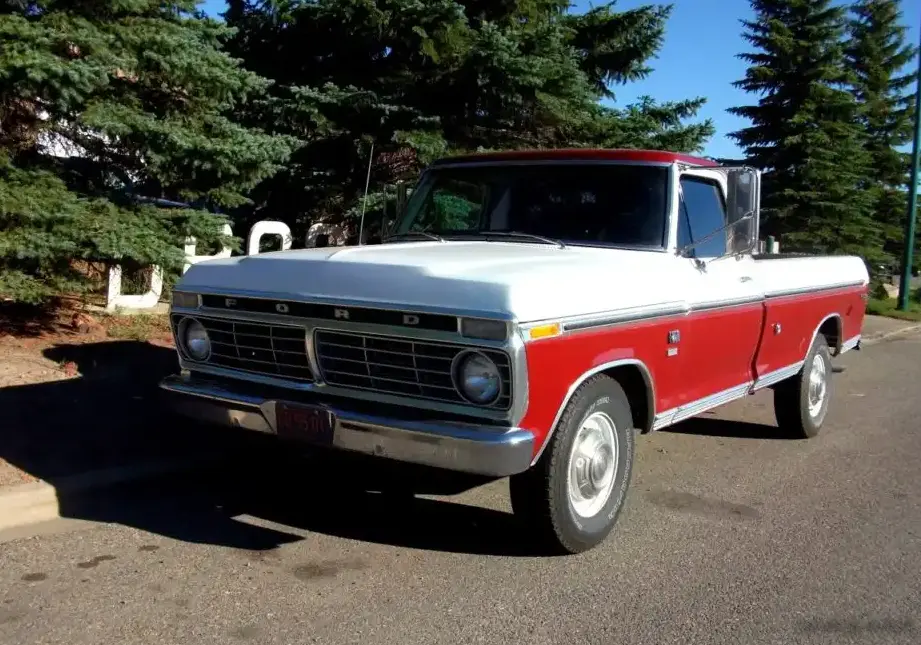
The Ford F-Series F-250 VI Regular Cab, equipped with the 4.9-liter (300 cubic inch) inline-six engine producing 113 horsepower, represents a cornerstone of Ford’s heavy-duty truck lineage. Produced from 1975 through 1979, this configuration occupied the entry-level position within the sixth generation (1973-1979) F-Series lineup, appealing to buyers prioritizing durability and affordability over outright performance. It served as a workhorse for farmers, ranchers, and tradespeople who needed a robust truck for hauling and towing, without the expense of the larger V8 options. This variant was particularly significant in the American market, where full-size pickups were – and continue to be – a dominant vehicle segment.
Technical Specifications
| Brand | Ford |
| Model | F-Series F-250 |
| Generation | F-Series F-250 VI Regular Cab |
| Type (Engine) | 4.9 300 Six (113 Hp) |
| Start of production | 1975 |
| End of production | 1979 |
| Powertrain Architecture | Internal Combustion engine |
| Body type | Pick-up |
| Seats | 3 |
| Doors | 2 |
| Fuel Type | Petrol (Gasoline) |
| Power | 113 Hp |
| Power per litre | 23 Hp/l |
| Engine displacement | 4916 cm3 / 299.99 cu. in. |
| Number of cylinders | 6 |
| Engine configuration | Inline |
| Cylinder Bore | 101.6 mm / 4 in. |
| Piston Stroke | 101.09 mm / 3.98 in. |
| Fuel injection system | Carburettor |
| Engine aspiration | Naturally aspirated engine |
| Max. weight | 3674 kg / 8099.78 lbs. |
| Trunk (boot) space – minimum | 1852-2084 l / 65.4 – 73.6 cu. ft. |
| Length | 5215 mm / 205.31 in. |
| Wheelbase | 3378 mm / 132.99 in. |
| Wading depth | 681 mm / 26.81 in. |
| Drivetrain Architecture | The Internal combustion engine (ICE) drives the rear wheels of the vehicle. |
| Drive wheel | Rear wheel drive |
| Number of gears and type of gearbox | 3 gears, manual transmission |
| Front suspension | Independent coil spring |
| Rear suspension | Leaf spring |
| Front brakes | Disc |
| Rear brakes | Drum |
| Tires size | 215/85 R16.5 |
| Wheel rims size | 6J x 16.5 |
Powertrain & Engine Architecture
The heart of this F-250 variant is the 4.9-liter (300 cubic inch) inline-six engine, a long-stroke design known for its exceptional low-end torque and durability. Designated internally as the 300 I6, this engine utilized a cast-iron block and cylinder head, contributing to its robust nature. Fuel delivery was managed by a two-barrel carburetor, a common setup for the era. The engine featured a simple, pushrod-operated valvetrain. While not a high-revving engine, the 300 I6 was capable of providing consistent power for demanding tasks. The standard transmission was a three-speed manual, designed to complement the engine’s torque characteristics. The rear-wheel-drive configuration was standard, as was typical for trucks of this period.
Driving Characteristics
The 113 horsepower and approximately 220 lb-ft of torque delivered by the 4.9-liter engine translated to a utilitarian driving experience. Acceleration was modest, and the truck was not designed for speed. However, the engine’s low-end torque made it well-suited for hauling loads and navigating challenging terrain. The three-speed manual transmission required deliberate shifting, and the gear ratios were optimized for work rather than performance. Compared to the optional V8 engines (302, 351, and 460 cubic inch), this inline-six version offered significantly less power, but it also provided better fuel economy and a simpler mechanical layout. The ride quality, typical of trucks from this era, was firm, and the leaf spring rear suspension could be bouncy when unloaded.
Equipment & Trim Levels
The F-250 with the 4.9-liter engine typically represented the base trim level. Standard features were minimal, focusing on functionality rather than luxury. The interior generally consisted of a vinyl bench seat, a basic dashboard with essential gauges, and rubber floor mats. Options were available, including upgraded upholstery, a radio, and a heater. Power steering and power brakes were often added as options, enhancing driver comfort and control. The exterior typically featured minimal chrome trim, reflecting its work-oriented nature. The Regular Cab configuration offered a single row of seating, prioritizing cargo space over passenger comfort.
Chassis & Braking
The F-250 chassis was a robust ladder frame construction, designed to withstand heavy loads and rough use. The front suspension utilized independent coil springs, providing a degree of ride comfort. The rear suspension employed leaf springs, which were well-suited for carrying heavy payloads. Braking duties were handled by disc brakes at the front and drum brakes at the rear. The braking system was adequate for the truck’s weight and intended use, but it lacked the sophistication of modern braking systems. Tire size was typically 215/85R16.5, providing a balance of traction and durability.
Market Reception & Comparison
The 4.9-liter F-250 was generally well-received by buyers seeking a dependable and affordable heavy-duty truck. Critics acknowledged its robust engine and straightforward design, but also noted its lack of refinement and limited power compared to the V8 options. Fuel economy, while not exceptional, was better than that of the larger engines. In terms of reliability, the 300 I6 engine earned a reputation for longevity, often outlasting the V8s due to its simpler construction. Compared to the Chevrolet and Dodge trucks of the same era, the Ford F-250 offered a competitive combination of price, durability, and capability.
Legacy
The 4.9-liter inline-six engine continued in production for several decades, becoming a legendary powerplant in Ford trucks and vans. Its simplicity and durability made it a favorite among mechanics and owners alike. Today, these F-250s are sought after by collectors and enthusiasts who appreciate their classic styling and rugged character. While not as desirable as the V8-powered models, the 4.9-liter version remains a viable and affordable option for those seeking a vintage work truck. Parts availability is generally good, and the engine is relatively easy to maintain. The 1975-1979 F-250 with the 300 I6 stands as a testament to Ford’s commitment to building durable and dependable trucks that could withstand the rigors of everyday use.