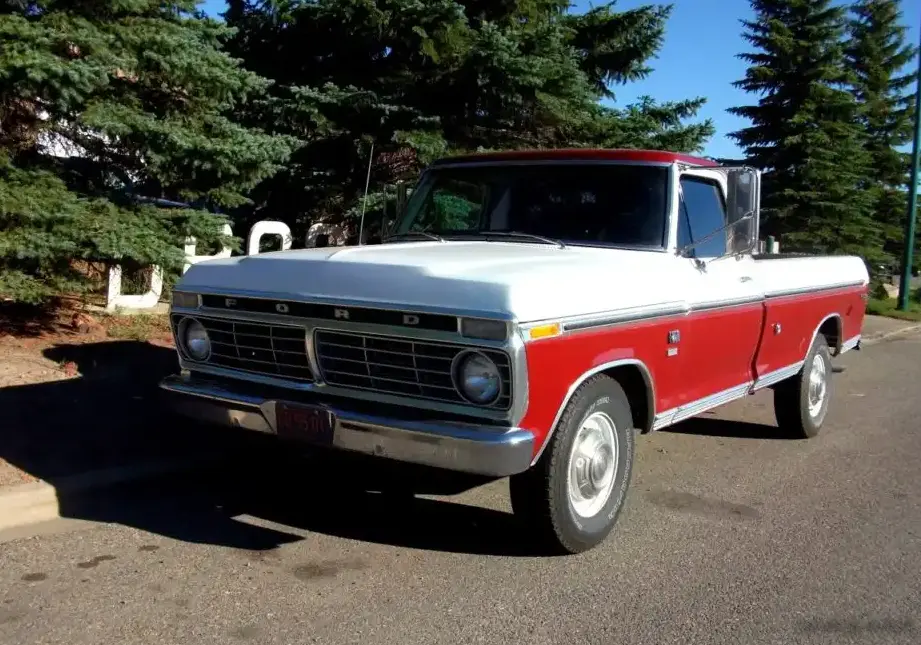
The Ford F-250, part of the broader F-Series lineup, has been a mainstay of the American pickup truck market since its introduction in 1953. The sixth generation, produced from 1973 to 1979, represented a significant evolution in terms of size, comfort, and capability. Within this generation, the F-250 Regular Cab equipped with the 4.9-liter (300 cubic inch) inline-six engine, producing 118 horsepower, occupied a unique position as a work-focused, entry-level offering. Production of this specific configuration ran from December 1972 through 1974, catering to buyers who prioritized durability and affordability over outright performance.
Technical Specifications
| Brand | Ford |
| Model | F-Series F-250 |
| Generation | F-Series F-250 VI Regular Cab |
| Type (Engine) | 4.9 300 Six (118 Hp) |
| Start of production | December, 1972 |
| End of production | 1974 |
| Powertrain Architecture | Internal Combustion engine |
| Body type | Pick-up |
| Seats | 3 |
| Doors | 2 |
| Fuel Type | Petrol (Gasoline) |
| Power | 118 Hp |
| Power per litre | 24 Hp/l |
| Engine displacement | 4916 cm3 / 299.99 cu. in. |
| Number of cylinders | 6 |
| Engine configuration | Inline |
| Cylinder Bore | 101.6 mm / 4 in. |
| Piston Stroke | 101.09 mm / 3.98 in. |
| Fuel injection system | Carburettor |
| Engine aspiration | Naturally aspirated engine |
| Max. weight | 3674 kg / 8099.78 lbs. |
| Trunk (boot) space – minimum | 1852-2070 l / 65.4 – 73.1 cu. ft. |
| Length | 5215 mm / 205.31 in. |
| Wheelbase | 3378 mm / 132.99 in. |
| Wading depth | 681 mm / 26.81 in. |
| Drivetrain Architecture | The Internal combustion engine (ICE) drives the rear wheels of the vehicle. |
| Drive wheel | Rear wheel drive |
| Number of gears and type of gearbox | 3 gears, manual transmission |
| Front suspension | Independent coil spring |
| Rear suspension | Leaf spring |
| Front brakes | Disc |
| Rear brakes | Drum |
| Steering type | Cone worm with recirculation balls |
| Power steering | Electric Steering |
| Tires size | 215/85 R16.5 |
| Wheel rims size | 6J x 16.5 |
Powertrain & Engine Architecture
The heart of this F-250 variant was the 4.9-liter (299 cubic inch) inline-six engine, commonly known as the “300 Six.” This engine, a member of Ford’s Y-block family, was renowned for its exceptional durability and low-end torque. While 118 horsepower wasn’t a groundbreaking figure, the engine’s robust construction and relatively simple design made it incredibly reliable. The engine utilized a single-barrel carburetor for fuel delivery, a common setup for the era. The valvetrain featured a traditional overhead valve configuration. The engine was longitudinally mounted in the chassis, driving the rear wheels. The standard transmission was a three-speed manual, chosen for its simplicity and cost-effectiveness. This transmission was geared towards maximizing torque for hauling and towing, rather than achieving high speeds.
Driving Characteristics
The 118 horsepower and 220 lb-ft of torque delivered by the 300 Six in the F-250 resulted in a driving experience focused on utility rather than speed. Acceleration was modest, and the truck was not designed for quick maneuvers. However, the engine’s strong low-end torque made it capable of handling substantial loads. The three-speed manual transmission, while not offering the versatility of more modern gearboxes, provided adequate control for most work-related tasks. The gear ratios were optimized for pulling power, meaning the engine would operate at higher RPMs during highway cruising. Compared to the optional V8 engines available in the F-250, this inline-six configuration offered significantly less power but better fuel economy and a simpler mechanical layout.
Equipment & Trim Levels
The F-250 with the 300 Six engine typically represented the base trim level. Standard features were minimal, reflecting its work-truck orientation. The interior generally consisted of a vinyl bench seat, a basic dashboard with essential gauges, and rubber floor mats. Options were available, including upgraded upholstery, a heater, and a basic AM radio. Power steering was often an optional extra, as was a more comfortable suspension package. The exterior typically featured minimal chrome trim and a functional, utilitarian design. The focus was on providing a durable and reliable vehicle capable of performing demanding tasks, rather than offering luxury or aesthetic enhancements.
Chassis & Braking
The F-250 chassis was a robust body-on-frame construction, designed to withstand heavy loads and rough terrain. The front suspension utilized independent coil springs, providing a relatively comfortable ride for a truck of its era. The rear suspension employed leaf springs, which were well-suited for carrying heavy payloads. Braking duties were handled by disc brakes at the front and drum brakes at the rear. The braking system, while adequate for the truck’s weight and intended use, lacked the sophistication of modern braking technologies. Steering was accomplished via a cone worm and recirculating ball system, offering a direct but somewhat heavy feel. The standard tire size was 215/85R16.5, chosen for its durability and load-carrying capacity.
Market Reception & Comparison
The F-250 with the 4.9-liter engine was generally well-received by buyers who prioritized affordability and reliability. Critics acknowledged the engine’s durability but noted its lack of power compared to the V8 options. Fuel economy, while not exceptional, was better than that of the larger engines. This variant appealed to farmers, ranchers, and tradespeople who needed a dependable truck for everyday work. Compared to the F-250 models equipped with the 390 cubic inch or 460 cubic inch V8 engines, the 300 Six version was significantly less expensive to purchase and maintain. However, it lacked the towing capacity and overall performance of its V8-powered siblings.
Legacy
The 4.9-liter inline-six engine, and specifically its implementation in the F-250, has earned a reputation for exceptional longevity. Many examples of these trucks are still in service today, a testament to the engine’s robust design and durability. In the used car market, these F-250s are often sought after by enthusiasts and those looking for a simple, reliable work truck. While parts availability may be becoming more challenging, the engine’s simplicity makes it relatively easy to repair and maintain. The 300 Six-powered F-250 represents a bygone era of American truck design, where durability and practicality were prioritized over luxury and performance. It remains a popular choice for those who appreciate a classic, no-nonsense pickup truck.