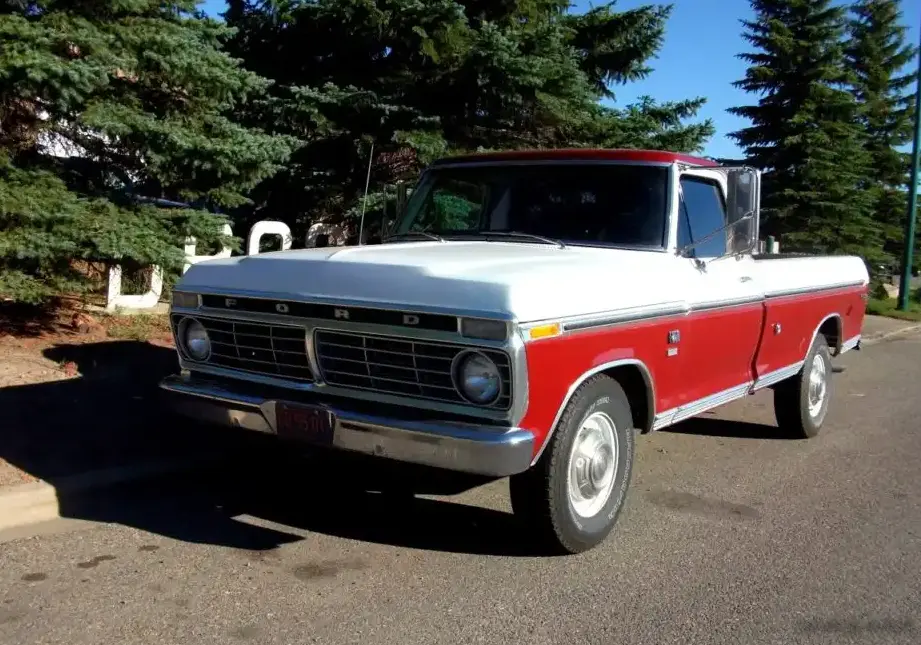
The Ford F-250, part of the sixth generation of the F-Series trucks produced from 1973 to 1979 (though early models began appearing in late 1972), represented a significant evolution in Ford’s heavy-duty truck lineup. The 1972-1976 F-250 with the 6.4-liter (390 cubic inch) V8 engine and automatic transmission occupied a middle ground within the range, offering a balance between capability and affordability. This configuration was aimed at buyers needing a robust work truck without the expense of the larger engine options, and it served as a popular choice for farmers, ranchers, and tradesmen. It was a workhorse designed for hauling and towing, representing a key part of Ford’s dominance in the American truck market.
Technical Specifications
| Brand | Ford |
| Model | F-Series F-250 |
| Generation | F-Series F-250 VI Regular Cab |
| Type (Engine) | 6.4 390 V8 (160 Hp) Automatic |
| Start of production | December, 1972 |
| End of production | 1976 |
| Powertrain Architecture | Internal Combustion engine |
| Body type | Pick-up |
| Seats | 3 |
| Doors | 2 |
| Fuel Type | Petrol (Gasoline) |
| Power | 160 Hp |
| Power per litre | 25 Hp/l |
| Engine displacement | 6391 cm3 |
| Engine displacement (cu. in.) | 390 cu. in. |
| Number of cylinders | 8 |
| Engine configuration | V-engine |
| Cylinder Bore | 102.87 mm (4.05 in.) |
| Piston Stroke | 96.01 mm (3.78 in.) |
| Fuel injection system | Carburettor |
| Engine aspiration | Naturally aspirated engine |
| Max. weight | 3674 kg (8099.78 lbs.) |
| Trunk (boot) space – minimum | 1852-2070 l (65.4 – 73.1 cu. ft.) |
| Length | 5215 mm (205.31 in.) |
| Wheelbase | 3378 mm (132.99 in.) |
| Wading depth | 681 mm (26.81 in.) |
| Drivetrain Architecture | The Internal combustion engine (ICE) drives the rear wheels of the vehicle. |
| Drive wheel | Rear wheel drive |
| Number of gears and type of gearbox | automatic transmission Cruise-O-Matic |
| Front suspension | Independent coil spring |
| Rear suspension | Leaf spring |
| Front brakes | Disc |
| Rear brakes | Drum |
| Steering type | Cone worm with recirculation balls |
| Power steering | Electric Steering |
| Tires size | 215/85 R16.5 |
| Wheel rims size | 6J x 16.5 |
Powertrain & Engine Architecture
The heart of this F-250 variant was the 6.4-liter (390 cubic inch) Ford V8 engine. Designated within Ford’s engine family as the 390 FE, it was a robust and relatively simple design. The engine utilized a cast iron block and cylinder heads, and featured a two-valve per cylinder configuration. Fuel delivery was managed by a two-barrel carburetor, a common setup for the era, prioritizing simplicity and ease of maintenance over outright performance. The 390 FE engine was known for its low-end torque, making it well-suited for hauling heavy loads. The automatic transmission was a Ford Cruise-O-Matic, a three-speed unit. This transmission was a workhorse itself, designed for durability and smooth operation, though it lacked the sophistication of later automatic transmissions. The Cruise-O-Matic’s gear ratios were optimized for towing and hauling, prioritizing pulling power over quick acceleration.
Driving Characteristics
The 160 horsepower and approximately 340 lb-ft of torque delivered by the 390 V8 and Cruise-O-Matic combination resulted in a driving experience focused on utility rather than speed. Acceleration was modest, and the truck wasn’t designed for rapid highway merging. However, it possessed ample low-end torque, allowing it to confidently tow trailers and haul heavy payloads. The automatic transmission provided smooth shifts, but it wasn’t particularly responsive. Compared to the available 302 cubic inch (5.0L) V8, the 390 offered significantly more power and towing capacity. Conversely, the larger 390 lacked the higher-revving nature and slightly improved fuel economy of the smaller engine. Compared to the larger 390 cubic inch (6.6L) or 460 cubic inch (7.5L) engines, this 390 offered a more economical option, albeit with a noticeable reduction in overall capability.
Equipment & Trim Levels
The F-250 in this configuration typically fell into the mid-range of available trim levels. Standard features included a basic vinyl bench seat, a simple dashboard with essential gauges (speedometer, fuel gauge, temperature gauge), and a basic AM radio. Options included upgraded interior trim, a heater and defroster, and various towing packages. The exterior typically featured minimal brightwork, reflecting its work-oriented nature. Buyers could opt for different paint colors, but the emphasis was on durability rather than aesthetics. Power steering was often included, but power brakes and air conditioning were typically optional extras, adding to the vehicle’s cost.
Chassis & Braking
The F-250’s chassis was a traditional body-on-frame construction, designed for strength and durability. The front suspension utilized independent coil springs, providing a relatively comfortable ride for a heavy-duty truck. The rear suspension employed leaf springs, which were well-suited for carrying heavy loads. Braking duties were handled by disc brakes at the front and drum brakes at the rear. While adequate for the truck’s weight and intended use, the braking system wasn’t particularly powerful by modern standards. Steering was accomplished via a cone worm and recirculating ball system, offering a solid but somewhat indirect feel. The tires, typically 215/85R16.5, were designed for durability and load-carrying capacity rather than high-performance handling.
Market Reception & Comparison
The F-250 with the 390 V8 and automatic transmission was generally well-received by buyers seeking a capable and reliable work truck. Critics praised its robust construction and ample low-end torque, but noted its modest performance and relatively basic interior. Compared to the Chevrolet C20 and Dodge D250 of the same era, the F-250 was often considered to offer a better balance of capability and value. Fuel economy was a concern, as with all trucks of this era, but the 390 V8 was generally considered to be more fuel-efficient than the larger engine options. Reliability was generally good, although the carburetor required periodic maintenance and tuning.
Legacy
The 1972-1976 Ford F-250 with the 390 V8 and automatic transmission has become a popular choice among classic truck enthusiasts. The 390 FE engine is known for its durability and relative simplicity, making it a relatively easy engine to maintain and repair. Parts availability is generally good, although some components can be difficult to find. These trucks are often sought after for restoration projects, and well-maintained examples can command a premium price in the used car market. While not the most powerful or luxurious truck of its era, the F-250 390 represents a solid and dependable workhorse that played a significant role in Ford’s long-standing dominance of the American truck market. Its enduring appeal lies in its rugged simplicity and its ability to get the job done.