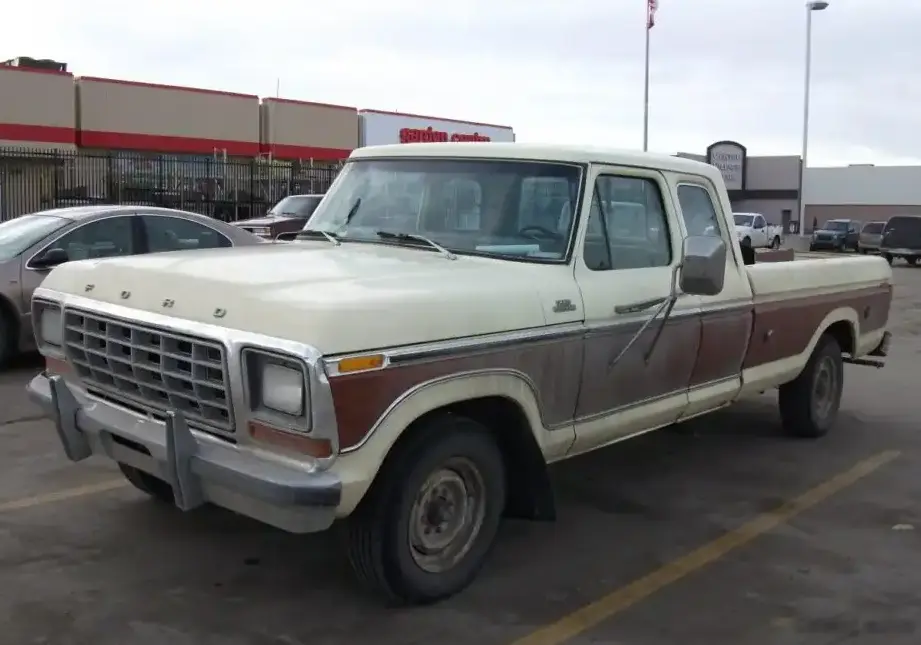
The Ford F-Series F-250 VI SuperCab, specifically equipped with the 6.4-liter 390 cubic inch V8 engine producing 160 horsepower, represents a significant iteration in Ford’s long-running and highly successful F-Series pickup truck line. Produced for a relatively short period, from 1975 to 1976, this variant occupied a middle ground within the F-250 range, offering a balance between capability and affordability. It was part of the sixth generation (1973-1979) of the F-Series, known for its increased size and focus on comfort compared to earlier models. The SuperCab designation indicated an extended cab configuration, providing additional passenger space beyond the standard cab.
Technical Specifications
| Brand | Ford |
| Model | F-Series F-250 |
| Generation | F-Series F-250 VI SuperCab |
| Type (Engine) | 6.4 390 V8 (160 Hp) |
| Start of production | 1975 |
| End of production | 1976 |
| Powertrain Architecture | Internal Combustion engine |
| Body type | Pick-up |
| Seats | 6 |
| Doors | 2 |
| Fuel Type | Petrol (Gasoline) |
| Power | 160 Hp |
| Power per litre | 25 Hp/l |
| Engine displacement | 6391 cm3 |
| Engine displacement (cu. in.) | 390 cu. in. |
| Number of cylinders | 8 |
| Engine configuration | V-engine |
| Cylinder Bore | 102.87 mm (4.05 in.) |
| Piston Stroke | 96.01 mm (3.78 in.) |
| Number of valves per cylinder | 4 |
| Fuel injection system | Carburettor |
| Engine aspiration | Naturally aspirated engine |
| Max. weight | 3674 kg (8099.78 lbs.) |
| Trunk (boot) space – minimum | 1727-2084 l (60.99 – 73.6 cu. ft.) |
| Length | 5362-5773 mm (211.1 – 227.28 in.) |
| Wheelbase | 3531-3937 mm (139.02 – 155 in.) |
| Wading depth | 673-678 mm (26.5 – 26.69 in.) |
| Drivetrain Architecture | Rear wheel drive. Internal Combustion engine (ICE) drives the rear wheels. |
| Drive wheel | Rear wheel drive |
| Number of gears and type of gearbox | 3 gears, manual transmission |
| Front suspension | Independent coil spring |
| Rear suspension | Leaf spring |
| Front brakes | Disc |
| Rear brakes | Drum |
| Power steering | Electric Steering |
| Tires size | 215/85 R16.5 |
| Wheel rims size | 16.5 |
Powertrain & Engine Architecture
The heart of this F-250 variant was the 390 cubic inch (6.4-liter) Ford Windsor V8 engine. This engine, designated as the 390 FE series, was a mainstay of Ford’s truck and large car lineup for many years. The 160 horsepower output was achieved through a two-barrel carburetor, a relatively conservative setup compared to some of the higher-performance versions of the 390 available in Ford’s passenger cars. The engine featured a cast iron block and cylinder heads, and a hydraulic lifter valvetrain. The 390 was known for its robust construction and relatively simple design, making it fairly reliable and easy to maintain. The engine was longitudinally mounted in the chassis, driving the rear wheels. The three-speed manual transmission was a standard offering, providing basic but functional gear changes. While an automatic transmission was available as an option, the base model typically came with the manual.
Driving Characteristics
The 160 horsepower 390 V8, coupled with the three-speed manual transmission, provided adequate, but not exhilarating, performance for the F-250. Acceleration was modest, and the truck was best suited for hauling and towing rather than quick sprints. The gear ratios in the three-speed manual were spaced to prioritize low-end torque for work applications. Compared to the larger 460 cubic inch V8 offered in the F-250, the 390 felt noticeably less powerful, especially when loaded. However, the 390 offered better fuel economy than the 460, a consideration for owners who used their trucks for daily driving as well as work. The leaf spring rear suspension provided a firm ride, typical of trucks of this era, and was designed to handle heavy loads. The front independent coil spring suspension offered a slightly more comfortable ride compared to solid front axles.
Equipment & Trim Levels
The F-250 SuperCab with the 390 V8 typically represented a mid-range trim level. Standard features included a basic interior with vinyl upholstery, a simple dashboard layout, and a functional, no-frills design. The SuperCab configuration added a rear seat, increasing passenger capacity to six. Optional extras included upgraded interior trim, air conditioning, a radio, and various towing packages. The exterior typically featured minimal chrome trim, reflecting its work-oriented nature. The SuperCab offered a practical solution for those needing to transport both cargo and passengers, making it popular with farmers, ranchers, and tradespeople.
Chassis & Braking
The F-250 chassis was a robust body-on-frame construction, designed for durability and heavy-duty use. The front suspension utilized independent coil springs, while the rear suspension employed leaf springs. This combination provided a good balance between ride comfort and load-carrying capacity. The braking system consisted of disc brakes on the front wheels and drum brakes on the rear. Power steering was available, making maneuvering the large truck easier, especially at low speeds. The 16.5-inch wheels were typically fitted with 215/85 R16.5 tires, providing adequate traction for most on-road and light off-road applications.
Market Reception & Comparison
The F-250 with the 390 V8 and manual transmission was generally well-received as a capable and reliable work truck. Critics noted its solid construction and adequate power for most tasks. However, it wasn’t considered a performance leader, and some reviewers felt that the 460 cubic inch V8 offered a significant improvement in power and towing capacity. Compared to the smaller F-100, the F-250 provided a higher payload and towing capacity. Compared to the larger F-350, it offered a slightly lower GVWR (Gross Vehicle Weight Rating), making it suitable for a wider range of applications. Fuel economy was typical for a truck of its size and era, averaging around 10-12 miles per gallon.
Legacy
The 1975-1976 Ford F-250 SuperCab with the 390 V8 has become a popular classic truck among collectors and enthusiasts. The 390 FE engine is known for its durability and relative simplicity, making it a relatively easy engine to maintain and rebuild. Parts availability is generally good, although some specific components may be difficult to find. These trucks are often sought after for restoration projects, and well-maintained examples can command a premium price in the used car market. The combination of the SuperCab configuration and the reliable 390 V8 makes this variant a desirable and practical classic truck for those seeking a piece of American automotive history.