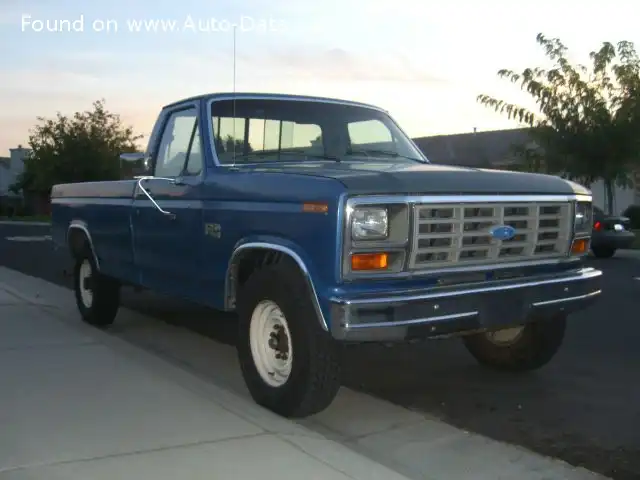
The Ford F-Series F-250 VII Regular Cab, equipped with the 4.9-liter inline-six engine producing 117 horsepower, represents a work-focused iteration of Ford’s immensely popular F-Series pickup truck line. Produced from 1979 to 1981, this variant occupied the entry-level position within the F-250 range, catering to buyers prioritizing durability and affordability over outright performance. It was part of the seventh generation of the F-Series (1973-1979, with carryover into 1980), a generation known for its robust construction and continued dominance of the American pickup truck market. This particular configuration was aimed at customers needing a heavy-duty truck for tasks like hauling and light towing, but who didn’t require the power of the larger V8 options.
Technical Specifications
| Brand | Ford |
| Model | F-Series F-250 |
| Generation | F-Series F-250 VII Regular Cab |
| Type (Engine) | 4.9 Six (117 Hp) |
| Start of production | September, 1979 |
| End of production | 1981 |
| Powertrain Architecture | Internal Combustion engine |
| Body type | Pick-up |
| Seats | 2-3 |
| Doors | 2 |
| Fuel Type | Petrol (Gasoline) |
| Power | 117 Hp |
| Power per litre | 23.8 Hp/l |
| Torque | 308 Nm / 227.17 lb.-ft. |
| Engine layout | Front, Longitudinal |
| Engine displacement | 4916 cm3 / 299.99 cu. in. |
| Number of cylinders | 6 |
| Engine configuration | Inline |
| Fuel injection system | Carburettor |
| Engine aspiration | Naturally aspirated engine |
| Max. weight | 3538 kg / 7799.95 lbs. |
| Fuel tank capacity | 72 l / 19.02 US gal | 15.84 UK gal |
| Length | 5291 mm / 208.31 in. |
| Width | 1778 mm / 70 in. |
| Height | 1829 mm / 72.01 in. |
| Wheelbase | 3378 mm / 132.99 in. |
| Wading depth | 795 mm / 31.3 in. |
| Drivetrain Architecture | The Internal combustion engine (ICE) drives the rear wheels of the vehicle. |
| Drive wheel | Rear wheel drive |
| Number of gears and type of gearbox | 3 gears, manual transmission |
| Front suspension | Independent coil spring |
| Front brakes | Disc |
| Rear brakes | Drum |
| Power steering | Electric Steering |
| Tires size | 215/85 R16.5 |
| Wheel rims size | 6J x 16.5 |
Powertrain & Engine Architecture
The heart of this F-250 variant is Ford’s 4.9-liter (299 cubic inch) inline-six engine, often referred to as the “300 six” despite its actual displacement. This engine, part of the Ford 300 family, is renowned for its exceptional durability and longevity. The 1979-1981 version produced 117 horsepower and 308 Nm (227.17 lb-ft) of torque. It utilized a single-barrel carburetor for fuel delivery, a relatively simple system contributing to its reliability. The engine features a cast iron block and head, and a two-valve-per-cylinder valvetrain. The engine’s longitudinal front-engine layout was standard for Ford trucks of this era. The standard transmission was a three-speed manual, designed to handle the engine’s torque output and provide adequate gearing for work applications. While an automatic transmission was available as an option, the base model typically came with the manual.
Driving Characteristics
The 4.9-liter engine, paired with the three-speed manual transmission, delivered a utilitarian driving experience. Acceleration was modest, prioritizing low-end torque for hauling and towing rather than outright speed. The gear ratios were selected to maximize pulling power, meaning the truck wasn’t particularly quick off the line or at highway speeds. Compared to the available V8 engines (351 cubic inch and 460 cubic inch), the 4.9-liter offered significantly less power, but also better fuel economy. The manual transmission provided a direct connection to the engine, allowing the driver to maintain control in challenging conditions. The truck’s suspension, while robust, was tuned for load-carrying capacity, resulting in a firm ride when unladen.
Equipment & Trim Levels
The F-250 Regular Cab with the 4.9-liter engine represented the base trim level. Standard features were minimal, reflecting its work-oriented focus. Typically, it included a basic vinyl bench seat, a simple dashboard with essential gauges, and a standard AM radio. Options were available, such as upgraded upholstery, a heater, and various convenience features. However, the base model was deliberately spartan, keeping the price point accessible to budget-conscious buyers. The interior was designed for durability and ease of cleaning, with minimal frills.
Chassis & Braking
The F-250 chassis was a body-on-frame construction, providing a robust platform for heavy-duty use. The front suspension utilized independent coil springs, offering a degree of ride comfort and improved handling compared to earlier solid-axle designs. The rear suspension employed leaf springs, capable of supporting substantial loads. Braking duties were handled by disc brakes at the front and drum brakes at the rear. Power steering was available, but not standard on the base model. The truck rode on 6J x 16.5 inch wheels, fitted with 215/85 R16.5 tires, chosen for their durability and load-carrying capacity.
Market Reception & Comparison
The F-250 with the 4.9-liter engine was well-received by buyers who needed a tough, reliable truck for work purposes but didn’t require the expense or complexity of a larger engine. Critics acknowledged its durability and fuel efficiency, but noted its lack of power compared to the V8 options. Compared to the 351 cubic inch V8, the 4.9-liter offered significantly less horsepower and torque, but also better fuel economy. The 460 cubic inch V8 provided even more power, but at a considerable cost in fuel consumption. The 4.9-liter engine was often favored by those who prioritized long-term reliability and low maintenance costs.
Legacy
The Ford 4.9-liter inline-six engine has earned a legendary reputation for its durability and longevity. Many examples remain on the road today, a testament to its robust construction. The F-250 variant with this engine is now a sought-after classic among truck enthusiasts and collectors. While not the fastest or most luxurious truck of its era, it represents a practical and reliable workhorse that played a significant role in the American automotive landscape. In the used car market, these trucks are valued for their simplicity, ease of maintenance, and enduring build quality. Parts availability remains good, making them relatively easy to keep running. The 4.9-liter engine’s reputation for reliability continues to attract buyers seeking a dependable and affordable pickup truck.