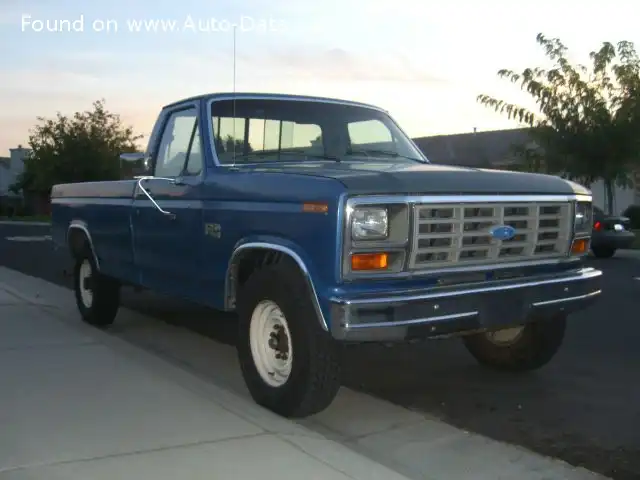
The Ford F-Series F-250 VII Regular Cab, equipped with the 4.9-liter inline-six engine and an automatic transmission, represents a workhorse configuration within the seventh generation of Ford’s immensely popular F-Series pickup trucks. Produced from 1981 through 1986, this variant occupied an important position in the lineup, offering a balance of affordability and capability for buyers needing a robust truck for hauling and everyday tasks. It was a key offering during a period where Ford solidified its dominance in the North American pickup truck market, catering to a broad spectrum of users from farmers and ranchers to construction workers and general contractors.
Technical Specifications
| Brand | Ford |
| Model | F-Series F-250 |
| Generation | F-Series F-250 VII Regular Cab |
| Type (Engine) | 4.9 Six (125 Hp) Automatic |
| Start of production | 1981 |
| End of production | 1986 |
| Powertrain Architecture | Internal Combustion engine |
| Body type | Pick-up |
| Seats | 2-3 |
| Doors | 2 |
| Fuel Type | Petrol (Gasoline) |
| Power | 125 Hp |
| Power per litre | 25.4 Hp/l |
| Torque | 339 Nm / 250.03 lb.-ft. |
| Engine layout | Front, Longitudinal |
| Engine displacement | 4916 cm3 / 299.99 cu. in. |
| Number of cylinders | 6 |
| Engine configuration | Inline |
| Fuel injection system | Multi-port manifold injection |
| Engine aspiration | Naturally aspirated engine |
| Max. weight | 3311 kg / 7299.51 lbs. |
| Fuel tank capacity | 72-144 l / 19.02 – 38.04 US gal | 15.84 – 31.68 UK gal |
| Length | 5291 mm / 208.31 in. |
| Width | 1778 mm / 70 in. |
| Height | 1859 mm / 73.19 in. |
| Wheelbase | 3378 mm / 132.99 in. |
| Wading depth | 823 mm / 32.4 in. |
| Drivetrain Architecture | The Internal combustion engine (ICE) drives the rear wheels of the vehicle. |
| Drive wheel | Rear wheel drive |
| Number of gears and type of gearbox | automatic transmission SelectShift |
| Front suspension | Independent coil spring |
| Front brakes | Disc |
| Rear brakes | Drum |
| Tires size | 215/85 R16 |
| Wheel rims size | 6J x 16 |
Powertrain & Engine Architecture
The heart of this F-250 variant is Ford’s 4.9-liter (299 cubic inch) inline-six cylinder engine. Often referred to as the “300 six” due to its displacement rounding up in marketing materials, this engine was a mainstay of Ford’s truck lineup for decades. The 1981-1986 version utilized multi-port fuel injection, a significant upgrade from the carburetor systems of earlier years, improving fuel efficiency and responsiveness. The engine’s robust bottom end and relatively simple design contributed to its legendary durability. The engine code for this period is generally associated with variations of the 300 I6, though specific sub-codes existed. The automatic transmission employed was the Ford SelectShift, a three-speed automatic known for its reliability and straightforward operation. While not offering the performance of more modern transmissions, it provided smooth shifts and adequate power delivery for the intended applications.
Driving Characteristics
The 125 horsepower and 250 lb-ft of torque produced by the 4.9-liter engine, coupled with the three-speed automatic, resulted in a driving experience focused on utility rather than outright speed. Acceleration was modest, and passing maneuvers required planning. However, the engine’s strong low-end torque made it well-suited for hauling heavy loads and navigating challenging terrain. The automatic transmission’s gear ratios were optimized for work, prioritizing pulling power over fuel economy at higher speeds. Compared to the available V8 options, this 4.9L automatic F-250 offered a noticeably slower pace, but it also provided better fuel economy and a simpler, more durable powertrain. Manual transmission versions of the same engine offered slightly improved performance and fuel efficiency, but the automatic was favored by many drivers for its ease of use.
Equipment & Trim Levels
The F-250 Regular Cab with the 4.9-liter engine and automatic transmission typically represented the entry-level offering in the F-250 range. Standard features were relatively basic, focusing on functionality. This included a vinyl bench seat, a simple dashboard layout with essential gauges, and a robust heating and ventilation system. Options included upgraded interior trim, such as cloth upholstery, a radio, and air conditioning. Power steering and power brakes were often included, but not always standard. The exterior trim was generally minimal, with basic chrome bumpers and steel wheels. The target audience for this trim level was buyers prioritizing affordability and durability over luxury and convenience.
Chassis & Braking
The F-250 chassis was built for heavy-duty work. It featured a robust ladder frame construction and a solid rear axle. The front suspension utilized independent coil springs, providing a reasonably comfortable ride for a heavy-duty truck. Braking duties were handled by disc brakes on the front axle and drum brakes on the rear. The drum brakes on the rear were a cost-saving measure, common in this class of truck at the time. The tires, typically 215/85R16, were designed for durability and load-carrying capacity. Stabilizer bars were often omitted on base models to maximize suspension travel and off-road capability.
Market Reception & Comparison
The 4.9-liter F-250 automatic was generally well-received by buyers seeking a reliable and affordable work truck. Critics acknowledged its lack of performance compared to V8-powered models, but praised its durability and fuel efficiency. Compared to the larger V8 engines, the 4.9L offered a significant improvement in fuel economy, particularly in city driving. However, the V8s provided substantially more power for towing and hauling heavier loads. The 4.9L automatic was often seen as a good choice for buyers who primarily used their trucks for lighter-duty tasks and valued long-term reliability.
Legacy
The 4.9-liter inline-six engine has earned a reputation as one of the most durable and reliable engines ever produced by Ford. Many examples remain on the road today, a testament to its robust design and simple mechanics. The powertrain, while not particularly sophisticated, proved to be exceptionally long-lasting with proper maintenance. In the used car market, these F-250s are often sought after by those looking for a simple, dependable truck that can withstand years of hard use. Parts availability remains good, and the engine’s straightforward design makes it relatively easy to repair. The 1981-1986 F-250 with the 4.9L and automatic transmission represents a classic example of American truck engineering, prioritizing durability and functionality over flashy features or high performance.