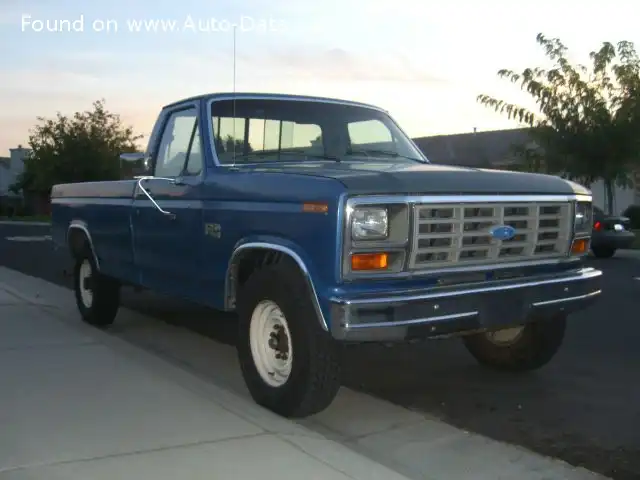
The Ford F-Series F-250 VII Regular Cab, equipped with the 5.0-liter V8 engine producing 133 horsepower, represents a significant iteration in Ford’s long-running and immensely popular F-Series line of trucks. Produced from 1979 to 1981, this variant occupied a crucial position in the F-250 range, offering a balance between capability and affordability for buyers needing a heavy-duty truck for work or personal use. This generation, known for its robust construction and straightforward design, served as a workhorse for many Americans during a period of economic change.
Technical Specifications
| Brand | Ford |
| Model | F-Series F-250 |
| Generation | F-Series F-250 VII Regular Cab |
| Type (Engine) | 5.0 V8 (133 Hp) |
| Start of production | September, 1979 |
| End of production | 1981 |
| Powertrain Architecture | Internal Combustion engine |
| Body type | Pick-up |
| Seats | 2-3 |
| Doors | 2 |
| Fuel Type | Petrol (Gasoline) |
| Power | 133 Hp |
| Power per litre | 26.9 Hp/l |
| Torque | 316 Nm / 233.07 lb.-ft. |
| Engine layout | Front, Longitudinal |
| Engine displacement | 4949 cm3 / 302.01 cu. in. |
| Number of cylinders | 8 |
| Engine configuration | V-engine |
| Fuel injection system | Carburettor |
| Engine aspiration | Naturally aspirated engine |
| Max. weight | 3538 kg / 7799.95 lbs. |
| Fuel tank capacity | 72 l / 19.02 US gal | 15.84 UK gal |
| Length | 5291 mm / 208.31 in. |
| Width | 1778 mm / 70 in. |
| Height | 1829 mm / 72.01 in. |
| Wheelbase | 3378 mm / 132.99 in. |
| Wading depth | 795 mm / 31.3 in. |
| Drivetrain Architecture | The Internal combustion engine (ICE) drives the rear wheels of the vehicle. |
| Drive wheel | Rear wheel drive |
| Number of gears and type of gearbox | 3 gears, manual transmission |
| Front suspension | Independent coil spring |
| Front brakes | Disc |
| Rear brakes | Drum |
| Power steering | Electric Steering |
| Tires size | 215/85 R16.5 |
| Wheel rims size | 6J x 16.5 |
Powertrain & Engine Architecture
The heart of this F-250 variant is the 4.9-liter (302 cubic inch) Ford 302 Windsor V8 engine. This engine, a mainstay of Ford’s lineup for decades, is characterized by its simple, robust design and relatively easy maintenance. The 1979-1981 version utilized a two-barrel carburetor for fuel delivery, a common practice for the time, prioritizing simplicity over the emerging fuel injection technologies. The engine features a cast iron block and cylinder heads, contributing to its durability. Valve actuation is managed by a traditional pushrod valvetrain. The 133 horsepower output, while modest by modern standards, was considered adequate for the truck’s intended purpose – hauling and towing. The engine’s torque peak of 316 Nm (233 lb-ft) was more crucial for real-world performance, providing the necessary grunt for demanding tasks. This particular F-250 was equipped with a three-speed manual transmission, a common pairing for this engine and trim level. The transmission’s gear ratios were optimized for work, prioritizing low-end torque over high-speed cruising.
Driving Characteristics
Behind the wheel, the F-250 with the 5.0L V8 and manual transmission delivers a distinctly analog driving experience. Acceleration is not its strong suit; the 133 horsepower requires careful management of the three-speed gearbox. However, the engine’s torque provides sufficient power for everyday driving and moderate towing. The manual transmission allows for precise control, particularly when navigating challenging terrain or hauling heavy loads. Compared to potential upgrades like the larger 6.6L diesel engines available in the F-250 lineup, this 5.0L variant is noticeably less powerful. However, it offers a simpler, lighter, and potentially more reliable powertrain. The ride quality, typical of trucks of this era, is firm, and the steering lacks the precision of modern power steering systems. The three-speed manual transmission, while durable, requires more driver involvement than an automatic, demanding more frequent shifting.
Equipment & Trim Levels
The F-250 Regular Cab in this configuration was generally considered an entry-level or mid-range offering. Standard equipment was fairly basic, reflecting its work-oriented nature. Typically, it included a vinyl bench seat, a simple dashboard with basic gauges, and a functional but spartan interior. Optional extras included upgraded interior trim, a radio, and heavier-duty suspension components. The exterior typically featured minimal chrome trim and durable paint finishes. Air conditioning was often an optional extra, as were power steering and power brakes. The Regular Cab configuration offered a single row of seating, prioritizing cargo space over passenger comfort.
Chassis & Braking
The F-250’s chassis is built around a robust ladder frame, designed to withstand the stresses of heavy-duty use. The front suspension utilizes independent coil springs, providing a reasonable level of ride comfort and handling. The rear suspension employs leaf springs, a traditional design well-suited for carrying heavy loads. Braking duties are handled by disc brakes at the front and drum brakes at the rear. Power steering was often an optional feature, and the steering system is relatively simple and direct. The tires, typically 215/85 R16.5, were chosen for their durability and load-carrying capacity. The truck’s relatively high ground clearance and robust suspension allowed for moderate off-road capability.
Market Reception & Comparison
The F-250 with the 5.0L V8 and manual transmission was generally well-received by buyers seeking a capable and affordable heavy-duty truck. Critics acknowledged its robust construction and reliable powertrain, but noted its relatively modest power output compared to larger-displacement engines. Fuel economy, while not a primary concern for truck buyers at the time, was reasonable for a vehicle of its size and capability. Compared to the diesel-powered F-250 models, this gasoline variant offered a lower initial purchase price but higher operating costs due to lower fuel efficiency. Compared to the F-150, the F-250 offered significantly greater towing and payload capacity, justifying its higher price point.
Legacy
The Ford F-Series F-250 VII Regular Cab 5.0 V8 (133 Hp) has become a popular choice among classic truck enthusiasts and collectors. The 302 Windsor V8 engine is known for its durability and readily available parts, making it relatively easy to maintain and repair. While not the most powerful or luxurious F-250 variant, it represents a significant piece of Ford’s history and a testament to the enduring appeal of the American work truck. Today, well-maintained examples command reasonable prices in the used car market, appealing to those seeking a classic truck with a simple, reliable powertrain. The simplicity of the design and the availability of parts contribute to its continued viability as a work truck or a weekend project vehicle.