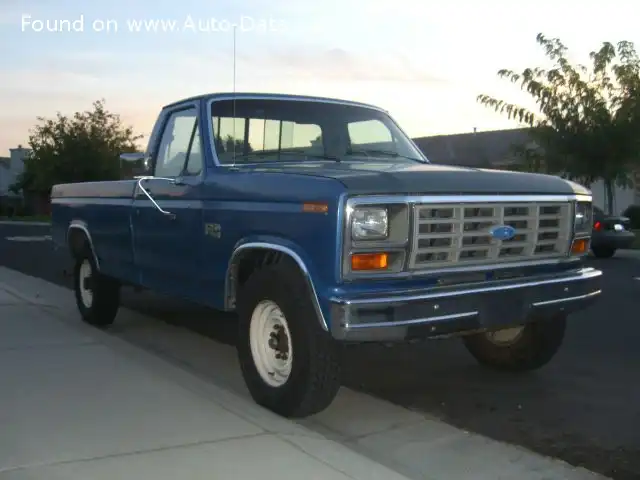
The Ford F-Series F-250 VII Regular Cab, equipped with the 5.0-liter V8 engine producing 133 horsepower and a four-wheel-drive (4×4) system, was a mainstay of Ford’s heavy-duty truck lineup from 1982 to 1985. This generation, part of the broader F-Series VII (1980-1986) redesign, represented a significant step forward in truck capability and comfort. The F-250, positioned between the lighter-duty F-150 and the even more robust F-350, catered to buyers needing substantial towing and hauling capacity for work or recreational purposes. This particular configuration, with the 5.0L V8 and 4×4, represented a balance between affordability and capability within the F-250 range.
Technical Specifications
| Brand | Ford |
| Model | F-Series F-250 |
| Generation | F-Series F-250 VII Regular Cab |
| Type (Engine) | 5.0 V8 (133 Hp) 4×4 |
| Start of production | 1982 |
| End of production | 1985 |
| Powertrain Architecture | Internal Combustion engine |
| Body type | Pick-up |
| Seats | 2-3 |
| Doors | 2 |
| Fuel Type | Petrol (Gasoline) |
| Power | 133 Hp |
| Power per litre | 26.9 Hp/l |
| Torque | 316 Nm / 233.07 lb.-ft. |
| Engine layout | Front, Longitudinal |
| Engine displacement | 4949 cm3 / 302.01 cu. in. |
| Number of cylinders | 8 |
| Engine configuration | V-engine |
| Fuel injection system | Carburettor |
| Engine aspiration | Naturally aspirated engine |
| Max. weight | 3357 kg / 7400.92 lbs. |
| Fuel tank capacity | 72-144 l / 19.02 – 38.04 US gal | 15.84 – 31.68 UK gal |
| Length | 5291 mm / 208.31 in. |
| Height | 1907 mm / 75.08 in. |
| Wheelbase | 3378 mm / 132.99 in. |
| Minimum turning circle | 14.4 m / 47.24 ft. |
| Wading depth | 839 mm / 33.03 in. |
| Drivetrain Architecture | The Internal combustion engine (ICE) drives the rear wheels permanently, and the front wheels are driven through an electrically or mechanically operated clutch if necessary. |
| Drive wheel | All wheel drive (4×4) |
| Number of gears | 4 |
| Gearbox type | Manual transmission |
| Front suspension | Independent coil spring, Transverse stabilizer |
| Rear suspension | Transverse stabilizer |
| Power steering | Electric Steering |
| Tires size | 235/85 R16.5 |
| Wheel rims size | 6J x 16.5 |
Powertrain & Engine Architecture
The heart of this F-250 variant was the 4.9-liter (302 cubic inch) Ford 302 Windsor V8 engine. This engine, a long-running and well-regarded design, utilized a cast iron block and cylinder heads. The 133 horsepower output was achieved through a two-barrel carburetor, a relatively simple fuel delivery system for the time. The engine featured a traditional pushrod valvetrain, with two valves per cylinder. The 4×4 system employed a transfer case allowing the driver to switch between two-wheel drive and four-wheel drive modes, with a low-range gear for increased torque in challenging off-road conditions. The four-speed manual transmission provided direct control over gear selection, and was a common pairing with this engine for those prioritizing cost and simplicity.
Driving Characteristics
The 133 hp 5.0L V8 in the F-250 offered adequate, but not exhilarating, performance. Acceleration was modest, particularly when heavily loaded. The four-speed manual transmission required frequent shifting, especially when climbing hills or towing. However, the engine delivered a usable amount of torque – 233 lb-ft – which made it suitable for hauling moderate loads and navigating rough terrain. Compared to the available larger engines (like the 6.9L diesel), this configuration prioritized fuel economy and lower initial cost over outright power. The 4×4 system provided enhanced traction in slippery conditions, making it a capable work truck and recreational vehicle. The manual transmission offered a more connected driving experience than the available automatic, allowing for greater control over engine braking and gear selection.
Equipment & Trim Levels
The F-250 Regular Cab in this configuration was typically a work-oriented trim. Standard features included a basic vinyl interior, a simple dashboard layout, and manual windows and locks. The bench seat accommodated up to three passengers, though the space was often utilized for tools or equipment. Optional extras included upgraded interior trim, a radio, and a rear sliding window. The focus was on durability and functionality rather than luxury. The Regular Cab configuration itself was the most basic, lacking the extended cab options available on other F-Series models.
Chassis & Braking
The F-250 chassis was built around a robust ladder frame, designed to withstand heavy loads and demanding use. The front suspension utilized independent coil springs and a transverse stabilizer bar, providing a reasonable ride quality for a heavy-duty truck. The rear suspension employed leaf springs and a transverse stabilizer bar. Braking was accomplished via drum brakes on all four wheels, which were adequate for the truck’s weight class but lacked the stopping power of disc brakes. Power steering was standard, making maneuvering the large truck easier, especially at low speeds.
Market Reception & Comparison
The 1982-1985 Ford F-250 with the 5.0L V8 and 4×4 was generally well-received as a capable and affordable work truck. Critics noted its solid construction and reliable powertrain. However, the 133 horsepower output was considered modest compared to the larger engine options. The 6.9L diesel, while more expensive, offered significantly more torque and better fuel economy for heavy-duty applications. The 300 cubic inch inline-six gasoline engine provided a more fuel-efficient alternative for lighter-duty tasks. The 5.0L V8/4×4 combination appealed to buyers who needed four-wheel drive capability but didn’t require the maximum towing or hauling capacity offered by the larger engines.
Legacy
The Ford 302 Windsor V8 engine, used in this F-250, is renowned for its durability and relative simplicity. Many examples of these trucks remain on the road today, a testament to their robust construction. While the 5.0L engine isn’t known for exceptional fuel economy, it’s relatively easy to maintain and repair. The carburetor requires periodic adjustment and rebuilding, but parts are readily available. The 4×4 system, if properly maintained, is also quite reliable. In the used car market, these F-250s are often sought after by enthusiasts and those needing a dependable, old-school work truck. They represent a simpler era of truck design, prioritizing functionality and durability over modern amenities.