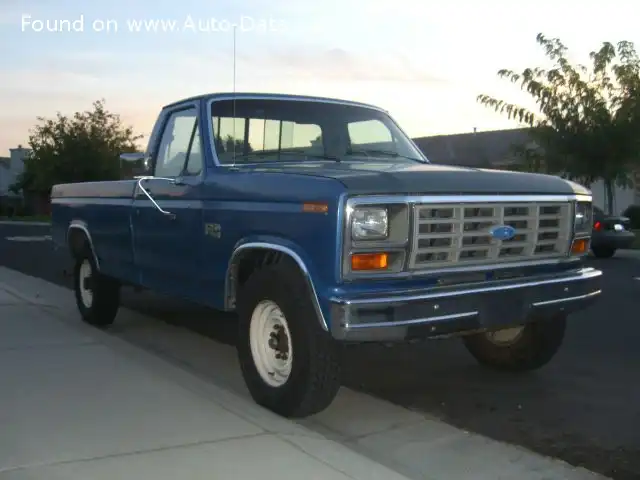
The Ford F-Series F-250 VII Regular Cab, equipped with the 5.0-liter V8 engine producing 133 horsepower and paired with an automatic transmission, represents a significant entry point into the heavy-duty truck market of the late 1970s and early 1980s. Produced from 1979 to 1981, this configuration occupied a crucial position in Ford’s lineup, offering a balance between capability and affordability for buyers needing a robust work truck. It was part of the seventh generation of the F-Series (1973-1979, with carryover to 1980), a generation known for its durable construction and straightforward design. This particular variant catered to customers who prioritized a simpler, less expensive option compared to the more powerful engine choices available.
Technical Specifications
| Brand | Ford |
| Model | F-Series F-250 |
| Generation | F-Series F-250 VII Regular Cab |
| Type (Engine) | 5.0 V8 (133 Hp) Automatic |
| Start of production | September, 1979 |
| End of production | 1981 |
| Powertrain Architecture | Internal Combustion engine |
| Body type | Pick-up |
| Seats | 2-3 |
| Doors | 2 |
| Fuel Type | Petrol (Gasoline) |
| Power | 133 Hp |
| Power per litre | 26.9 Hp/l |
| Torque | 316 Nm / 233.07 lb.-ft. |
| Engine layout | Front, Longitudinal |
| Engine displacement | 4949 cm3 / 302.01 cu. in. |
| Number of cylinders | 8 |
| Engine configuration | V-engine |
| Fuel injection system | Carburettor |
| Engine aspiration | Naturally aspirated engine |
| Max. weight | 3538 kg / 7799.95 lbs. |
| Fuel tank capacity | 72 l / 19.02 US gal | 15.84 UK gal |
| Length | 5291 mm / 208.31 in. |
| Width | 1778 mm / 70 in. |
| Height | 1829 mm / 72.01 in. |
| Wheelbase | 3378 mm / 132.99 in. |
| Wading depth | 795 mm / 31.3 in. |
| Drivetrain Architecture | The Internal combustion engine (ICE) drives the rear wheels of the vehicle. |
| Drive wheel | Rear wheel drive |
| Number of gears and type of gearbox | automatic transmission SelectShift |
| Front suspension | Independent coil spring |
| Front brakes | Disc |
| Rear brakes | Drum |
| Power steering | Electric Steering |
| Tires size | 215/85 R16.5 |
| Wheel rims size | 6J x 16.5 |
Powertrain & Engine Architecture
The heart of this F-250 variant is the 302 cubic inch (4.9-liter) Ford Windsor V8 engine. This engine, designated as a 5.0L despite its actual displacement, was a mainstay of Ford’s lineup for decades. The 1979-1981 version utilized a two-barrel carburetor for fuel delivery, a relatively simple system compared to fuel injection, contributing to its lower cost. The engine featured a cast iron block and cylinder heads, known for their durability. The valvetrain employed a traditional pushrod design with two valves per cylinder. The “SelectShift” automatic transmission was a three-speed unit, designed for durability and ease of use rather than outright performance. It was a common transmission in Ford trucks of this era, known for its reliability when properly maintained.
Driving Characteristics
The 133 horsepower and 233 lb-ft of torque delivered by this powertrain configuration resulted in a work-oriented driving experience. Acceleration was modest, and the truck was not designed for quick speeds. The three-speed automatic transmission, while reliable, had relatively wide gear ratios. This meant that the engine often operated at higher RPMs during highway cruising, impacting fuel economy. However, the low-end torque of the 5.0L V8 provided adequate pulling power for typical tasks such as hauling moderate loads or towing smaller trailers. Compared to the available 351 cubic inch (5.8L) or 460 cubic inch (7.5L) V8 options, this 5.0L version offered significantly less power and performance, but at a lower purchase price and with potentially better fuel economy (though still relatively poor by modern standards).
Equipment & Trim Levels
The F-250 Regular Cab with the 5.0L engine and automatic transmission typically represented the base trim level. Standard features were minimal, focusing on functionality. This included a basic vinyl bench seat, a simple dashboard with essential gauges (speedometer, fuel gauge, temperature gauge), and a basic AM radio. Options were available, such as upgraded interior trim, air conditioning, power steering (often standard), and a heavier-duty suspension package. The exterior typically featured minimal chrome trim, reflecting its work-truck orientation. Buyers could choose from a limited palette of solid paint colors.
Chassis & Braking
The F-250 chassis was built for durability and load-carrying capacity. It featured a robust ladder frame construction. The front suspension utilized independent coil springs, providing a reasonably comfortable ride for a heavy-duty truck. The rear suspension employed leaf springs, designed to handle heavy loads. Braking was accomplished with disc brakes on the front axle and drum brakes on the rear. Power steering was often included, making maneuvering the large truck easier. The tires, typically 215/85R16.5 size, were chosen for their load-carrying capacity and durability rather than performance.
Market Reception & Comparison
The 5.0L V8/automatic F-250 was viewed as a practical and affordable option for buyers who didn’t require the extra power of the larger engines. Critics acknowledged its capability for light to medium-duty work, but noted its lack of refinement and relatively poor fuel economy. Compared to the 351 and 460 cubic inch V8 options, it offered significantly lower performance but a lower purchase price. The 351 offered a noticeable increase in power and towing capacity, while the 460 was the top-of-the-line choice for those needing maximum capability. The 5.0L version appealed to buyers who prioritized cost savings and simplicity over performance.
Legacy
The 5.0L Windsor V8 engine, in general, has a reputation for longevity and relative ease of maintenance. While the carburetor requires periodic adjustment and rebuilding, the engine itself is known for its durability. The three-speed automatic transmission is also generally reliable, provided it receives regular fluid changes. Today, these F-250s are sought after by collectors and enthusiasts who appreciate their classic styling and straightforward design. While not the most powerful or luxurious truck of its era, the 5.0L/automatic variant represents a solid and dependable workhorse that has stood the test of time. Finding well-maintained examples can be challenging, as many were used extensively for work and may have suffered from neglect. However, their simplicity and readily available parts make them relatively easy to restore and maintain.