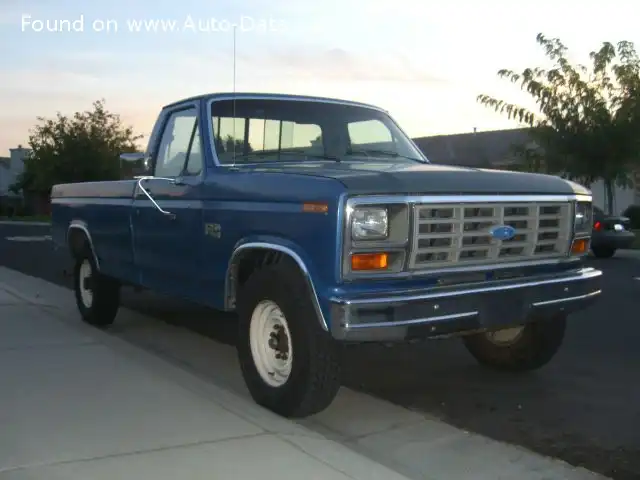
The Ford F-250 VII Regular Cab, equipped with the 5.8-liter V8 engine producing 136 horsepower and paired with an automatic transmission, represents a significant iteration in Ford’s long-running F-Series pickup truck lineage. Produced from 1979 through 1982, this variant occupied a crucial position in the F-250 lineup, offering a balance between capability and affordability for buyers needing a heavy-duty truck for work or personal use. It falls within the seventh generation of the F-Series (1973–1979, with updates extending into 1980), a generation known for its robust construction and enduring popularity. This particular configuration was aimed at buyers who prioritized ease of use and automatic convenience over the higher performance offered by other engine options.
Technical Specifications
| Brand | Ford |
| Model | F-Series F-250 |
| Generation | F-Series F-250 VII Regular Cab |
| Type (Engine) | 5.8 V8 (136 Hp) Automatic |
| Start of production | September, 1979 |
| End of production | 1982 |
| Powertrain Architecture | Internal Combustion engine |
| Body type | Pick-up |
| Seats | 2-3 |
| Doors | 2 |
| Fuel Type | Petrol (Gasoline) |
| Power | 136 Hp |
| Power per litre | 23.6 Hp/l |
| Torque | 355 Nm / 261.83 lb.-ft. |
| Engine layout | Front, Longitudinal |
| Engine displacement | 5752 cm3 / 351.01 cu. in. |
| Number of cylinders | 8 |
| Engine configuration | V-engine |
| Fuel injection system | Carburettor |
| Engine aspiration | Naturally aspirated engine |
| Max. weight | 3538 kg / 7799.95 lbs. |
| Fuel tank capacity | 72 l / 19.02 US gal | 15.84 UK gal |
| Length | 5291 mm / 208.31 in. |
| Width | 1778 mm / 70 in. |
| Height | 1829 mm / 72.01 in. |
| Wheelbase | 3378 mm / 132.99 in. |
| Wading depth | 795 mm / 31.3 in. |
| Drivetrain Architecture | The Internal combustion engine (ICE) drives the rear wheels of the vehicle. |
| Drive wheel | Rear wheel drive |
| Number of gears and type of gearbox | automatic transmission SelectShift |
| Front suspension | Independent coil spring |
| Front brakes | Disc |
| Rear brakes | Drum |
| Power steering | Electric Steering |
| Tires size | 215/85 R16.5 |
| Wheel rims size | 6J x 16.5 |
Powertrain & Engine Architecture
The heart of this F-250 variant is Ford’s 5.8-liter (351 cubic inch) Windsor V8 engine. This engine, designated internally as the 351W, is a robust and relatively simple design, utilizing a cast iron block and cylinder heads. The 136 horsepower output was achieved through a two-barrel carburetor, a relatively conservative setup compared to the four-barrel carburetors found on some higher-performance Ford engines of the era. The engine features a traditional pushrod valvetrain with two valves per cylinder. The automatic transmission employed was the Ford SelectShift, a three-speed automatic known for its durability and straightforward operation. This transmission was designed to provide smooth shifts and reliable performance under heavy loads, making it well-suited for truck applications. The engine’s longitudinal front-engine layout was standard for Ford trucks of this period, contributing to a balanced weight distribution.
Driving Characteristics
The 136 hp 5.8L V8 and automatic transmission combination in the F-250 delivered a driving experience focused on usability rather than outright speed. Acceleration was modest, particularly when the truck was loaded. The three-speed automatic transmission, while reliable, had relatively wide gear ratios, meaning the engine often operated at higher RPMs during highway cruising. This resulted in a noticeable lack of fuel efficiency compared to later fuel-injected engines. However, the engine provided ample low-end torque, making it capable of hauling heavy loads and navigating challenging terrain. Compared to the available 6.9-liter diesel or the higher-output gasoline V8s, this configuration prioritized affordability and ease of maintenance over maximum performance. The automatic transmission simplified operation for drivers accustomed to passenger cars, making the F-250 more accessible to a wider range of buyers.
Equipment & Trim Levels
The F-250 Regular Cab in this configuration typically came with a fairly basic level of equipment. Standard features included a vinyl bench seat, a simple instrument cluster, and manual windows and locks. The interior trim was generally utilitarian, reflecting the truck’s work-oriented purpose. Optional extras included air conditioning, an upgraded AM/FM radio, and a sliding rear window. Higher trim levels, such as the XLT, offered more luxurious features like cloth upholstery, carpeting, and additional chrome trim. However, the base model with the 5.8L engine and automatic transmission was generally geared towards buyers who prioritized functionality and value.
Chassis & Braking
The F-250’s chassis was built around a heavy-duty frame designed to withstand the stresses of hauling and towing. The front suspension utilized independent coil springs, providing a relatively comfortable ride for a heavy-duty truck. The rear suspension employed leaf springs, which were well-suited for carrying heavy loads. Braking duties were handled by disc brakes at the front and drum brakes at the rear. Power steering was standard, making it easier to maneuver the large truck. The 215/85 R16.5 tires provided adequate traction for most on-road and light off-road applications. The relatively simple suspension and braking systems were designed for durability and ease of maintenance.
Market Reception & Comparison
The F-250 with the 5.8L V8 and automatic transmission was generally well-received by buyers who needed a capable and affordable heavy-duty truck. Critics noted its robust construction and reliable powertrain, but also pointed out its relatively modest performance and fuel economy. Compared to the diesel-powered F-250, this gasoline variant offered lower initial cost but higher operating costs due to fuel consumption. Compared to the larger-displacement gasoline V8s, it provided a more economical option, albeit with reduced power. The automatic transmission was praised for its ease of use, making the truck more appealing to drivers who preferred not to operate a manual transmission.
Legacy
The 5.8L Windsor V8 engine and the Ford SelectShift automatic transmission proved to be durable and reliable powertrains. Many examples of these trucks are still on the road today, a testament to their robust construction. While not as sought-after as some of the higher-performance or diesel-powered F-250 variants, the 5.8L automatic remains a viable option for buyers looking for a classic American pickup truck. Parts availability is generally good, and the relatively simple mechanical design makes it relatively easy to maintain. In the used car market, these trucks typically command lower prices than their more powerful counterparts, making them an attractive option for budget-minded buyers. The enduring popularity of the Ford F-Series, and the reputation for reliability of the Windsor V8, ensure that this variant will continue to be appreciated by truck enthusiasts for years to come.