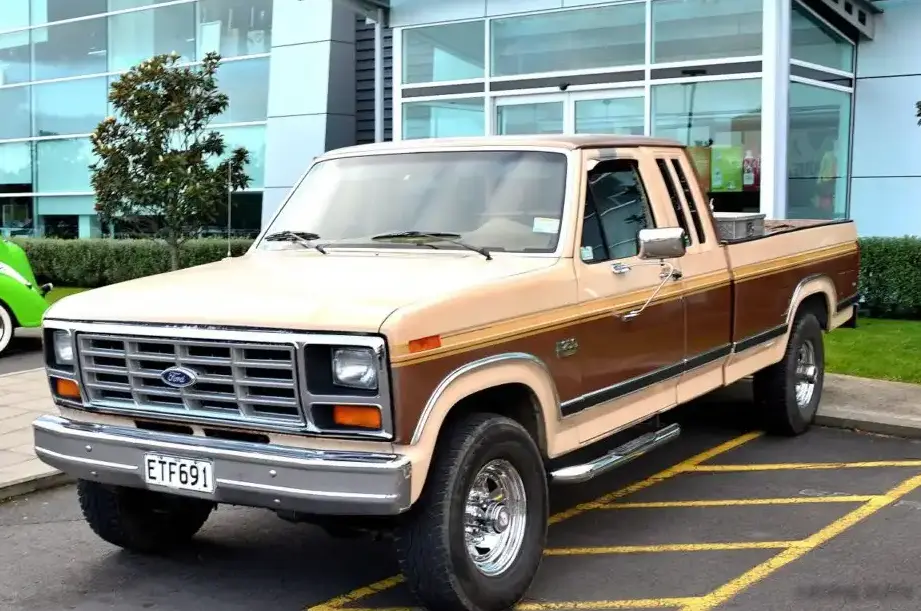
The Ford F-Series F-250 VII SuperCab, equipped with the 4.9-liter inline-six engine and an automatic transmission, represents a workhorse configuration within the seventh generation of Ford’s immensely popular F-Series pickup trucks. Produced from 1981 through 1986, this variant occupied a crucial position in the lineup, offering a balance between affordability, capability, and relative fuel efficiency for the era. The F-250, positioned above the F-150, was designed for heavier-duty tasks, appealing to those needing increased towing and payload capacity. The SuperCab designation indicated an extended passenger cabin, providing seating for up to six occupants, a feature increasingly desirable for families and work crews.
Technical Specifications
| Brand | Ford |
| Model | F-Series F-250 |
| Generation | F-Series F-250 VII SuperCab |
| Type (Engine) | 4.9 Six (125 Hp) Automatic |
| Start of production | 1981 |
| End of production | 1986 |
| Powertrain Architecture | Internal Combustion engine |
| Body type | Pick-up |
| Seats | 5-6 |
| Doors | 2 |
| Fuel Type | Petrol (Gasoline) |
| Power | 125 Hp |
| Power per litre | 25.4 Hp/l |
| Torque | 339 Nm / 250.03 lb.-ft. |
| Engine layout | Front, Longitudinal |
| Engine displacement | 4916 cm3 / 299.99 cu. in. |
| Number of cylinders | 6 |
| Engine configuration | Inline |
| Fuel injection system | Multi-port manifold injection |
| Engine aspiration | Naturally aspirated engine |
| Max. weight | 3583 kg / 7899.16 lbs. |
| Fuel tank capacity | 72-144 l / 19.02 – 38.04 US gal | 15.84 – 31.68 UK gal |
| Length | 5850 mm / 230.31 in. |
| Width | 1778 mm / 70 in. |
| Height | 1885 mm / 74.21 in. |
| Wheelbase | 3937 mm / 155 in. |
| Wading depth | 846 mm / 33.31 in. |
| Drivetrain Architecture | The Internal combustion engine (ICE) drives the rear wheels of the vehicle. |
| Drive wheel | Rear wheel drive |
| Number of gears and type of gearbox | automatic transmission SelectShift |
| Front suspension | Independent coil spring |
| Front brakes | Disc |
| Rear brakes | Drum |
| Power steering | Electric Steering |
| Tires size | 235/85 R16 |
| Wheel rims size | 6.0J x 16 |
Powertrain & Engine Architecture
The heart of this F-250 variant is Ford’s 4.9-liter (299 cubic inch) inline-six cylinder engine. Often referred to as the “300 six” due to its historical predecessor, this engine was known for its durability and relatively simple design. The 1981-1986 version featured multi-port fuel injection, a significant upgrade from the carbureted versions of earlier years, improving fuel efficiency and throttle response. The engine utilizes a cast iron block and head, contributing to its robust nature. The SelectShift automatic transmission, a three-speed unit, was the standard offering for this configuration. While not known for its performance, the SelectShift was reliable and well-suited to the engine’s torque characteristics. The transmission’s gear ratios were optimized for towing and hauling, prioritizing low-end grunt over outright acceleration.
Driving Characteristics
The 4.9-liter engine, producing 125 horsepower and 250 lb-ft of torque, delivered adequate, but not exhilarating, performance. Acceleration was modest, particularly when loaded or towing. The automatic transmission, while smooth in operation, contributed to a somewhat leisurely driving experience. Compared to the available V8 engines (such as the 351 Windsor or 460 big-block), the 4.9-liter lacked the raw power for heavy towing or rapid acceleration. However, it offered a noticeable improvement in fuel economy. The gear ratios in the SelectShift transmission were spaced to maximize the engine’s torque, making it a capable performer in everyday driving and moderate hauling situations. The rear-wheel-drive configuration, combined with the truck’s substantial weight, provided a stable and predictable driving experience.
Equipment & Trim Levels
The F-250 SuperCab 4.9L Automatic typically came with a fairly basic level of equipment, reflecting its positioning as a work-oriented truck. Standard features included a vinyl bench seat, basic instrumentation (speedometer, fuel gauge, temperature gauge), and a simple AM radio. The SuperCab configuration added extra passenger space behind the front seats, often with side-facing jump seats. Optional extras included air conditioning, upgraded audio systems, power steering, and various trim packages. Interior upholstery options ranged from basic vinyl to more durable cloth materials. The dashboard layout was functional and straightforward, prioritizing ease of use over aesthetic appeal.
Chassis & Braking
The F-250’s chassis was built for durability and load-carrying capacity. It featured a heavy-duty frame and a robust suspension system. The front suspension utilized independent coil springs, providing a relatively comfortable ride for a truck of this size. The rear suspension employed leaf springs, designed to handle heavy loads. Braking duties were handled by disc brakes at the front and drum brakes at the rear. Power steering was often an optional extra, but became increasingly common. The standard tire size was 235/85R16, providing a good balance between ride comfort and load-carrying capacity. Stabilizer bars were typically not standard equipment on this trim level, but could be added as an option.
Market Reception & Comparison
The F-250 SuperCab 4.9L Automatic was generally well-received by buyers seeking a capable and affordable work truck. Critics praised its durability and fuel efficiency, particularly compared to the larger V8 engines. However, its lack of power was often noted. Compared to the F-150, the F-250 offered increased towing and payload capacity, making it a popular choice for those needing a heavier-duty vehicle. Compared to the V8-powered F-250s, the 4.9-liter version was more economical to operate, but lacked the same level of performance. The combination of the extended SuperCab and the 4.9-liter engine appealed to buyers who needed both passenger space and reasonable fuel economy.
Legacy
The 4.9-liter inline-six engine, in its various iterations, became legendary for its longevity and reliability. Many examples of this engine are still in service today, often with hundreds of thousands of miles on the odometer. The SelectShift automatic transmission, while not as sophisticated as modern transmissions, proved to be reasonably durable. In the used car market, F-250s equipped with the 4.9-liter engine are often sought after by those looking for a simple, reliable, and affordable work truck. While not a high-performance machine, this variant represents a solid and dependable choice for those needing a capable pickup truck.