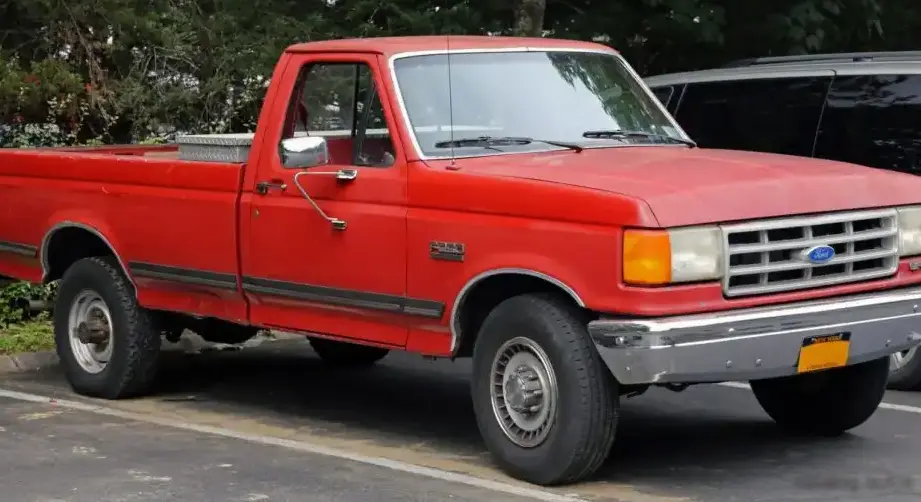
The Ford F-Series F-250 VIII Regular Cab, equipped with the 4.9-liter inline-six engine producing 150 horsepower, was a mainstay of Ford’s heavy-duty truck lineup from 1988 to 1991. This variant occupied an entry-level position within the F-250 range, offering a balance of affordability and capability for buyers needing a robust work truck. It was part of the eighth generation (F-Series VIII) of the Ford F-Series, a lineage that began in 1948 and continues to this day. The F-250, positioned above the F-150 and below the F-350, catered to customers requiring greater towing and payload capacity than the lighter-duty F-150 could provide.
Technical Specifications
| Brand | Ford |
| Model | F-Series F-250 |
| Generation | F-Series F-250 VIII Regular Cab |
| Type (Engine) | 4.9 300 Six (150 Hp) |
| Start of production | 1988 |
| End of production | 1991 |
| Powertrain Architecture | Internal Combustion engine |
| Body type | Pick-up |
| Seats | 3 |
| Doors | 2 |
| Fuel Type | Petrol (Gasoline) |
| Power | 150 Hp @ 3400 rpm |
| Power per litre | 30.5 Hp/l |
| Torque | 353 Nm @ 2000 rpm / 260.36 lb.-ft. @ 2000 rpm |
| Engine layout | Front, Longitudinal |
| Engine displacement | 4916 cm3 / 299.99 cu. in. |
| Number of cylinders | 6 |
| Engine configuration | Inline |
| Cylinder Bore | 101.6 mm / 4 in. |
| Piston Stroke | 101.09 mm / 3.98 in. |
| Compression ratio | 8.8:1 |
| Fuel injection system | Multi-port manifold injection |
| Engine aspiration | Naturally aspirated engine |
| Max. weight | 2994 kg / 6600.64 lbs. |
| Fuel tank capacity | 69 l / 18.23 US gal | 15.18 UK gal |
| Length | 5339 mm / 210.2 in. |
| Width | 1778 mm / 70 in. |
| Height | 1854 mm / 72.99 in. |
| Wheelbase | 3378 mm / 132.99 in. |
| Wading depth | 826 mm / 32.52 in. |
| Drivetrain Architecture | The Internal combustion engine (ICE) drives the rear wheels of the vehicle. |
| Drive wheel | Rear wheel drive |
| Number of gears and type of gearbox | 5 gears, manual transmission |
| Front suspension | Independent coil spring |
| Rear suspension | Leaf spring |
| Front brakes | Disc |
| Rear brakes | Drum |
| Power steering | Electric Steering |
| Tires size | 215/85 R16 |
| Wheel rims size | 6J x 16 |
Powertrain & Engine Architecture
The heart of this F-250 variant was the 4.9-liter (299 cubic inch) inline-six cylinder engine, commonly known as the “300 Six.” This engine, a long-stroke design, was renowned for its durability and low-end torque. It featured a cast-iron block and cylinder head, and a simple, robust valvetrain with a single camshaft operating overhead valves. Fuel delivery was managed by a multi-port fuel injection system, a significant upgrade from the carburetor systems used in earlier iterations of the engine. The 300 Six produced 150 horsepower at 3400 rpm and 353 Nm (260 lb-ft) of torque at 2000 rpm. The engine’s longitudinal mounting within the chassis and rear-wheel drive configuration were standard for Ford trucks of this era. The standard transmission was a 5-speed manual, contributing to the truck’s work-oriented character. While an automatic transmission was available as an option, the manual was favored by those prioritizing fuel economy and direct control.
Driving Characteristics
The 150 hp 300 Six, coupled with the 5-speed manual transmission, provided adequate, though not exhilarating, performance. Acceleration was modest, and the truck was best suited for hauling and towing rather than spirited driving. The engine’s strength lay in its low-end torque, making it capable of pulling heavy loads from a standstill. The manual transmission’s gear ratios were optimized for work, with a relatively low first gear for starting with a load and a higher fifth gear for highway cruising. Compared to the optional V8 engines available in the F-250 (such as the 5.8L and 7.5L), the 300 Six offered significantly less horsepower but comparable, and in some cases, superior low-end torque. The V8s were preferred by those needing maximum power for demanding tasks, while the 300 Six appealed to buyers prioritizing fuel efficiency and long-term reliability.
Equipment & Trim Levels
The F-250 VIII Regular Cab with the 4.9-liter engine typically came with a basic level of equipment. Standard features included a vinyl bench seat, a basic AM radio, and manual windows and locks. The interior was utilitarian in design, focused on durability and ease of cleaning. Optional extras included air conditioning, an upgraded sound system, and a sliding rear window. Trim levels were relatively simple; the primary differentiation was based on the engine and transmission choices. This particular variant was generally considered the base model, appealing to buyers who needed a no-frills work truck. The Regular Cab configuration offered a single row of seating, prioritizing cargo space over passenger comfort.
Chassis & Braking
The F-250 VIII chassis was a traditional body-on-frame construction, providing a robust and durable platform for heavy-duty use. The front suspension utilized independent coil springs, offering a reasonable ride quality for a truck of this size. The rear suspension employed leaf springs, designed to handle heavy loads. Braking duties were handled by disc brakes at the front and drum brakes at the rear. Power steering was standard, making the truck easier to maneuver, especially when loaded. The tires were typically 215/85 R16, chosen for their durability and load-carrying capacity. The frame itself was heavily reinforced to withstand the stresses of towing and hauling.
Market Reception & Comparison
The F-250 with the 4.9-liter engine was well-received by buyers seeking a dependable and affordable work truck. Critics praised the 300 Six’s durability and fuel efficiency, but noted its lack of power compared to the V8 options. Fuel economy was a strong point, averaging around 14-16 mpg in real-world driving conditions, significantly better than the V8-powered models. Reliability was also a key selling point; the 300 Six was known for its ability to withstand years of hard use with minimal maintenance. Compared to competing trucks from Chevrolet and Dodge, the Ford F-250 offered a compelling combination of capability, affordability, and reliability.
Legacy
The 4.9-liter 300 Six engine has achieved legendary status among Ford truck enthusiasts. Its simple design and robust construction have made it remarkably durable, with many examples still running strong today. The powertrain, while not particularly powerful by modern standards, remains a popular choice for those seeking a reliable and easy-to-maintain work truck. In the used car market, F-250s equipped with the 300 Six often command a premium due to their reputation for longevity. The engine’s simplicity also makes it relatively easy to repair, further contributing to its enduring appeal. The F-250 VIII Regular Cab 4.9 remains a testament to Ford’s commitment to building tough and dependable trucks.