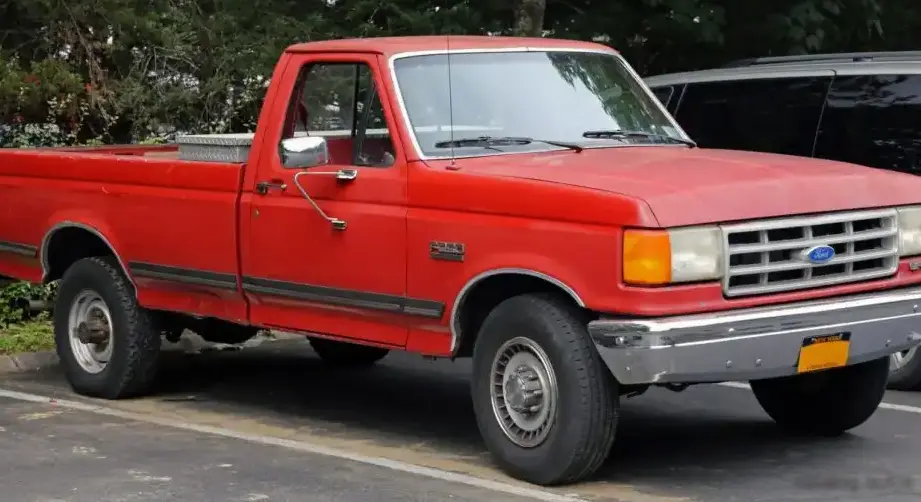
The Ford F-Series F-250 VIII Regular Cab, equipped with the 5.0-liter V8 Windsor engine and an automatic transmission, represents a significant iteration in Ford’s long-running and immensely popular F-Series line of trucks. Produced from 1986 through 1988, this variant occupied a middle ground within the F-250 range, offering a balance between capability and affordability for buyers needing more than the F-150 could provide, but not requiring the full-duty capacity of the F-350. This generation, known as the eighth iteration of the F-Series, saw refinements in styling and technology while maintaining the rugged, body-on-frame construction that defined Ford trucks for decades.
Technical Specifications
| Brand | Ford |
| Model | F-Series F-250 |
| Generation | F-Series F-250 VIII Regular Cab |
| Type (Engine) | 5.0 V8 Windsor (185 Hp) Automatic |
| Start of production | 1986 |
| End of production | 1988 |
| Powertrain Architecture | Internal Combustion engine |
| Body type | Pick-up |
| Seats | 3 |
| Doors | 2 |
| Fuel Type | Petrol (Gasoline) |
| Power | 185 Hp |
| Power per litre | 37.4 Hp/l |
| Torque | 366 Nm / 269.95 lb.-ft. |
| Engine layout | Front, Longitudinal |
| Engine displacement | 4949 cm3 / 302.01 cu. in. |
| Number of cylinders | 8 |
| Engine configuration | V-engine |
| Fuel injection system | Multi-port manifold injection |
| Engine aspiration | Naturally aspirated engine |
| Max. weight | 3493 kg / 7700.75 lbs. |
| Fuel tank capacity | 72 l / 19.02 US gal | 15.84 UK gal |
| Length | 5339 mm / 210.2 in. |
| Width | 1778 mm / 70 in. |
| Height | 1854 mm / 72.99 in. |
| Wheelbase | 3378 mm / 132.99 in. |
| Wading depth | 826 mm / 32.52 in. |
| Drivetrain Architecture | The Internal combustion engine (ICE) drives the rear wheels of the vehicle. |
| Drive wheel | Rear wheel drive |
| Number of gears and type of gearbox | automatic transmission SelectShift |
| Front suspension | Independent coil spring |
| Front brakes | Disc |
| Rear brakes | Drum |
| Power steering | Electric Steering |
| Tires size | 215/85 R16; 235/85 R16 |
| Wheel rims size | 6J x 16 |
Powertrain & Engine Architecture
The heart of this F-250 variant is the 5.0-liter (302 cubic inch) Windsor V8 engine. This engine, a mainstay of Ford’s lineup for decades, is a pushrod engine with a cast iron block and aluminum cylinder heads. The 185 horsepower output was achieved through a multi-port fuel injection system, a significant upgrade over the carbureted engines of earlier years. This system improved fuel efficiency and throttle response. The engine’s valvetrain utilizes two valves per cylinder, operated by a hydraulic lifter camshaft. The “SelectShift” automatic transmission, a three-speed unit, was the standard offering for this configuration. It was chosen for its durability and relative simplicity, prioritizing reliability over outright performance. The transmission was electronically controlled, offering smoother shifts compared to earlier hydraulically governed automatics.
Driving Characteristics
The 185 hp 5.0L V8 and automatic transmission combination in the F-250 delivered adequate, but not exhilarating, performance. Acceleration was modest, particularly when hauling or towing. The automatic transmission’s gear ratios were optimized for work, prioritizing low-end torque over high-speed responsiveness. Compared to the available 6.9L diesel engine, the 5.0L V8 offered significantly less torque, making it less suitable for heavy-duty applications. However, it was more refined and quieter than the diesel. Against other gasoline engine options, like the larger 5.8L V8, the 5.0L provided a better balance of fuel economy and power for everyday use. The rear-wheel-drive configuration, standard on this model, meant that traction could be a concern in slippery conditions, although limited-slip differentials were available as an option.
Equipment & Trim Levels
The F-250 VIII Regular Cab with the 5.0L engine typically came with a fairly basic level of equipment. Standard features included a vinyl bench seat, a basic AM radio, and manual windows and locks. The interior was functional and durable, designed to withstand the rigors of truck ownership. Optional extras included air conditioning, a more powerful stereo system, upgraded interior trim, and power windows/locks. The trim level, often referred to as “Custom” or “XL,” dictated the level of standard features and available options. The XL trim generally offered more comfort and convenience features than the base Custom model. Exterior options included various paint colors, chrome trim packages, and different bed configurations (short bed, long bed).
Chassis & Braking
The F-250 VIII Regular Cab utilized a traditional body-on-frame construction, providing a robust and durable platform. The front suspension consisted of independent coil springs, offering a relatively comfortable ride for a heavy-duty truck. The rear suspension employed leaf springs, designed to handle heavy loads. Braking duties were handled by disc brakes at the front and drum brakes at the rear. Power steering was standard, making maneuvering the large truck easier. Tire sizes varied, with 215/85 R16 and 235/85 R16 being common options. The chassis was designed to accommodate a significant payload and towing capacity, although these figures were lower than those of the heavier-duty F-350.
Market Reception & Comparison
The F-250 with the 5.0L V8 and automatic transmission was generally well-received as a capable and affordable work truck. Critics noted its adequate power for most tasks, its comfortable ride (for a truck), and its relatively low price point. However, it was often criticized for its lack of power when heavily loaded or towing. Compared to the diesel-powered F-250, the 5.0L V8 offered lower fuel economy but a lower initial cost. Against other gasoline-powered trucks in its class, the F-250 offered a competitive combination of features, performance, and reliability. Its reputation for durability and ease of maintenance contributed to its popularity among buyers.
Legacy
The 5.0L Windsor V8-powered F-250 from the 1986-1988 model years has proven to be a remarkably durable and reliable truck. Many examples are still on the road today, a testament to Ford’s engineering and the engine’s inherent robustness. The automatic transmission, while not the most technologically advanced, has also proven to be relatively trouble-free. In the used car market, these trucks are often sought after by enthusiasts and those needing a dependable work vehicle. Parts availability remains good, and the relatively simple mechanical design makes them relatively easy to repair and maintain. While not a collector’s item in the same vein as some classic trucks, the F-250 with the 5.0L V8 holds a respected place in Ford’s history and continues to serve as a reliable workhorse for many owners.