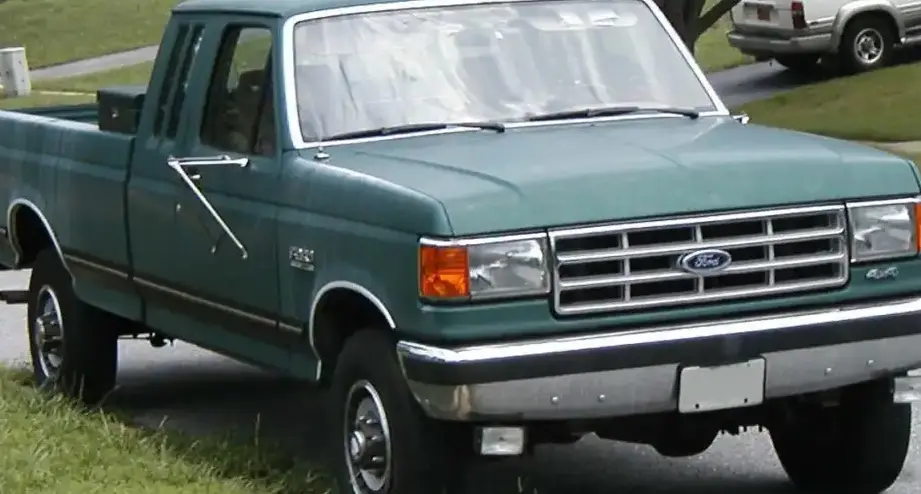
The Ford F-Series F-250 VIII SuperCab HD, equipped with the 7.3-liter V8 Indirect Diesel Injection (IDI) engine producing 180 horsepower, represents a significant iteration of Ford’s heavy-duty truck lineage. Produced from 1988 through 1991, this variant occupied a crucial position in the F-250 lineup, offering a balance between capability and affordability for buyers needing a robust work truck. It falls within the eighth generation (F-Series VIII) of the Ford F-Series, known for its substantial updates in styling and engineering compared to its predecessor. This particular configuration – the 7.3L IDI V8 paired with a four-speed automatic transmission and four-wheel drive – was a popular choice for those requiring a dependable truck for towing, hauling, and navigating challenging terrain.
Technical Specifications
| Brand | Ford |
| Model | F-Series F-250 |
| Generation | F-Series F-250 VIII SuperCab HD |
| Type (Engine) | 7.3 V8 IDI (180 Hp) 4×4 Automatic |
| Start of production | 1988 |
| End of production | 1991 |
| Powertrain Architecture | Internal Combustion engine |
| Body type | Pick-up |
| Seats | 6 |
| Doors | 2 |
| Fuel Type | Diesel |
| Power | 180 Hp @ 3300 rpm |
| Power per litre | 24.7 Hp/l |
| Torque | 468 Nm @ 1400 rpm / 345.18 lb.-ft. @ 1400 rpm |
| Engine layout | Front, Longitudinal |
| Engine displacement | 7276 cm3 / 444.01 cu. in. |
| Number of cylinders | 8 |
| Engine configuration | V-engine |
| Cylinder Bore | 104.39 mm / 4.11 in. |
| Piston Stroke | 106.17 mm / 4.18 in. |
| Compression ratio | 21.5:1 |
| Fuel injection system | Precombustion chamber injection |
| Engine oil capacity | 9.3 l / 9.83 US qt | 8.18 UK qt |
| Coolant | 27.5 l / 29.06 US qt | 24.2 UK qt |
| Max. weight | 3992 kg / 8800.85 lbs. |
| Fuel tank capacity | 141 l / 37.25 US gal | 31.02 UK gal |
| Length | 5895 mm / 232.09 in. |
| Width | 1778 mm / 70 in. |
| Height | 1956 mm / 77.01 in. |
| Wheelbase | 3937 mm / 155 in. |
| Wading depth | 914 mm / 35.98 in. |
| Drivetrain Architecture | The Internal combustion engine (ICE) drives the rear wheels permanently, and the front wheels are driven through an electrically or mechanically operated clutch if necessary. |
| Drive wheel | All wheel drive (4×4) |
| Number of gears and type of gearbox | 4 gears, automatic transmission |
| Front suspension | Leaf spring |
| Rear suspension | Leaf spring |
| Front brakes | Disc |
| Rear brakes | Drum |
| Power steering | Electric Steering |
| Tires size | 235/85 R16 |
| Wheel rims size | 16 |
Powertrain & Engine Architecture
The heart of this F-250 is the 7.3-liter IDI V8 engine. “IDI” stands for Indirect Diesel Injection, a system utilizing a pre-combustion chamber. Fuel is injected into a small chamber connected to the main cylinder, where it ignites and then ignites the main charge. This design, while less efficient than direct injection systems, offered quieter operation and reduced engine knock, characteristics valued in the late 1980s and early 1990s. The engine features a robust cast iron block and head, contributing to its longevity. The 180 horsepower output is achieved at 3300 rpm, while the substantial 468 Nm (345.18 lb-ft) of torque is readily available at a low 1400 rpm, making it well-suited for heavy-duty tasks. The four-speed automatic transmission (typically a Ford C6) was chosen for its durability and simplicity. While not offering the refinement of more modern automatics, it provided smooth, if somewhat deliberate, shifts and was capable of handling the engine’s torque output.
Driving Characteristics
The 180 hp/automatic combination in the F-250 delivered a driving experience focused on utility rather than outright performance. Acceleration was modest, and the truck wasn’t designed for quick sprints. However, the ample low-end torque made it a capable tower and hauler. The automatic transmission’s gear ratios were optimized for work, prioritizing pulling power over fuel efficiency. Compared to the available manual transmission, the automatic offered greater ease of use, particularly in stop-and-go traffic or for drivers less familiar with diesel engines. Against higher-output versions of the F-250, such as those equipped with the gasoline V8s, the IDI diesel lacked the responsiveness and top-end power, but it compensated with superior fuel economy and a longer lifespan.
Equipment & Trim Levels
The F-250 SuperCab HD 7.3L IDI typically came with a fairly basic level of equipment, reflecting its work-oriented nature. Standard features included a vinyl bench seat, basic instrumentation, and manual windows and locks. The SuperCab configuration added extra rear seating, increasing passenger capacity to six. Optional extras included air conditioning, an upgraded sound system, power windows and locks, and a tilt steering wheel. Interior upholstery was generally durable vinyl or cloth. The dashboard layout was functional and straightforward, prioritizing ease of use over aesthetics. Trim levels were relatively limited, with most variations stemming from the addition of optional packages.
Chassis & Braking
The F-250’s chassis was built for durability and load-carrying capacity. It utilized a heavy-duty frame and leaf spring suspension at both the front and rear. The leaf springs were designed to handle substantial weight and provide a stable ride, even when the truck was heavily loaded. Braking was accomplished via front disc brakes and rear drum brakes. Power steering was standard, making maneuvering the large truck easier. The 4×4 system employed a manually-shifted transfer case, allowing the driver to select between two-wheel drive, four-wheel drive high, and four-wheel drive low for optimal traction in various conditions. Tire size was typically 235/85 R16, chosen for their durability and load-carrying capacity.
Market Reception & Comparison
The F-250 7.3L IDI 4×4 Automatic was generally well-received by buyers seeking a dependable and capable heavy-duty truck. Critics praised its robust construction, ample torque, and relatively simple mechanical design. Fuel economy, while not exceptional, was considered good for a vehicle of its size and capability. Compared to other trims in the F-250 lineup, the 7.3L IDI offered a more affordable entry point into the heavy-duty truck market. While the gasoline-powered F-250s offered more horsepower, the diesel provided superior torque and fuel efficiency, making it a popular choice for those who prioritized work capability over outright speed.
Legacy
The 7.3-liter IDI V8 engine, and the F-250 trucks that housed it, have developed a strong following among diesel enthusiasts. The engine is known for its durability and relative simplicity, making it a popular choice for restoration projects and modifications. While not as technologically advanced as modern diesel engines, the 7.3L IDI remains a reliable and capable powerplant. In the used car market today, these F-250s are often sought after by those looking for a classic work truck or a platform for customization. Well-maintained examples can command a premium price, reflecting their enduring appeal and reputation for longevity. The simplicity of the engine also makes it relatively easy to repair and maintain, further contributing to its lasting popularity.