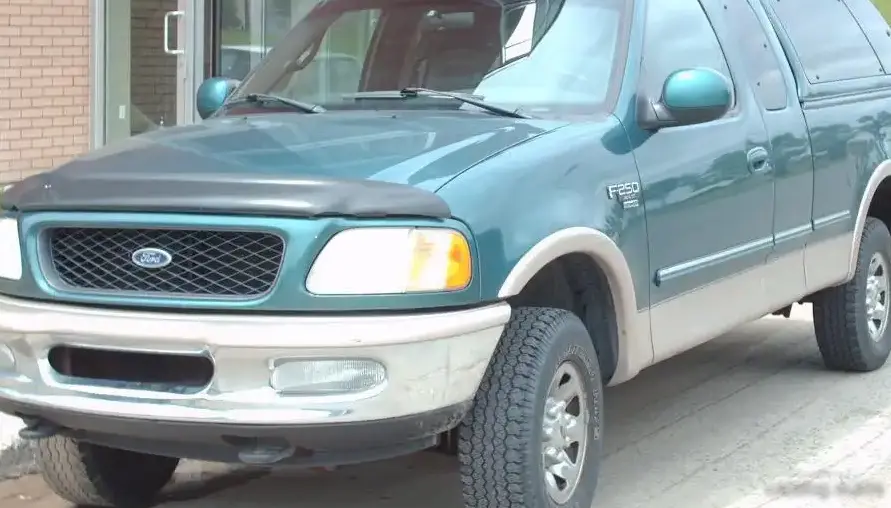
The Ford F-Series F-250 X SuperCab, equipped with the 4.6-liter V8 Triton engine producing 220 horsepower, was a mainstay of Ford’s heavy-duty truck lineup from 1996 through 1999. This variant occupied a middle ground within the F-250 range, offering a balance between capability and affordability. It served as a popular choice for buyers needing a robust truck for work or personal use, but who didn’t require the higher towing capacities or power of the larger engine options. The F-250 itself was part of the ninth generation of the Ford F-Series (1992-1997), and the SuperCab configuration provided expanded rear seating compared to the standard cab.
Technical Specifications
| Brand | Ford |
| Model | F-Series F-250 |
| Generation | F-Series F-250 X SuperCab |
| Type (Engine) | 4.6 V8 Triton (220 Hp) |
| Start of production | July, 1996 |
| End of production | 1999 |
| Powertrain Architecture | Internal Combustion engine |
| Body type | Pick-up |
| Seats | 5-6 |
| Doors | 2 |
| Fuel Type | Petrol (Gasoline) |
| Power | 220 Hp @ 4500 rpm |
| Power per litre | 47.8 Hp/l |
| Torque | 393 Nm @ 3250 rpm / 289.86 lb.-ft. @ 3250 rpm |
| Engine layout | Front, Longitudinal |
| Engine Model/Code | Triton |
| Engine displacement | 4605 cm3 / 281.01 cu. in. |
| Number of cylinders | 8 |
| Engine configuration | V-engine |
| Compression ratio | 9:1 |
| Fuel injection system | Multi-port manifold injection |
| Engine aspiration | Naturally aspirated engine |
| Engine oil capacity | 5.7 l / 6.02 US qt | 5.02 UK qt |
| Coolant | 16.9 l / 17.86 US qt | 14.87 UK qt |
| Max. weight | 3084 kg / 6799.06 lbs |
| Trunk (boot) space – minimum | 1659 l / 58.59 cu. ft |
| Fuel tank capacity | 95 l / 25.1 US gal | 20.9 UK gal |
| Permitted trailer load with brakes (12%) | 1406 kg / 3099.7 lbs |
| Length | 5608-5646 mm / 220.79 – 222.28 in |
| Width | 1656 mm / 65.2 in |
| Wheelbase | 3531 mm / 139.02 in |
| Ride height (ground clearance) | 183 mm / 7.2 in |
| Wading depth | 848 mm / 33.39 in |
| Drivetrain Architecture | Rear wheel drive. Internal Combustion engine (ICE) drives the rear wheels. |
| Drive wheel | Rear wheel drive |
| Number of gears and type of gearbox | 5 gears, manual transmission |
| Front suspension | Independent coil spring, Transverse stabilizer |
| Front brakes | Ventilated discs |
| Rear brakes | Ventilated discs |
| Power steering | Electric Steering |
| Tires size | 255/70 R16 |
| Wheel rims size | 7.0J x 16 |
Powertrain & Engine Architecture
The heart of this F-250 variant was the 4.6-liter Triton V8 engine. This engine, part of Ford’s modular engine family, featured a cast-iron block with aluminum cylinder heads. The 9:1 compression ratio and multi-port fuel injection system contributed to its relatively smooth operation and decent power output for its displacement. The engine code, while often simply referred to as “Triton,” varied slightly depending on the specific year and application. The 4.6L Triton was known for its relatively simple design, making it easier to maintain compared to some of its competitors. The five-speed manual transmission was the standard offering, providing drivers with full control over gear selection. This transmission was chosen for its durability and ability to handle the truck’s torque output.
Driving Characteristics
The 220 horsepower and 289 lb-ft of torque delivered by the 4.6L Triton in the F-250 provided adequate, but not overwhelming, performance. Acceleration was moderate, and the truck felt most comfortable cruising at highway speeds. Compared to the larger 5.4L and 7.5L V8 options, the 4.6L lacked the sheer pulling power for heavy towing. However, for lighter loads and everyday driving, it proved to be a capable and efficient choice. The manual transmission allowed for precise control, but required more driver involvement than the available automatic option. The gear ratios were tuned for a balance of fuel economy and towing capability, with a lower first gear for starting with a load and higher gears for efficient highway cruising.
Equipment & Trim Levels
The F-250 X SuperCab with the 4.6L engine typically came standard with features like air conditioning, a basic AM/FM radio, and cloth upholstery. The SuperCab configuration offered a split bench seat in the rear, providing seating for up to three passengers. Optional extras included power windows and locks, a better sound system, cruise control, and upgraded interior trim. The “X” trim level denoted a mid-range offering, positioned above the base XL trim but below the more luxurious XLT. Buyers could also add features like a trailer towing package, which included a heavier-duty hitch and wiring harness.
Chassis & Braking
The F-250’s chassis was built for durability and heavy-duty use. It featured a robust frame and a solid rear axle. The front suspension utilized independent coil springs and a transverse stabilizer bar to improve ride quality and handling. Braking duties were handled by ventilated discs on all four wheels, providing adequate stopping power for the truck’s weight. Power steering was standard, making it easier to maneuver the large vehicle. The tires, typically 255/70R16, were chosen for their balance of on-road comfort and off-road capability.
Market Reception & Comparison
The 4.6L F-250 SuperCab was generally well-received by critics and buyers alike. It was praised for its comfortable ride, spacious interior, and relatively fuel-efficient engine compared to the larger V8 options. However, some reviewers noted that the 4.6L engine could feel underpowered when towing heavy loads or driving in hilly terrain. Compared to the 5.4L V8, the 4.6L offered better fuel economy but significantly less power. The 7.5L V8 was the top-of-the-line option, providing the most towing capacity but at the expense of fuel efficiency. The 4.6L variant appealed to buyers who prioritized affordability and everyday usability over maximum towing capability.
Legacy
The 4.6L Triton engine, in general, proved to be a reliable powerplant, although early versions were known for potential timing chain issues. With proper maintenance, these engines could easily surpass 200,000 miles. The F-250 SuperCab with the 4.6L engine remains a popular choice in the used truck market today, particularly for buyers seeking a capable and affordable work truck. Parts availability is generally good, and the truck’s simple design makes it relatively easy to repair. While not as sought-after as the higher-powered variants, the 4.6L F-250 offers a compelling combination of value, durability, and practicality.