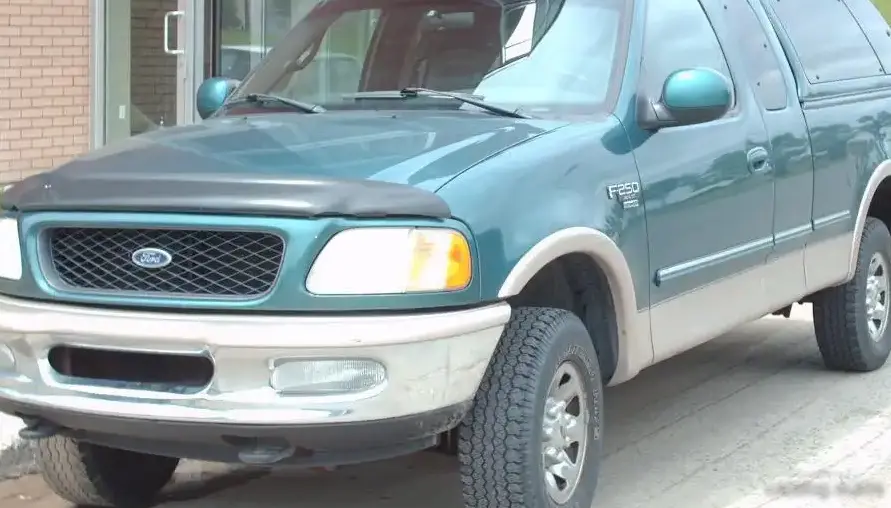
The Ford F-Series F-250 X SuperCab, equipped with the 4.6-liter V8 Triton engine and a four-speed automatic transmission, was a mainstay of Ford’s heavy-duty truck lineup from 1996 to 1999. This configuration represented a balance between capability and affordability within the F-250 range, slotting below the more powerful 5.4L and 7.3L diesel options. It was part of the ninth generation of the F-Series (1992-1997, with updates extending to 1999), known internally as the F-150/250/350 platform. The SuperCab body style offered extended cab space, providing limited rear seating and storage, making it a popular choice for families and work crews needing occasional passenger capacity.
Technical Specifications
| Brand | Ford |
| Model | F-Series F-250 |
| Generation | F-Series F-250 X SuperCab |
| Type (Engine) | 4.6 V8 Triton (220 Hp) Automatic |
| Start of production | July, 1996 |
| End of production | 1999 |
| Powertrain Architecture | Internal Combustion engine |
| Body type | Pick-up |
| Seats | 5-6 |
| Doors | 2 |
| Fuel Type | Petrol (Gasoline) |
| Power | 220 Hp @ 4500 rpm |
| Power per litre | 47.8 Hp/l |
| Torque | 393 Nm @ 3250 rpm / 289.86 lb.-ft. @ 3250 rpm |
| Engine layout | Front, Longitudinal |
| Engine Model/Code | Triton |
| Engine displacement | 4605 cm3 / 281.01 cu. in. |
| Number of cylinders | 8 |
| Engine configuration | V-engine |
| Compression ratio | 9:1 |
| Fuel injection system | Multi-port manifold injection |
| Engine aspiration | Naturally aspirated engine |
| Engine oil capacity | 5.7 l / 6.02 US qt | 5.02 UK qt |
| Coolant | 16.9 l / 17.86 US qt | 14.87 UK qt |
| Max. weight | 3402 kg / 7500.13 lbs |
| Trunk (boot) space – minimum | 1659 l / 58.59 cu. ft |
| Fuel tank capacity | 95 l / 25.1 US gal | 20.9 UK gal |
| Permitted trailer load with brakes (12%) | 3266 kg / 7200.3 lbs |
| Length | 5608-5646 mm / 220.79 – 222.28 in |
| Width | 1656 mm / 65.2 in |
| Wheelbase | 3531 mm / 139.02 in |
| Ride height (ground clearance) | 183 mm / 7.2 in |
| Wading depth | 848 mm / 33.39 in |
| Drivetrain Architecture | The Internal combustion engine (ICE) drives the rear wheels of the vehicle. |
| Drive wheel | Rear wheel drive |
| Number of gears and type of gearbox | 4 gears, automatic transmission |
| Front suspension | Independent coil spring, Transverse stabilizer |
| Front brakes | Ventilated discs |
| Rear brakes | Ventilated discs |
| Power steering | Electric Steering |
| Tires size | 245/75 R16 |
| Wheel rims size | 7.0J x 16 |
Powertrain & Engine Architecture
The heart of this F-250 variant was the 4.6-liter Triton V8 engine. Introduced in 1996, the Triton family of engines represented a significant update for Ford’s truck lineup. This particular engine, designated as the 4.6L Modular engine, featured a cast-iron block with aluminum cylinder heads. It utilized a sequential electronic fuel injection (SEFI) system, delivering precise fuel metering for improved efficiency and performance. The engine’s overhead valve (OHV) valvetrain, while traditional, was optimized for low-end torque, a crucial characteristic for a work truck. The four-speed 4R70W automatic transmission was chosen for its durability and suitability for towing applications. This transmission featured electronic control for smoother shifting and adaptive shift patterns.
Driving Characteristics
The 220 horsepower and 393 Nm (289.86 lb-ft) of torque produced by the 4.6L Triton, when paired with the four-speed automatic, provided adequate, but not exceptional, performance. Acceleration was modest, and passing maneuvers required careful planning, especially when towing or carrying a heavy load. The automatic transmission’s gear ratios were optimized for towing and hauling, resulting in a lower first gear for increased pulling power. However, this also meant that the engine often operated at higher RPMs during highway cruising, potentially impacting fuel economy. Compared to the 5.4L Triton or the 7.3L Power Stroke diesel, this configuration felt noticeably less powerful. The manual transmission option, when available, offered a more engaging driving experience and slightly improved fuel efficiency, but the automatic was favored by many buyers for its ease of use.
Equipment & Trim Levels
The F-250 X SuperCab with the 4.6L engine typically came standard with features like air conditioning, a basic AM/FM radio, and cloth upholstery. The “X” trim level represented a mid-range offering, providing a step up from the base XL trim but falling short of the luxurious Lariat trim. Optional extras included power windows and locks, a CD player, upgraded sound systems, and various towing packages. The SuperCab configuration added a small rear seat and extra storage space behind the front seats, making it more versatile than the standard cab models. Interior color options were generally limited to neutral tones like gray and tan.
Chassis & Braking
The F-250 chassis was built for heavy-duty use, featuring a robust frame and heavy-duty suspension components. The front suspension utilized independent coil springs with a transverse stabilizer bar to improve handling and ride comfort. The rear suspension employed leaf springs, designed to handle substantial payloads. Braking duties were handled by ventilated discs on all four wheels, providing adequate stopping power for most applications. Power steering was standard, making maneuvering the large truck easier. The 245/75 R16 tires were chosen for their balance of on-road comfort and off-road capability.
Market Reception & Comparison
The 4.6L Triton-equipped F-250 SuperCab was generally well-received as a capable and affordable work truck. Critics noted its adequate power for everyday tasks and its comfortable ride quality. However, it was often criticized for its lack of outright performance compared to the larger-displacement engines. Fuel economy was average for a truck of its size and class. Compared to the 5.4L Triton, the 4.6L offered lower initial cost and slightly better fuel economy, but at the expense of power. The diesel options provided significantly more torque and better fuel economy for heavy towing, but came with a higher price tag and potentially higher maintenance costs.
Legacy
The 4.6L Triton engine proved to be a relatively reliable powertrain, although some issues with spark plug breakage in earlier years were reported. The 4R70W automatic transmission was also generally durable, provided it was properly maintained. Today, these F-250s can be found in the used car market at relatively affordable prices. They remain popular choices for those needing a capable work truck or a classic American pickup. While not the most powerful or fuel-efficient option in the F-250 lineup, the 4.6L Triton-equipped model offers a good balance of capability, affordability, and reliability, making it a solid choice for a variety of applications. Proper maintenance, including regular oil changes and transmission fluid flushes, is crucial for ensuring the longevity of these trucks.