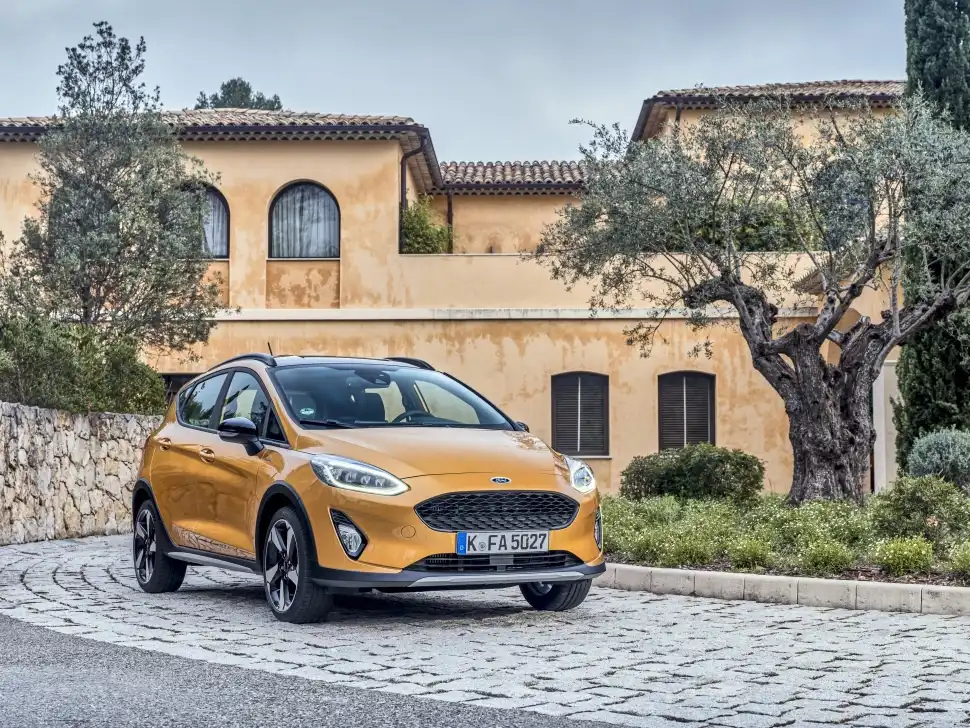
The Ford Fiesta Active VIII (Mk8) 1.0 EcoBoost 125 hp model, produced from March 2018 to 2021, represents a specific configuration within the broader Mk8 Fiesta Active range. Positioned as a mid-range offering, this variant blended the practicality of a supermini hatchback with the slightly raised ride height and rugged styling cues of a crossover. It aimed to appeal to buyers seeking a fuel-efficient, versatile, and modern vehicle for urban and occasional rural driving. The Fiesta Mk8 platform (B763) was a significant update for Ford’s long-running Fiesta line, introducing new technology, improved safety features, and a more sophisticated driving experience.
Technical Specifications
| Brand | Ford |
| Model | Fiesta |
| Generation | Fiesta Active VIII (Mk8) |
| Type (Engine) | 1.0 EcoBoost (125 Hp) |
| Start of production | March, 2018 |
| End of production | 2021 |
| Powertrain Architecture | Internal Combustion engine |
| Body type | Hatchback, Crossover |
| Seats | 5 |
| Doors | 5 |
| Fuel consumption (urban) | 5.9 l/100 km (39.9 US mpg, 47.9 UK mpg, 16.9 km/l) |
| Fuel consumption (extra urban) | 4.4 l/100 km (53.5 US mpg, 64.2 UK mpg, 22.7 km/l) |
| Fuel consumption (combined) | 5 l/100 km (47 US mpg, 56.5 UK mpg, 20 km/l) |
| CO2 emissions | 114 g/km |
| Fuel Type | Petrol (Gasoline) |
| Acceleration 0 – 100 km/h | 10.4 sec |
| Acceleration 0 – 62 mph | 10.4 sec |
| Acceleration 0 – 60 mph | 9.9 sec |
| Maximum speed | 191 km/h (118.68 mph) |
| Emission standard | Euro 6 |
| Weight-to-power ratio | 9.3 kg/Hp, 107.2 Hp/tonne |
| Weight-to-torque ratio | 6.9 kg/Nm, 145.8 Nm/tonne |
| Power | 125 Hp @ 6000 rpm |
| Power per litre | 125.3 Hp/l |
| Torque | 170 Nm @ 1500-4500 rpm (125.39 lb.-ft. @ 1500-4500 rpm) |
| Engine layout | Front, Transverse |
| Engine Model/Code | M1JL, M1JM, M1JP |
| Engine displacement | 998 cm3 (60.9 cu. in.) |
| Number of cylinders | 3 |
| Engine configuration | Inline |
| Cylinder Bore | 71.9 mm (2.83 in.) |
| Piston Stroke | 82 mm (3.23 in.) |
| Compression ratio | 10:1 |
| Number of valves per cylinder | 4 |
| Fuel injection system | Direct injection |
| Engine aspiration | Turbocharger, Intercooler |
| Valvetrain | DOHC |
| Engine oil capacity | 4.6 l (4.86 US qt | 4.05 UK qt) |
| Coolant | 5.8 l (6.13 US qt | 5.1 UK qt) |
| Kerb Weight | 1166 kg (2570.59 lbs.) |
| Max. weight | 1685 kg (3714.79 lbs.) |
| Max load | 519 kg (1144.2 lbs.) |
| Trunk (boot) space – minimum | 311 l (10.98 cu. ft.) |
| Trunk (boot) space – maximum | 1093 l (38.6 cu. ft.) |
| Fuel tank capacity | 42 l (11.1 US gal | 9.24 UK gal) |
| Max. roof load | 50 kg (110.23 lbs.) |
| Permitted trailer load with brakes (12%) | 1000 kg (2204.62 lbs.) |
| Permitted trailer load without brakes | 620 kg (1366.87 lbs.) |
| Permitted towbar download | 65 kg (143.3 lbs.) |
| Length | 4068 mm (160.16 in.) |
| Width | 1756 mm (69.13 in.) |
| Width with mirrors folded | 1783 mm (70.2 in.) |
| Width including mirrors | 1941 mm (76.42 in.) |
| Height | 1498 mm (58.98 in.) |
| Wheelbase | 2493 mm (98.15 in.) |
| Front track | 1513 mm (59.57 in.) |
| Rear (Back) track | 1476 mm (58.11 in.) |
| Front overhang | 857 mm (33.74 in.) |
| Rear overhang | 718 mm (28.27 in.) |
| Ride height (ground clearance) | 130-152 mm (5.12 – 5.98 in.) |
| Drag coefficient (Cd) | 0.33 |
| Minimum turning circle (turning diameter) | 10.3 m (33.79 ft.) |
| Drivetrain Architecture | The Internal combustion engine (ICE) drives the front wheels of the vehicle. |
| Drive wheel | Front wheel drive |
| Number of gears and type of gearbox | 6 gears, manual transmission |
| Front brakes | Ventilated discs |
| Rear brakes | Disc |
| Assisting systems | ABS (Anti-lock braking system) |
| Steering type | Steering rack and pinion |
| Power steering | Electric Steering |
| Tires size | 205/45 R17 |
| Wheel rims size | 17 |
INTRODUCTION
The Ford Fiesta Active VIII (Mk8) 1.0 EcoBoost 125 hp, launched in 2018, was a key component of Ford’s strategy to broaden the Fiesta’s appeal. Building on the success of the Mk7 generation, the Mk8 Fiesta introduced a more mature and refined design, along with a host of new technologies. The Active trim level, specifically, aimed to capitalize on the growing popularity of small crossovers, offering a slightly elevated ride height and more robust styling compared to the standard Fiesta hatchback. This 1.0 EcoBoost 125 hp variant served as a sweet spot in the range, providing a balance between affordability, fuel efficiency, and acceptable performance.
Powertrain & Engine Architecture
At the heart of this Fiesta Active is Ford’s 1.0 EcoBoost three-cylinder engine, specifically the M1JL, M1JM, or M1JP engine code depending on the exact production date and market. This engine is a marvel of downsizing technology, utilizing a single-scroll turbocharger, direct fuel injection, and variable valve timing to deliver a surprisingly punchy performance from its small displacement. The direct injection system operates at pressures up to 200 bar, ensuring precise fuel delivery and efficient combustion. The engine features a DOHC (Dual Overhead Camshaft) valvetrain with four valves per cylinder. The 125 hp output is achieved through careful calibration of the engine management system. The engine is transversely mounted at the front of the vehicle. The Fiesta Active 1.0 EcoBoost 125 hp was typically paired with a six-speed manual transmission, although a six-speed automatic transmission was also available, albeit less common. The automatic transmission is a conventional torque converter type, prioritizing smooth shifts and ease of use over outright performance.
Driving Characteristics
The 1.0 EcoBoost 125 hp engine in the Fiesta Active provides a lively driving experience, particularly in the lower gears. While not a sports car, the turbocharger provides a noticeable boost in power, making overtaking and merging onto highways relatively effortless. The 0-60 mph time of around 9.9 seconds is respectable for a vehicle in this class. The six-speed manual transmission offers precise shifts and allows the driver to make the most of the engine’s powerband. The automatic transmission, while convenient, can feel slightly less responsive and may result in slightly higher fuel consumption. The Active’s slightly raised suspension provides a more comfortable ride than the standard Fiesta, absorbing bumps and imperfections in the road more effectively. However, this does come at the expense of some handling sharpness.
Equipment & Trim Levels
The Fiesta Active 1.0 EcoBoost 125 hp typically came equipped with a generous level of standard features. These included air conditioning, a touchscreen infotainment system with Bluetooth connectivity, alloy wheels, and a leather-wrapped steering wheel. Higher trim levels added features such as a rear-view camera, parking sensors, heated seats, and a premium sound system. Interior upholstery was typically cloth, with options for partial leather trim. The dashboard layout was modern and functional, with a focus on ease of use. Optional extras included a panoramic sunroof, navigation system, and various driver assistance technologies.
Chassis & Braking
The Fiesta Active utilizes a MacPherson strut front suspension and a twist-beam rear suspension. The Active trim level features a slightly raised ride height compared to the standard Fiesta, providing increased ground clearance. Braking duties are handled by ventilated discs at the front and solid discs at the rear. Anti-lock Braking System (ABS) is standard, along with Electronic Stability Control (ESC). The steering is electrically assisted, providing a light and precise feel. The Active trim typically featured slightly larger diameter stabilizer bars compared to lower-spec Fiesta models, improving body control and reducing roll.
Market Reception & Comparison
The Fiesta Active 1.0 EcoBoost 125 hp was generally well-received by automotive critics. It was praised for its fuel efficiency, comfortable ride, and surprisingly engaging driving dynamics. Compared to the lower-powered 1.0 EcoBoost 100 hp variant, the 125 hp version offered a noticeable improvement in performance, making it a more enjoyable car to drive. Compared to the higher-output 1.5 EcoBoost models, the 1.0 EcoBoost 125 hp offered a better balance between performance and fuel economy. The 1.0 EcoBoost engine, while generally reliable, has been known to exhibit occasional issues with timing belt tensioners, so regular maintenance is crucial. Fuel economy figures of around 47 mpg combined were typical, making it a very economical choice for daily commuting.
Legacy
The Ford Fiesta Active 1.0 EcoBoost 125 hp remains a popular choice on the used car market. Its combination of practicality, fuel efficiency, and affordability makes it an attractive option for buyers seeking a small, versatile vehicle. The 1.0 EcoBoost engine has proven to be relatively reliable, although regular servicing is essential to prevent potential issues. The Mk8 Fiesta, as a whole, represents a significant step forward for Ford’s supermini, and the Active variant continues to appeal to those seeking a slightly more rugged and versatile option.