Technical Specifications
| Brand | Ford |
| Model | Fiesta |
| Generation | Fiesta Active VIII (Mk8) |
| Type (Engine) | 1.5 TDCi (85 Hp) |
| Start of production | March, 2018 |
| End of production | August, 2020 |
| Powertrain Architecture | Internal Combustion engine |
| Body type | Hatchback, Crossover |
| Seats | 5 |
| Doors | 5 |
| Fuel consumption (urban) | 4.4 l/100 km (53.5 US mpg, 64.2 UK mpg, 22.7 km/l) |
| Fuel consumption (extra urban) | 3.7 l/100 km (63.6 US mpg, 76.3 UK mpg, 27 km/l) |
| Fuel consumption (combined) | 4 l/100 km (58.8 US mpg, 70.6 UK mpg, 25 km/l) |
| CO2 emissions | 103 g/km |
| Fuel Type | Diesel |
| Acceleration 0 – 100 km/h | 12.6 sec |
| Acceleration 0 – 62 mph | 12.6 sec |
| Acceleration 0 – 60 mph | 12 sec |
| Maximum speed | 170 km/h (105.63 mph) |
| Emission standard | Euro 6 |
| Weight-to-power ratio | 14 kg/Hp, 71.4 Hp/tonne |
| Weight-to-torque ratio | 5.5 kg/Nm, 180.7 Nm/tonne |
| Power | 85 Hp @ 3750 rpm |
| Power per litre | 56.7 Hp/l |
| Torque | 215 Nm @ 1750-2500 rpm (158.58 lb.-ft. @ 1750-2500 rpm) |
| Engine layout | Front, Transverse |
| Engine Model/Code | XUJC, XUJD, XUJE, XUJF, XUJG, XUJK, XUJM |
| Engine displacement | 1499 cm3 (91.47 cu. in.) |
| Number of cylinders | 4 |
| Engine configuration | Inline |
| Cylinder Bore | 73.5 mm (2.89 in.) |
| Piston Stroke | 88.3 mm (3.48 in.) |
| Compression ratio | 16:1 |
| Number of valves per cylinder | 2 |
| Fuel injection system | Diesel Commonrail |
| Engine aspiration | Turbocharger, Intercooler |
| Valvetrain | SOHC |
| Engine oil capacity | 3.85 l (4.07 US qt | 3.39 UK qt) |
| Coolant | 5.5 l (5.81 US qt | 4.84 UK qt) |
| Kerb Weight | 1190 kg (2623.5 lbs.) |
| Max. weight | 1690 kg (3725.81 lbs.) |
| Max load | 500 kg (1102.31 lbs.) |
| Trunk (boot) space – minimum | 311 l (10.98 cu. ft.) |
| Trunk (boot) space – maximum | 1093 l (38.6 cu. ft.) |
| Fuel tank capacity | 40 l (10.57 US gal | 8.8 UK gal) |
| Max. roof load | 50 kg (110.23 lbs.) |
| Permitted trailer load with brakes (12%) | 750 kg (1653.47 lbs.) |
| Permitted trailer load without brakes | 630 kg (1388.91 lbs.) |
| Permitted towbar download | 45 kg (99.21 lbs.) |
| Length | 4068 mm (160.16 in.) |
| Width | 1756 mm (69.13 in.) |
| Width with mirrors folded | 1783 mm (70.2 in.) |
| Width including mirrors | 1941 mm (76.42 in.) |
| Height | 1498 mm (58.98 in.) |
| Wheelbase | 2493 mm (98.15 in.) |
| Front track | 1513 mm (59.57 in.) |
| Rear (Back) track | 1476 mm (58.11 in.) |
| Front overhang | 857 mm (33.74 in.) |
| Rear overhang | 718 mm (28.27 in.) |
| Ride height (ground clearance) | 130-152 mm (5.12 – 5.98 in.) |
| Drag coefficient (Cd) | 0.33 |
| Minimum turning circle (turning diameter) | 10.3 m (33.79 ft.) |
| Drivetrain Architecture | The Internal combustion engine (ICE) drives the front wheels of the vehicle. |
| Drive wheel | Front wheel drive |
| Number of gears and type of gearbox | 6 gears, manual transmission |
| Front brakes | Ventilated discs |
| Rear brakes | Disc |
| Assisting systems | ABS (Anti-lock braking system) |
| Steering type | Steering rack and pinion |
| Power steering | Electric Steering |
| Tires size | 205/45 R17 |
| Wheel rims size | 17 |
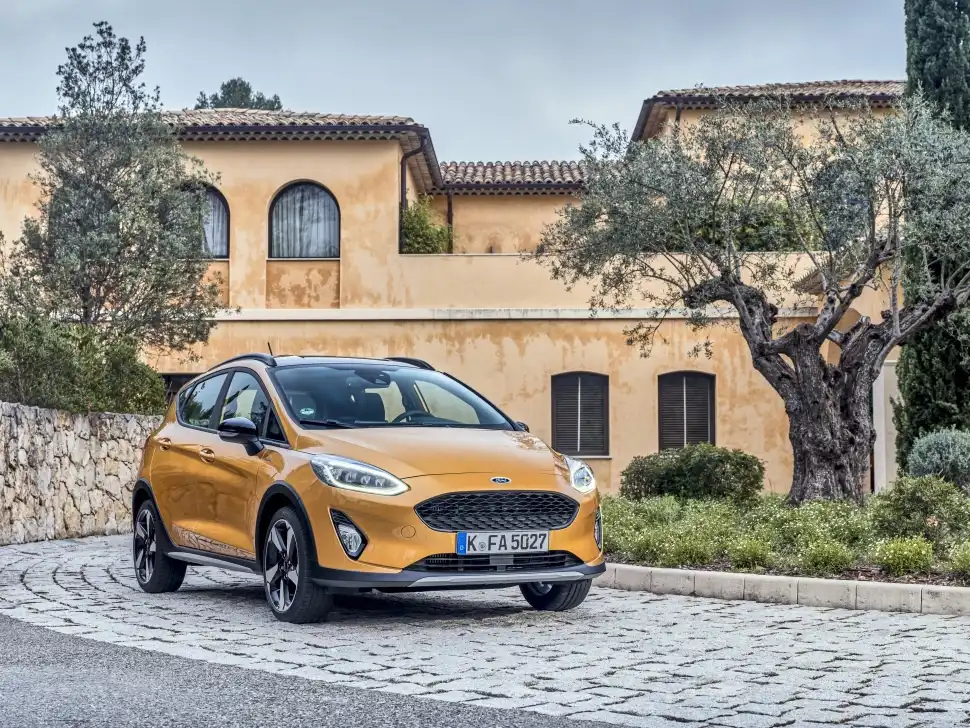
The Ford Fiesta Active VIII (Mk8) 1.5 TDCi 85 hp, launched in 2018, represented Ford’s response to the growing demand for small, fuel-efficient crossovers in Europe. It was designed to appeal to buyers seeking a vehicle that offered the practicality of a hatchback with a slightly more rugged appearance and a raised driving position. This particular variant, powered by the 1.5-liter TDCi diesel engine, was positioned as the economy-focused option within the Active range, sitting below the more powerful petrol variants. The Mk8 Fiesta, overall, was a significant update to the long-running Fiesta nameplate, featuring a more mature design, improved interior quality, and a suite of new technologies.
Powertrain & Engine Architecture
The heart of this Fiesta Active is the 1.5-liter TDCi diesel engine, belonging to Ford’s Duratorq family. Engine codes for this engine included XUJC, XUJD, XUJE, XUJF, XUJG, XUJK, and XUJM, depending on the specific calibration and market. This engine is a four-cylinder, inline configuration, utilizing a turbocharger with intercooling to boost power and efficiency. It employs a common-rail direct fuel injection system, delivering fuel directly into the cylinders at high pressure for optimized combustion. The engine features a single overhead camshaft (SOHC) valvetrain with two valves per cylinder. The 85 hp output is achieved at 3750 rpm, while peak torque of 215 Nm (158.58 lb.-ft.) is available between 1750-2500 rpm. This engine was paired with a six-speed manual transmission, chosen for its fuel efficiency and affordability. While an automatic transmission was available on other Fiesta Mk8 variants, it wasn’t offered with this specific 1.5 TDCi 85 hp engine.
Driving Characteristics
The 1.5 TDCi 85 hp Fiesta Active offered a comfortable, if not particularly exhilarating, driving experience. The engine’s torque delivery provided adequate pulling power for everyday driving, making it suitable for urban commutes and highway cruising. However, acceleration was modest, taking around 12.6 seconds to reach 62 mph (100 km/h). The six-speed manual transmission allowed drivers to keep the engine in its optimal torque band, maximizing fuel efficiency. Compared to the higher-output petrol versions of the Fiesta, this diesel variant felt noticeably slower, especially during overtaking maneuvers. The Active trim’s slightly softer suspension setup contributed to a more comfortable ride, absorbing bumps and imperfections in the road better than the standard Fiesta. However, this came at the expense of some handling sharpness.
Equipment & Trim Levels
The Fiesta Active 1.5 TDCi 85 hp came reasonably well-equipped as standard. Key features included air conditioning, power windows, a basic infotainment system with Bluetooth connectivity, and alloy wheels. Safety features such as ABS, electronic stability control, and multiple airbags were also standard. Optional extras included Ford’s SYNC 3 infotainment system with an 8-inch touchscreen, navigation, rear parking sensors, and a winter pack (heated seats and windscreen). Interior upholstery was typically cloth, with a dark color scheme. The dashboard layout was similar to other Mk8 Fiesta models, featuring a clean and modern design.
Chassis & Braking
The Fiesta Active featured a MacPherson strut front suspension and a twist-beam rear suspension. The Active trim level included a slightly raised ride height compared to the standard Fiesta, providing increased ground clearance. Braking duties were handled by ventilated discs on the front wheels and solid discs on the rear. ABS (Anti-lock Braking System) was standard, enhancing braking performance and stability. The steering system was an electric power-assisted rack and pinion setup, offering light and precise steering feel.
Market Reception & Comparison
The Fiesta Active 1.5 TDCi 85 hp was generally well-received by critics as a practical and fuel-efficient option. It was praised for its comfortable ride, decent fuel economy (around 4 l/100 km or 58.8 US mpg combined), and affordable price point. However, some reviewers criticized its lack of outright performance and the somewhat basic interior trim. Compared to the 1.0 EcoBoost petrol variants, the diesel offered superior fuel economy but lacked the same level of refinement and responsiveness. The 1.5 TDCi was also seen as a more sensible choice than the higher-powered diesel options for drivers who primarily used the car for commuting and short trips.
Legacy
The 1.5 TDCi engine, while generally reliable, has been known to exhibit issues with the diesel particulate filter (DPF) if not driven on longer journeys regularly. Proper maintenance, including regular oil changes and DPF regeneration, is crucial for ensuring long-term reliability. In the used car market, the Fiesta Active 1.5 TDCi 85 hp represents a good value proposition for buyers seeking a fuel-efficient and practical small car. Its relatively low running costs and comfortable ride make it a popular choice for urban drivers. However, potential buyers should be aware of the potential DPF issues and ensure the car has been well-maintained.