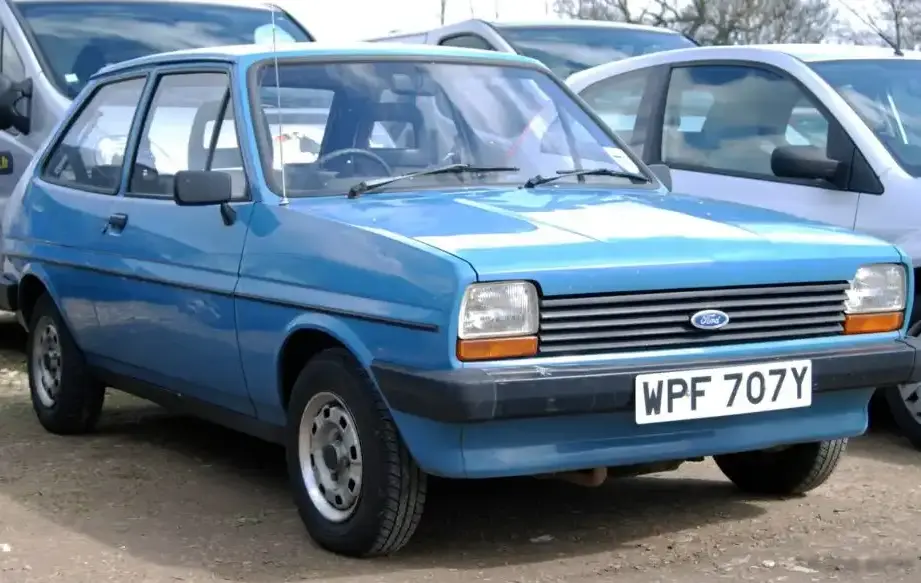
The Ford Fiesta Mk1, produced from 1976 to 1983, represented Ford of Europe’s entry into the burgeoning supermini segment. Responding to the success of rivals like the Fiat 127 and Renault 5, the Fiesta was designed as a completely new vehicle, rather than a derivative of an existing model. The 0.9-liter (45 horsepower) variant, introduced at the car’s launch, served as the foundational model for the Fiesta range, aimed at providing affordable and economical transportation for a broad customer base. It was a critical component in establishing the Fiesta as a popular choice in Europe, and later, in select export markets. This particular engine and trim level occupied the entry-level position within the Fiesta lineup, prioritizing fuel efficiency and low running costs over outright performance.
Technical Specifications
| Brand | Ford |
| Model | Fiesta |
| Generation | Fiesta I (Mk1) |
| Type (Engine) | 0.9 (45 Hp) |
| Start of Production | 1976 |
| End of Production | 1983 |
| Powertrain Architecture | Internal Combustion Engine |
| Body Type | Hatchback |
| Fuel Type | Petrol (Gasoline) |
| Power | 45 Hp |
| Engine Aspiration | Naturally Aspirated |
Powertrain & Engine Architecture
The heart of the Fiesta 0.9 was the 1300cc OHV (Overhead Valve) engine, though designated as a 957cc unit. This engine, internally known as the Kent engine family, was a simple and robust design. It featured a two-bearing crankshaft and a single camshaft operating the valves via pushrods. The engine utilized a single downdraft carburetor for fuel delivery, a common setup for the time, prioritizing simplicity and cost-effectiveness. The 45 horsepower output was achieved at 6000 rpm, with a modest 58 lb-ft of torque available at 3000 rpm. The engine was paired exclusively with a four-speed manual transmission in the early years, later offering a three-speed automatic option. The automatic transmission, while providing convenience, further reduced acceleration performance. The engine block was cast iron, contributing to its durability, while the cylinder head was aluminum, helping to reduce weight. The Kent engine, while not technologically advanced, was known for its reliability and ease of maintenance.
Driving Characteristics
The Fiesta 0.9L offered a decidedly unhurried driving experience. With a relatively low power-to-weight ratio, acceleration was slow, particularly with the automatic transmission. Zero to sixty mph times were in the region of 18-20 seconds, making it unsuitable for drivers seeking spirited performance. However, the Fiesta excelled in urban environments. The light steering and compact dimensions made it easy to maneuver in tight spaces, and the engine provided sufficient power for city driving. The four-speed manual transmission allowed for better control and slightly improved acceleration compared to the automatic. Gear ratios were relatively tall, prioritizing fuel economy over performance. The suspension, consisting of independent front suspension with MacPherson struts and a twist-beam rear axle, provided a comfortable, if somewhat basic, ride. The car felt nimble and responsive at lower speeds, but body roll was noticeable during cornering.
Equipment & Trim Levels
The base-level Fiesta 0.9 was sparsely equipped, reflecting its position as the entry-level model. Standard features included cloth upholstery, vinyl floor covering, and basic instrumentation consisting of a speedometer and fuel gauge. The steering wheel was a simple two-spoke design. Optional extras included a heater, a radio, and upgraded upholstery. Later models saw the introduction of slightly more refined trim levels, such as the ‘Popular’ and ‘L’ models, which added features like a passenger sun visor, a cigarette lighter, and more comfortable seats. The interior design was functional and utilitarian, prioritizing practicality over aesthetics. The dashboard was constructed from durable plastic and featured minimal ornamentation.
Chassis & Braking
The Fiesta Mk1 utilized a monocoque chassis construction, providing a good balance of strength and weight. The front suspension featured MacPherson struts with anti-roll bar, while the rear suspension employed a twist-beam axle. This setup provided a reasonable level of ride comfort and handling for a car in its class. Braking was initially provided by drum brakes on all four wheels. Later models, particularly the higher-spec trims, were upgraded with front disc brakes, offering improved stopping power. The braking system was hydraulically operated, providing a consistent pedal feel. Steering was rack and pinion, contributing to the car’s light and responsive handling. The Fiesta’s relatively lightweight construction helped to compensate for the modest braking performance.
Market Reception & Comparison
The Ford Fiesta 0.9L was generally well-received by critics and consumers alike. It was praised for its affordability, fuel efficiency, and ease of driving. However, its lack of power was a common criticism. Compared to rivals like the Fiat 127 and Renault 5, the Fiesta offered a slightly more refined driving experience, but its performance was generally comparable. The 1.1 and 1.3-liter versions of the Fiesta offered significantly more power and were favored by drivers who prioritized performance. The 0.9L model was particularly popular with first-time car buyers, families on a budget, and those who primarily used the car for short urban journeys. Fuel economy was a key selling point, averaging around 45-50 mpg. Reliability was generally good, although the carburetor required periodic adjustment and maintenance.
Legacy
The Fiesta Mk1 0.9L played a crucial role in establishing the Fiesta as a successful and enduring model in the Ford lineup. While the engine itself is now considered outdated, its simplicity and durability have ensured that many examples remain on the road today. The Fiesta Mk1 is now a popular choice among classic car enthusiasts, particularly those seeking an affordable and easy-to-maintain vintage vehicle. The 0.9-liter engine, while not powerful, is relatively easy to rebuild and maintain, making it a good option for those new to classic car ownership. The Fiesta Mk1’s impact on the supermini segment cannot be overstated. It set a new standard for affordability, practicality, and driving enjoyment, and paved the way for future generations of Ford Fiestas.