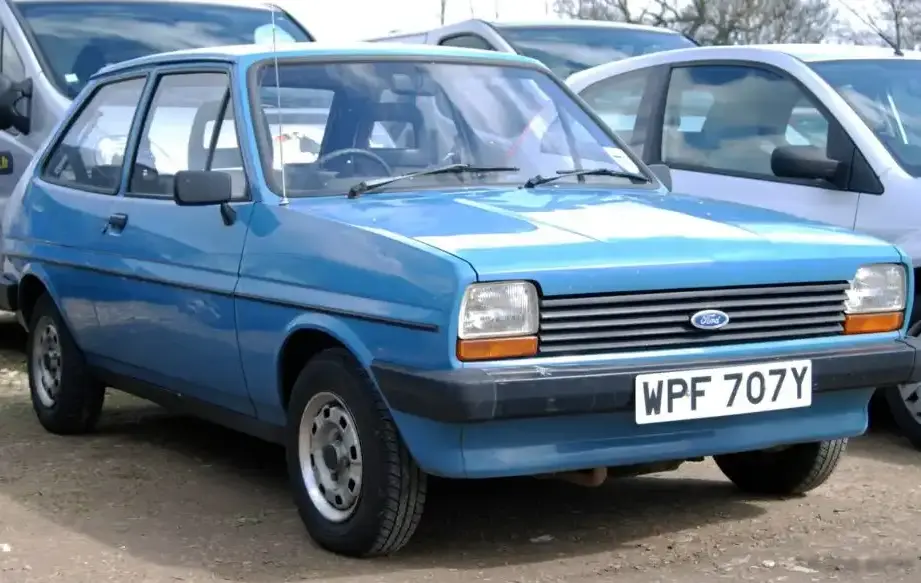
The Ford Fiesta Mk1 1.3, produced between 1977 and 1983, represents the entry point into the first generation of Ford’s globally successful supermini. Launched as a direct response to the rising popularity of small, fuel-efficient European cars like the Fiat 127 and Renault 5, the Fiesta was Ford’s first front-wheel-drive vehicle. The 1.3-liter variant, producing 66 horsepower, served as the mainstay of the range, offering affordable transportation for a broad customer base. It was a crucial model for Ford, establishing a foothold in a segment previously dominated by European manufacturers and laying the groundwork for the Fiesta’s enduring legacy. The Mk1 Fiesta, built primarily at Ford’s Valencia plant in Spain, was a significant departure from Ford’s traditional rear-wheel-drive offerings and played a key role in modernizing the company’s image.
Technical Specifications
| Brand | Ford |
| Model | Fiesta |
| Generation | Fiesta I (Mk1) |
| Type (Engine) | 1.3 (66 Hp) |
| Start of production | 1977 |
| End of production | 1983 |
| Powertrain Architecture | Internal Combustion engine |
| Body type | Hatchback |
| Fuel Type | Petrol (Gasoline) |
| Power | 66 Hp |
| Engine aspiration | Naturally aspirated engine |
Powertrain & Engine Architecture
The Fiesta Mk1 1.3 was powered by the Ford Valencia engine, an inline four-cylinder, naturally aspirated gasoline engine. Displacing 1,297 cc (79.1 cubic inches), the engine featured a cast iron block and an aluminum cylinder head. It utilized a single overhead camshaft (SOHC) design, operating two valves per cylinder. Fuel delivery was managed by a single Weber 32/36 DGV carburetor, a relatively simple and reliable system for the time. The engine’s modest 66 horsepower at 6,000 rpm and 78 lb-ft of torque at 3,000 rpm were sufficient for the Fiesta’s lightweight construction. The engine code is typically identified as 111A. The transmission offered was a four-speed manual, although a three-speed automatic transmission was available as an option, albeit less common. The automatic transmission, a Ford-built unit, was known for its smooth operation but contributed to slightly reduced fuel economy and acceleration compared to the manual version. The engine’s design prioritized fuel efficiency and durability over outright performance, reflecting the economic conditions and consumer preferences of the late 1970s and early 1980s.
Driving Characteristics
The Fiesta 1.3 offered a comfortable, if uninspiring, driving experience. Acceleration was adequate for city driving and short highway trips, with a 0-60 mph time of around 14-16 seconds. The four-speed manual transmission provided a reasonable spread of gears, allowing the engine to operate efficiently at cruising speeds. The automatic transmission, while convenient, noticeably dulled acceleration and required more frequent downshifts when overtaking. The Fiesta’s front-wheel-drive layout provided good traction in most conditions, and the steering was light and precise, making it easy to maneuver in tight spaces. The suspension, consisting of independent front struts and a twist-beam rear axle, offered a compliant ride, absorbing bumps and imperfections in the road surface reasonably well. However, the Fiesta’s small size and relatively narrow track width meant that it could feel susceptible to crosswinds at higher speeds. Compared to the later 1.6-liter versions, the 1.3 felt noticeably slower, particularly when fully loaded with passengers and luggage. The manual transmission version offered a more engaging driving experience, allowing drivers to exploit the engine’s limited power more effectively.
Equipment & Trim Levels
The Fiesta Mk1 1.3 was offered in a range of trim levels, including the base ‘Popular’, the mid-range ‘L’, and the more luxurious ‘GL’. The ‘Popular’ trim was very basic, featuring vinyl upholstery, minimal instrumentation, and steel wheels. The ‘L’ trim added features such as cloth upholstery, a more comprehensive instrument panel, and a heated rear window. The ‘GL’ trim offered the highest level of equipment, including a sunroof, upgraded interior trim, and optional alloy wheels. Standard features across most trims included front disc brakes, a four-speed manual transmission (automatic optional), and a basic AM radio. Optional extras included a radio/cassette player, a rear window wiper, and central locking. Interior colors were typically limited to shades of blue, brown, and grey. The dashboard layout was functional and straightforward, with clearly labeled controls. The Fiesta’s interior was relatively spacious for a car of its size, offering comfortable seating for four adults.
Chassis & Braking
The Fiesta Mk1 utilized a monocoque chassis construction, providing a good balance of strength and lightness. The front suspension featured independent MacPherson struts with anti-roll bar, while the rear suspension employed a simple twist-beam axle. Braking was initially provided by front disc brakes and rear drum brakes on most models. Later models, particularly the ‘GL’ trim, often featured rear disc brakes as standard equipment. The braking system was hydraulic, providing adequate stopping power for the Fiesta’s weight and performance. Steering was rack and pinion, offering precise and responsive handling. The Fiesta’s relatively lightweight construction contributed to its nimble handling characteristics. Tire size was typically 155/80R13. The suspension setup was tuned for comfort rather than outright performance, prioritizing a smooth ride over sharp handling.
Market Reception & Comparison
The Ford Fiesta Mk1 1.3 was generally well-received by critics and consumers alike. It was praised for its fuel efficiency, affordability, and ease of driving. However, some critics noted its modest performance and relatively basic interior. Compared to its rivals, such as the Fiat 127 and Renault 5, the Fiesta offered a more refined driving experience and a more spacious interior. The 1.3-liter engine provided adequate performance for most drivers, but those seeking more power often opted for the 1.6-liter version. Fuel economy was a strong point, averaging around 45-50 mpg in mixed driving conditions. Reliability was generally good, although the carburetor could occasionally require adjustment. The Fiesta’s relatively low price made it an attractive option for first-time car buyers and families on a budget. The automatic transmission version, while convenient, suffered from lower fuel economy and slower acceleration compared to the manual.
Legacy
The Ford Fiesta Mk1 1.3 remains a popular classic car today, appreciated for its simplicity, reliability, and affordability. The Valencia engine, while not particularly powerful, proved to be durable and long-lasting. Parts availability is generally good, although some trim-specific components can be difficult to find. The Fiesta Mk1 has a strong following among classic car enthusiasts, and well-maintained examples are increasingly sought after. The 1.3-liter engine is considered to be the most reliable and economical engine in the Mk1 Fiesta range. While not a performance icon, the Fiesta Mk1 1.3 played a crucial role in establishing the Fiesta as a global automotive success story and remains a fondly remembered example of 1970s and 1980s automotive design. The car’s enduring appeal lies in its practicality, affordability, and the nostalgic connection it holds for many drivers.