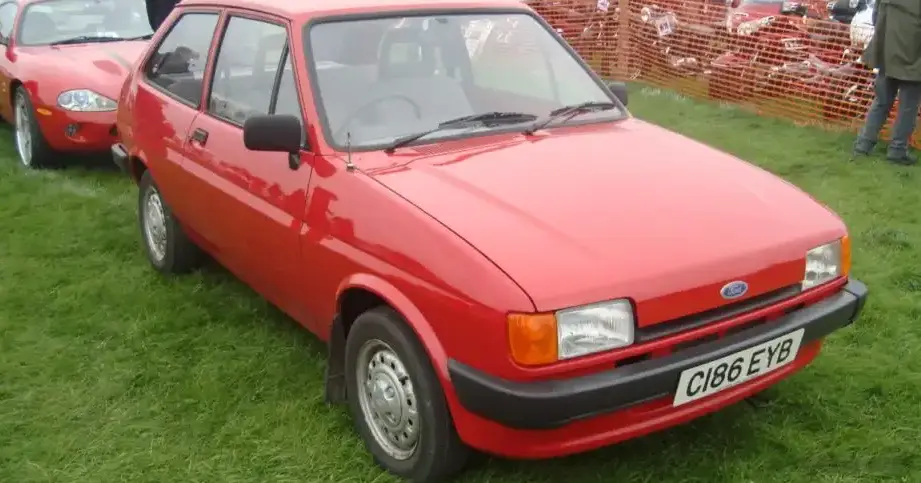
The Ford Fiesta Mk2, produced from 1983 to 1989, represented a significant evolution of Ford’s popular supermini. Within the Mk2 range, the 1.0-liter (FBD) variant, producing 45 horsepower, served as the entry-level model, aimed at budget-conscious buyers and those prioritizing fuel economy. This version played a crucial role in establishing the Fiesta as a mainstay in the European automotive market, offering affordable personal transportation during a period of economic change. The Fiesta Mk2, built upon the existing Mk1 platform with styling updates and mechanical refinements, quickly became a common sight on roads across Europe.
Technical Specifications
| Brand | Ford |
| Model | Fiesta |
| Generation | Fiesta II (Mk2) |
| Type (Engine) | 1.0 (FBD) (45 Hp) |
| Start of production | 1983 |
| End of production | 1989 |
| Powertrain Architecture | Internal Combustion engine |
| Body type | Hatchback |
| Seats | 5 |
| Doors | 3 |
| Fuel Type | Petrol (Gasoline) |
| Maximum speed | 145 km/h (90.1 mph) |
| Power | 45 Hp |
| Power per litre | 45.6 Hp/l |
| Engine layout | Front, Transverse |
| Engine Model/Code | FBD |
| Engine displacement | 987 cm3 (60.23 cu. in.) |
| Number of cylinders | 4 |
| Fuel injection system | Carburettor |
| Engine aspiration | Naturally aspirated engine |
| Engine oil capacity | 3.4 l (3.59 US qt | 2.99 UK qt) |
| Coolant | 5.3 l (5.6 US qt | 4.66 UK qt) |
Powertrain & Engine Architecture
The heart of the Fiesta 1.0 (FBD) was the 987cc, inline-four cylinder engine. This engine, designated the FBD code, was a continuation of the engine family used in the original Fiesta, but with minor revisions for improved efficiency and reliability. It utilized a single, downdraft carburetor for fuel delivery, a relatively simple system common for vehicles of this era. The engine featured a single overhead camshaft (SOHC) operating a two-valve per cylinder configuration. This design prioritized simplicity and low-end torque over outright power. The FBD engine was known for its robust construction, though its limited displacement and carbureted fuel system meant it wasn’t particularly sophisticated by the standards of the late 1980s. The engine was transversely mounted, driving the front wheels through a four-speed manual or, as in this case, a four-speed automatic transmission. The automatic transmission was a key feature of this variant, aiming to broaden its appeal to drivers seeking convenience.
Driving Characteristics
The 1.0-liter Fiesta with the automatic transmission offered a decidedly unhurried driving experience. With only 45 horsepower on tap, acceleration was modest, and overtaking required careful planning. The four-speed automatic transmission, while providing ease of use, further impacted performance, with relatively wide gear ratios. The automatic transmission was not known for its responsiveness, and often felt sluggish during kickdown maneuvers. However, the engine’s low-end torque made it reasonably tractable around town, and the light weight of the Fiesta helped to mitigate the power deficit. Fuel economy was a major strength, making it an attractive option for daily commuting. Compared to the 1.3-liter and 1.6-liter versions of the Fiesta Mk2, the 1.0-liter automatic was significantly slower and less refined, but it offered a lower purchase price and better fuel efficiency.
Equipment & Trim Levels
The 1.0-liter Fiesta, particularly in its base trim, was relatively sparsely equipped. Standard features typically included cloth upholstery, basic instrumentation (speedometer, fuel gauge, and temperature gauge), and a steering wheel. Power steering and central locking were generally not available on this base model. Optional extras included a radio, heated rear window, and upgraded interior trim. The interior design was functional and utilitarian, reflecting the car’s budget-oriented positioning. The dashboard layout was simple and easy to use, with clearly labeled controls. The Fiesta 1.0 automatic often came with a slightly more comprehensive trim level than the base manual version, sometimes including features like a basic stereo system as standard.
Chassis & Braking
The Fiesta Mk2 utilized a MacPherson strut front suspension and a twist-beam rear suspension. The suspension setup was tuned for comfort rather than outright handling prowess. The 1.0-liter models typically featured smaller tires and narrower wheels compared to the higher-spec versions. Braking was provided by disc brakes on the front wheels and drum brakes on the rear. The braking system was adequate for the car’s performance, but lacked the stopping power of more modern vehicles. Stabilizer bars were often omitted on the base 1.0-liter models, further contributing to a softer, more comfortable ride.
Market Reception & Comparison
The Fiesta 1.0 automatic was generally well-received as an affordable and economical city car. Critics acknowledged its lack of performance but praised its fuel efficiency and ease of driving. It was often compared to other small, budget-oriented hatchbacks of the era, such as the Vauxhall Nova and the Austin Metro. The 1.0-liter Fiesta typically offered better build quality and a more refined driving experience than its British rivals. However, it was often more expensive to purchase. Compared to the higher-powered Fiesta variants, the 1.0-liter automatic was seen as a compromise, sacrificing performance for economy and convenience.
Legacy
The Ford Fiesta Mk2 1.0 (FBD) automatic, while not a performance icon, holds a significant place in automotive history as a representative of affordable, practical transportation in the 1980s. The FBD engine proved to be remarkably durable, and many examples are still on the road today. In the used car market, these Fiestas are often sought after by enthusiasts looking for a classic, easy-to-maintain vehicle. While parts availability can be a challenge, the Fiesta’s simple mechanical design makes it relatively easy to repair. The automatic transmission, while not particularly advanced, has proven to be reasonably reliable. The Fiesta Mk2 1.0 automatic remains a testament to Ford’s ability to produce a well-built, economical, and enduring small car.