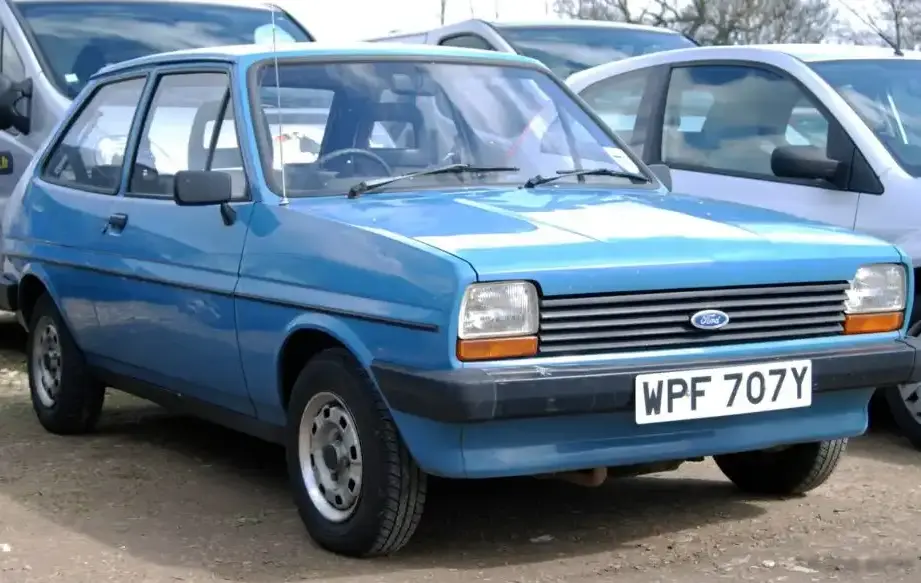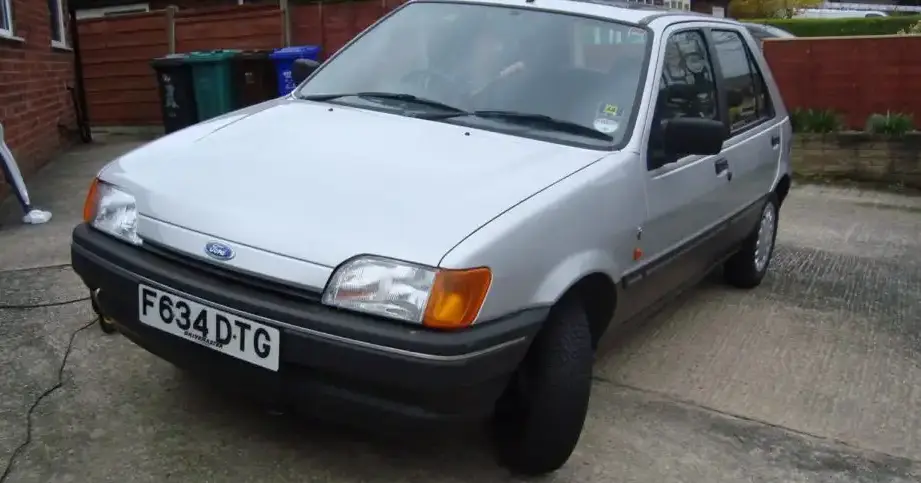
The Ford Fiesta Mk3, produced between 1989 and 1995, represented a significant evolution of Ford’s popular supermini. The 1.1-liter variant, delivering 50 horsepower, served as the entry point to the Mk3 range, particularly in European and some Commonwealth markets. Positioned as an affordable and economical option, it aimed at first-time buyers, city commuters, and those prioritizing fuel efficiency over outright performance. This model was built on the Ford B platform, shared with other small Ford vehicles of the era. It was a key player in the competitive small car segment, facing rivals like the Peugeot 205, Renault Clio, and Volkswagen Polo.
Technical Specifications
| Brand | Ford |
| Model | Fiesta |
| Generation | Fiesta III (Mk3) |
| Type (Engine) | 1.1 (50 Hp) |
| Start of production | 1989 |
| End of production | 1995 |
| Powertrain Architecture | Internal Combustion engine |
| Body type | Hatchback |
| Seats | 5 |
| Doors | 3 |
| Fuel consumption (combined) | 6.1 l/100 km (38.6 US mpg, 46.3 UK mpg, 16.4 km/l) |
| Fuel Type | Petrol (Gasoline) |
| Acceleration 0 – 100 km/h | 19.1 sec |
| Acceleration 0 – 62 mph | 19.1 sec |
| Acceleration 0 – 60 mph | 18.1 sec |
| Maximum speed | 143 km/h (88.86 mph) |
| Weight-to-power ratio | 16.9 kg/Hp, 59.2 Hp/tonne |
| Weight-to-torque ratio | 10.2 kg/Nm, 98.2 Nm/tonne |
| Power | 50 Hp @ 5200 rpm |
| Power per litre | 44.7 Hp/l |
| Torque | 83 Nm @ 3000 rpm (61.22 lb.-ft. @ 3000 rpm) |
| Engine layout | Front, Transverse |
| Engine Model/Code | G6A |
| Engine displacement | 1119 cm3 (68.29 cu. in.) |
| Number of cylinders | 4 |
| Engine configuration | Inline |
| Cylinder Bore | 68.7 mm (2.7 in.) |
| Piston Stroke | 75.5 mm (2.97 in.) |
| Compression ratio | 8.8:1 |
| Number of valves per cylinder | 2 |
| Fuel injection system | Single-point injection |
| Engine aspiration | Naturally aspirated |
| Engine oil capacity | 3.25 l (3.43 US qt | 2.86 UK qt) |
| Coolant | 7.1 l (7.5 US qt | 6.25 UK qt) |
| Kerb Weight | 845 kg (1862.91 lbs.) |
| Max. weight | 1325 kg (2921.12 lbs.) |
| Max load | 480 kg (1058.22 lbs.) |
| Trunk (boot) space – minimum | 250 l (8.83 cu. ft.) |
| Trunk (boot) space – maximum | 625 l (22.07 cu. ft.) |
| Fuel tank capacity | 42 l (11.1 US gal | 9.24 UK gal) |
| Length | 3743 mm (147.36 in.) |
| Width | 1606 mm (63.23 in.) |
| Height | 1379 mm (54.29 in.) |
| Wheelbase | 2446 mm (96.3 in.) |
| Front track | 1392 mm (54.8 in.) |
| Rear (Back) track | 1384 mm (54.49 in.) |
| Drivetrain Architecture | The Internal combustion engine (ICE) drives the front wheels of the vehicle. |
| Drive wheel | Front wheel drive |
| Number of gears and type of gearbox | 5 gears, manual transmission |
| Front suspension | Wishbone |
| Rear suspension | Coil spring |
| Front brakes | Disc |
| Rear brakes | Drum |
| Assisting systems | ABS (Anti-lock braking system) |
| Steering type | Steering rack and pinion |
| Tires size | 155/70 R13 |
Introduction
The Fiesta Mk3 1.1 represented the base model of the third-generation Fiesta lineup, produced from 1989 to 1995. It was designed to offer affordable transportation in a rapidly evolving automotive market. The Mk3 Fiesta was a significant departure from its predecessor, featuring a more rounded and aerodynamic design. The 1.1-liter engine, while modest in output, was known for its reliability and fuel economy, making it a popular choice for budget-conscious buyers. This variant was primarily sold in Europe, Australia, and other markets where smaller, fuel-efficient cars were in high demand.
Powertrain & Engine Architecture
The heart of the Fiesta Mk3 1.1 was the Ford G6A engine, a 1.1-liter inline-four cylinder petrol engine. This engine featured a single overhead camshaft (SOHC) and two valves per cylinder. The G6A utilized a single-point fuel injection system (SPI), a relatively simple and cost-effective technology for the time. This system injected fuel into the intake manifold rather than directly into the cylinders, contributing to its lower cost but also resulting in slightly lower efficiency compared to multi-point injection. The engine produced 50 horsepower at 5200 rpm and 83 Nm (61.22 lb-ft) of torque at 3000 rpm. The engine’s relatively low compression ratio of 8.8:1 was a design choice aimed at allowing the engine to run on lower octane fuel, common in many markets. The standard transmission was a five-speed manual gearbox, although a three-speed automatic transmission was offered as an option, albeit less common. The automatic transmission was a Ford-sourced unit, known for its durability but also for its relatively slow shift times.
Driving Characteristics
The Fiesta Mk3 1.1, particularly in its manual transmission guise, offered a basic but functional driving experience. Acceleration was leisurely, taking over 19 seconds to reach 60 mph. The engine felt strained at higher speeds, and overtaking required careful planning. The five-speed manual gearbox helped to keep the engine in its optimal power band, but the overall performance was geared towards economy rather than excitement. The automatic version further diminished performance, with noticeably slower acceleration and a tendency to hunt for gears. The steering was light and precise, making it easy to maneuver in urban environments. The suspension, while simple, provided a reasonably comfortable ride, absorbing bumps and imperfections in the road surface adequately. The car’s light weight contributed to its nimble handling, making it enjoyable to drive on twisty roads, despite its limited power.
Equipment & Trim Levels
The Fiesta Mk3 1.1 typically came with a basic level of equipment. Standard features included cloth upholstery, a basic instrument cluster, and manual windows and door locks. The interior was functional and durable, prioritizing practicality over luxury. Optional extras included a sunroof, central locking, and upgraded audio systems. Trim levels varied depending on the market, but generally, the 1.1-liter model represented the entry-level specification. Later models saw the introduction of minor cosmetic upgrades, such as revised dashboard trim and seat fabrics.
Chassis & Braking
The Fiesta Mk3 utilized a front-wheel-drive layout with a MacPherson strut front suspension and a twist-beam rear suspension. The front brakes were disc brakes, providing adequate stopping power, while the rear brakes were drum brakes, a cost-saving measure common in this class of vehicle. ABS (Anti-lock Braking System) was available as an option, enhancing safety in emergency braking situations. The steering was a rack and pinion system, providing precise and responsive steering feel. The car’s relatively light weight contributed to its agile handling characteristics.
Market Reception & Comparison
The Fiesta Mk3 1.1 was generally well-received as an affordable and reliable city car. Critics praised its fuel economy and ease of driving, but noted its lack of performance. Compared to higher-spec Fiesta models, such as the 1.6-liter versions, the 1.1-liter variant offered significantly less power and refinement. However, it was considerably cheaper to buy and run, making it an attractive option for budget-conscious buyers. Compared to rivals like the Peugeot 205 and Renault Clio, the Fiesta Mk3 1.1 offered a similar level of practicality and economy, but was often perceived as being slightly less stylish.
Legacy
The Fiesta Mk3 1.1, while not a performance icon, proved to be a durable and reliable vehicle. The G6A engine, despite its simplicity, was known for its longevity, and many examples are still on the road today. The car’s affordability and low running costs have made it a popular choice for classic car enthusiasts and those seeking a cheap and cheerful runaround. In the used car market, the Fiesta Mk3 1.1 remains a relatively affordable option, although well-maintained examples are becoming increasingly rare. Its legacy lies in providing affordable and reliable transportation to a generation of drivers, cementing the Fiesta’s reputation as a popular and practical supermini.