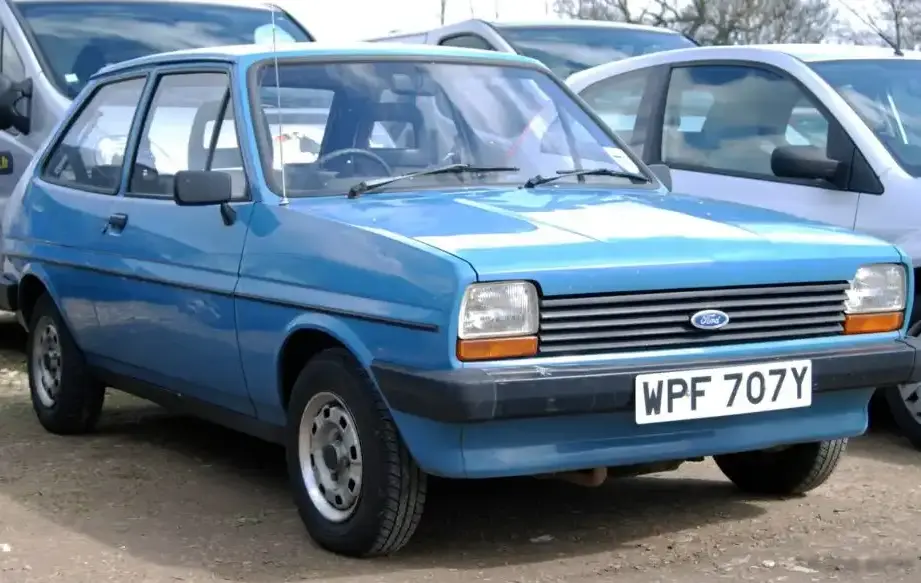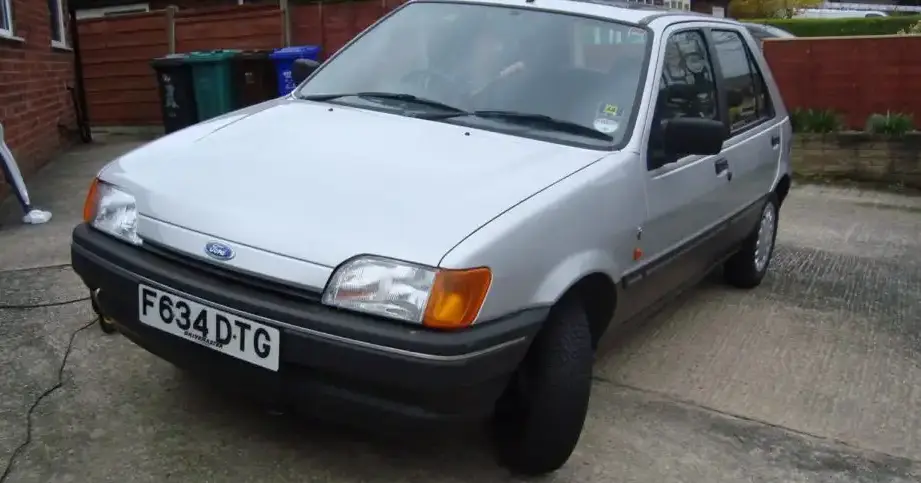
The Ford Fiesta Mk3, produced between 1989 and 1995, represented a significant evolution of Ford’s popular supermini. The 1.1-liter variant, delivering 55 horsepower, served as the entry point to the Mk3 Fiesta range, particularly in European and some Commonwealth markets. Positioned as an affordable and economical option, it catered to buyers prioritizing fuel efficiency and low running costs over outright performance. This model played a crucial role in maintaining the Fiesta’s position as one of the best-selling small cars in Europe during the early 1990s. The Mk3 Fiesta, built on the platform code 1HX0, offered improved refinement and a more modern interior compared to its predecessor.
Technical Specifications
| Brand | Ford |
| Model | Fiesta |
| Generation | Fiesta III (Mk3) |
| Type (Engine) | 1.1 (55 Hp) |
| Start of production | 1989 |
| End of production | 1995 |
| Powertrain Architecture | Internal Combustion engine |
| Body type | Hatchback |
| Seats | 5 |
| Doors | 3/5 |
| Fuel consumption (urban) | 6.7 l/100 km (35.1 US mpg, 42.2 UK mpg, 14.9 km/l) |
| Fuel consumption (extra urban) | 5.5 l/100 km (42.8 US mpg, 51.4 UK mpg, 18.2 km/l) |
| Fuel consumption (combined) | 6.1 l/100 km (38.6 US mpg, 46.3 UK mpg, 16.4 km/l) |
| Fuel Type | Petrol (Gasoline) |
| Acceleration 0 – 100 km/h | 18.6 sec |
| Acceleration 0 – 62 mph | 18.6 sec |
| Acceleration 0 – 60 mph | 17.7 sec |
| Maximum speed | 180 km/h (111.85 mph) |
| Weight-to-power ratio | 15.4 kg/Hp, 65.1 Hp/tonne |
| Power | 55 Hp |
| Power per litre | 49.2 Hp/l |
| Engine layout | Front, Transverse |
| Engine Model/Code | GUD, GUE |
| Engine displacement | 1118 cm3 (68.22 cu. in.) |
| Number of cylinders | 4 |
| Engine configuration | Inline |
| Number of valves per cylinder | 2 |
| Fuel injection system | Single-point injection |
| Engine aspiration | Naturally aspirated engine |
| Engine oil capacity | 3.25 l (3.43 US qt, 2.86 UK qt) |
| Coolant capacity | 7.1 l (7.5 US qt, 6.25 UK qt) |
| Kerb Weight | 845 kg (1862.91 lbs.) |
| Max. weight | 1325 kg (2921.12 lbs.) |
| Max load | 480 kg (1058.22 lbs.) |
| Trunk (boot) space – minimum | 250 l (8.83 cu. ft.) |
| Trunk (boot) space – maximum | 625 l (22.07 cu. ft.) |
| Fuel tank capacity | 42 l (11.1 US gal, 9.24 UK gal) |
| Length | 3743 mm (147.36 in.) |
| Width | 1606 mm (63.23 in.) |
| Height | 1379 mm (54.29 in.) |
| Wheelbase | 2446 mm (96.3 in.) |
| Front track | 1392 mm (54.8 in.) |
| Rear track | 1384 mm (54.49 in.) |
| Drivetrain Architecture | Front wheel drive |
| Number of gears | 5 |
| Gearbox type | Manual transmission |
| Front suspension | Wishbone |
| Rear suspension | Coil spring |
| Front brakes | Disc |
| Rear brakes | Drum |
| Tires size | 155/70 R13 |
| Wheel rims size | 13 |
Powertrain & Engine Architecture
The heart of the Fiesta 1.1 was the Ford GUD or GUE engine, a 1.1-liter inline-four cylinder petrol engine. This engine featured a single overhead camshaft (SOHC) operating two valves per cylinder. The GUD engine was initially used, later replaced by the GUE which featured minor improvements. Fuel delivery was handled by a single-point fuel injection system, a relatively simple setup compared to the multi-point injection systems becoming more common at the time. This system, while contributing to the engine’s affordability, resulted in slightly less precise fuel metering and a modest power output. The engine’s relatively low compression ratio and conservative tuning prioritized fuel economy and reliability over performance. The 5-speed manual transmission was standard, offering a reasonably wide range of gear ratios designed to maximize the engine’s efficiency.
Driving Characteristics
The 1.1-liter Fiesta was not designed for spirited driving. Acceleration was leisurely, taking approximately 18.6 seconds to reach 62 mph. The engine felt strained at higher speeds, and overtaking required careful planning. However, within urban environments, the Fiesta 1.1 proved to be a nimble and easy-to-drive vehicle. The light steering and compact dimensions made maneuvering in tight spaces a breeze. The gear ratios were well-suited to city driving, providing adequate acceleration from low speeds. Compared to the more powerful 1.4 and 1.6-liter versions, the 1.1 offered a significantly more economical driving experience, but at the expense of performance. The manual transmission, while not particularly sporty, was precise and easy to use.
Equipment & Trim Levels
The 1.1-liter Fiesta typically represented the base trim level. Standard equipment generally included basic cloth upholstery, a simple dashboard layout, and manual windows and door locks. Central locking and power steering were often optional extras. Higher trim levels, such as the LX, added features like upgraded interior trim, a better stereo system, and sometimes alloy wheels. The 1.1 was often seen as a practical and functional vehicle, with a focus on providing basic transportation rather than luxury features. Optional extras were available, allowing buyers to customize their Fiesta to some extent, but the 1.1 remained the most affordable and sparsely equipped model in the range.
Chassis & Braking
The Fiesta Mk3 utilized a relatively simple chassis design. Front suspension consisted of independent wishbones, while the rear employed a twist-beam axle with coil springs. This setup provided a comfortable ride quality, although handling was not particularly sharp. Braking was typically accomplished with front disc brakes and rear drum brakes. The braking system was adequate for the car’s performance, but lacked the stopping power of more advanced systems found on higher-spec models. Stabilizer bars were often omitted on the base 1.1 model, further contributing to a softer, more comfort-oriented ride.
Market Reception & Comparison
The Fiesta 1.1 was generally well-received as an affordable and economical city car. Critics praised its fuel efficiency and ease of driving, but noted its lack of performance. Compared to other small cars of the era, such as the Peugeot 205 and the Renault Clio, the Fiesta 1.1 offered a competitive price point and a reputation for reliability. However, it lagged behind these rivals in terms of handling and refinement. Within the Fiesta lineup, the 1.1 served as a stepping stone for buyers who prioritized cost savings over driving enjoyment. The 1.4 and 1.6-liter models offered significantly more power and a more engaging driving experience, but at a higher price.
Legacy
The Ford Fiesta Mk3 1.1, while not a performance icon, remains a popular choice among classic car enthusiasts and budget-conscious buyers. The GUD/GUE engine is known for its durability and relative simplicity, making it relatively easy to maintain. However, age-related issues such as corrosion and wear and tear on rubber components are common. Today, well-maintained examples of the Fiesta 1.1 can be found for relatively low prices, making them an affordable entry point into classic car ownership. The model’s enduring appeal lies in its practicality, fuel efficiency, and the nostalgic charm of a classic Ford supermini.