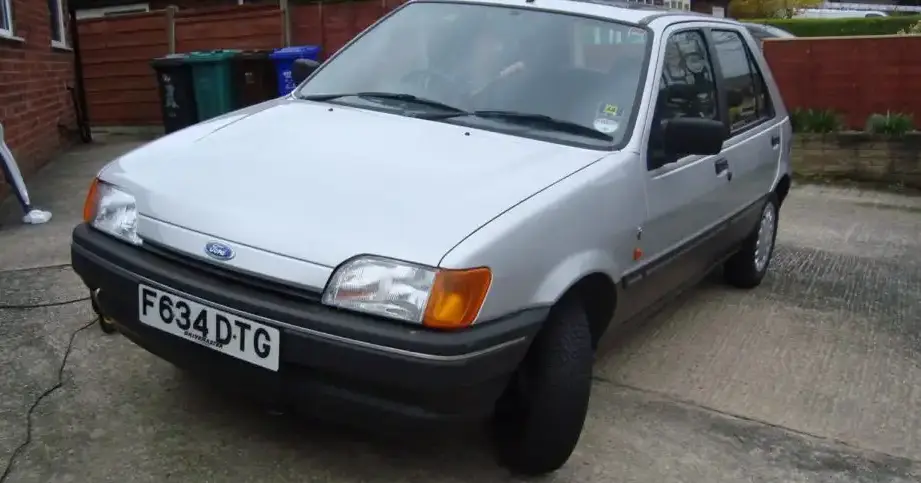
The Ford Fiesta Mk3, produced between 1989 and 1995, represented a significant evolution of Ford’s popular supermini. The 1.4-liter (73 hp) variant, often equipped with a four or five-speed manual transmission, occupied a central position in the Mk3 Fiesta lineup, offering a balance between affordability, fuel economy, and usability. This model served as a practical and accessible option for a broad range of buyers in Europe, where the Fiesta was a dominant force in the small car segment. While not the sportiest or most luxurious trim, the 1.4 Fiesta provided a reliable and economical means of transportation for many.
Technical Specifications
| Brand | Ford |
| Model | Fiesta |
| Generation | Fiesta III (Mk3) |
| Type (Engine) | 1.4 (73 Hp) |
| Start of production | 1989 |
| End of production | 1995 |
| Powertrain Architecture | Internal Combustion engine |
| Body type | Hatchback |
| Seats | 5 |
| Doors | 3/5 |
| Fuel consumption (combined) | 7.5 l/100 km |
| Fuel consumption (US mpg) | 31.4 US mpg |
| Fuel consumption (UK mpg) | 37.7 UK mpg |
| Fuel consumption (km/l) | 13.3 km/l |
| Fuel Type | Petrol (Gasoline) |
| Acceleration 0 – 100 km/h | 12.8 sec |
| Acceleration 0 – 62 mph | 12.8 sec |
| Acceleration 0 – 60 mph | 12.2 sec |
| Maximum speed | 167 km/h (103.77 mph) |
| Weight-to-power ratio | 12.2 kg/Hp |
| Weight-to-torque ratio | 8.4 kg/Nm |
| Power | 73 Hp @ 5100 rpm |
| Power per litre | 52.4 Hp/l |
| Torque | 106 Nm @ 2750 rpm (78.18 lb.-ft. @ 2750 rpm) |
| Engine layout | Front, Transverse |
| Engine Model/Code | F4A, FUG, FUJ |
| Engine displacement | 1392 cm3 (84.95 cu. in.) |
| Number of cylinders | 4 |
| Engine configuration | Inline |
| Cylinder Bore | 77.2 mm (3.04 in.) |
| Piston Stroke | 74.3 mm (2.93 in.) |
| Compression ratio | 9.5:1 |
| Number of valves per cylinder | 2 |
| Fuel injection system | Multi-port manifold injection |
| Engine aspiration | Naturally aspirated engine |
| Valvetrain | OHC |
| Engine oil capacity | 3.5 l (3.7 US qt | 3.08 UK qt) |
| Coolant capacity | 7 l (7.4 US qt | 6.16 UK qt) |
| Kerb Weight | 890 kg (1962.11 lbs.) |
| Max. weight | 1375 kg (3031.36 lbs.) |
| Max load | 485 kg (1069.24 lbs.) |
| Trunk (boot) space – minimum | 250 l (8.83 cu. ft.) |
| Trunk (boot) space – maximum | 625 l (22.07 cu. ft.) |
| Fuel tank capacity | 42 l (11.1 US gal | 9.24 UK gal) |
| Length | 3743 mm (147.36 in.) |
| Width | 1606 mm (63.23 in.) |
| Height | 1379 mm (54.29 in.) |
| Wheelbase | 2446 mm (96.3 in.) |
| Front track | 1392 mm (54.8 in.) |
| Rear track | 1384 mm (54.49 in.) |
| Drivetrain Architecture | Front wheel drive |
| Number of gears | 5 gears, manual transmission |
| Front suspension | Wishbone |
| Rear suspension | Coil spring |
| Front brakes | Disc |
| Rear brakes | Drum |
| Assisting systems | ABS (Anti-lock braking system) |
| Steering type | Steering rack and pinion |
| Tires size | 165/65 R13 |
Introduction
The Ford Fiesta Mk3 1.4 (73 hp) was a mainstay of the Ford lineup from 1989 to 1995. Built on the 1HX0/A3 platform, it represented a significant refinement over the Mk2, offering improved styling, interior space, and mechanical reliability. This particular variant, powered by the 1.4-liter engine, was positioned as a practical and economical choice for buyers seeking a versatile supermini. It was commonly available in both three-door and five-door body styles, catering to different needs and preferences. The 1.4L engine was a popular choice, offering a good balance between performance and fuel efficiency.
Powertrain & Engine Architecture
The heart of the Fiesta Mk3 1.4 was the Ford F4A, FUG, or FUJ engine, a 1392cc inline-four cylinder unit. This engine featured a single overhead camshaft (OHC) valvetrain with two valves per cylinder. Fuel delivery was handled by a multi-port fuel injection system, contributing to improved efficiency and reduced emissions compared to earlier carbureted models. The engine produced 73 horsepower at 5100 rpm and 106 Nm (78.18 lb-ft) of torque at 2750 rpm. The engine’s relatively simple design made it relatively easy to maintain. The five-speed manual transmission was the most common pairing, offering a good spread of gears for both urban driving and highway cruising. The transmission was known for its light shift action and durability.
Driving Characteristics
The Fiesta Mk3 1.4, with its 73 hp output, wasn’t designed for outright speed. Acceleration from 0 to 60 mph took around 12.2 seconds, and the top speed was approximately 103.77 mph. However, the engine provided adequate power for everyday driving, with a usable torque curve that made it reasonably responsive in most situations. Compared to the more powerful 1.6-liter versions, the 1.4 felt less strained at higher speeds, and the fuel economy was noticeably better. The manual transmission allowed for precise control, and the gear ratios were well-suited to the engine’s characteristics. While not as engaging as some of its rivals, the Fiesta Mk3 1.4 offered a comfortable and predictable driving experience.
Equipment & Trim Levels
The 1.4-liter Fiesta typically came with a modest level of standard equipment. Basic models featured cloth upholstery, a simple dashboard layout, and manual windows and door locks. Higher trim levels, such as the LX or Ghia, added features like central locking, electric windows, a sunroof, and upgraded interior trim. Optional extras included a radio/cassette player, alloy wheels, and metallic paint. The interior was functional and well-built, although the materials were generally basic. The Fiesta Mk3 offered a surprisingly spacious cabin for a supermini, with adequate room for five passengers.
Chassis & Braking
The Fiesta Mk3 utilized a front-wheel-drive layout with independent wishbone suspension at the front and a coil spring rear suspension. This setup provided a comfortable ride and decent handling characteristics. The steering was rack and pinion, offering precise and responsive control. Braking duties were handled by disc brakes at the front and drum brakes at the rear. Anti-lock braking system (ABS) was available as an option on some models, enhancing safety. The suspension was tuned for comfort, but it also provided adequate stability in corners. The relatively light weight of the Fiesta Mk3 contributed to its nimble handling.
Market Reception & Comparison
The Fiesta Mk3 1.4 was generally well-received by critics and buyers alike. It was praised for its practicality, fuel economy, and reliability. Compared to other superminis of the era, such as the Peugeot 205 and the Renault Clio, the Fiesta offered a good balance of features and value. The 1.4-liter engine was considered a good compromise between performance and economy, making it a popular choice for those who didn’t need the extra power of the 1.6-liter models. However, some critics noted that the interior was somewhat bland and that the ride could be a bit firm on rough roads.
Legacy
The Ford Fiesta Mk3 1.4 has proven to be a remarkably durable and reliable vehicle. Many examples are still on the road today, testament to the quality of its engineering and construction. The 1.4-liter engine is known for its longevity, and parts are readily available. In the used car market, the Fiesta Mk3 1.4 remains an affordable and practical option for those seeking a classic supermini. Its simplicity and ease of maintenance make it a popular choice for enthusiasts and first-time car owners. The Fiesta Mk3 1.4 holds a significant place in automotive history as a quintessential example of a well-rounded and dependable small car.