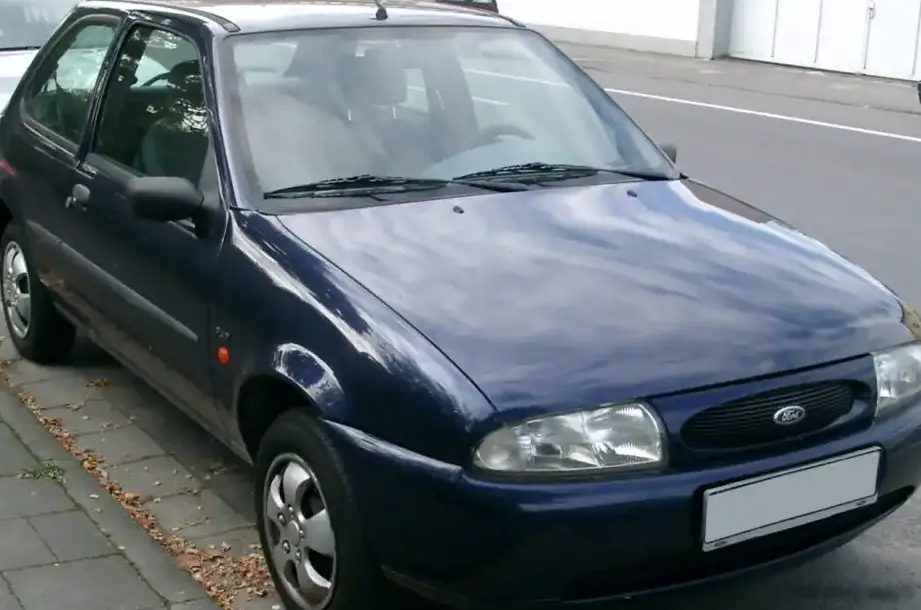
The Ford Fiesta Mk4, produced between 1995 and 2002, represented a significant step forward for Ford’s supermini offering. The 3-door 1.25i 16V variant with a Continuously Variable Transmission (CVT), manufactured from 1997 to 1999, occupied the entry-level to mid-range position within the Mk4 Fiesta lineup. This model aimed to provide affordable and economical transportation, appealing to buyers prioritizing fuel efficiency and ease of driving over outright performance. It was a key component of Ford’s strategy to offer a diverse range of Fiesta models to cater to varying customer needs in the European market.
Technical Specifications
| Brand | Ford |
| Model | Fiesta |
| Generation | Fiesta IV (Mk4) 3 door |
| Type (Engine) | 1.25i 16V (75 Hp) CVT |
| Start of production | 1997 year |
| End of production | 1999 year |
| Powertrain Architecture | Internal Combustion engine |
| Body type | Hatchback |
| Seats | 5 |
| Doors | 3 |
| Fuel consumption (economy) – combined | 7.1 l/100 km |
| Fuel consumption (economy) – combined | 33.1 US mpg |
| Fuel consumption (economy) – combined | 39.8 UK mpg |
| Fuel consumption (economy) – combined | 14.1 km/l |
| CO2 emissions | 167 g/km |
| Fuel Type | Petrol (Gasoline) |
| Acceleration 0 – 100 km/h | 15.6 sec |
| Acceleration 0 – 62 mph | 15.6 sec |
| Acceleration 0 – 60 mph | 14.8 sec |
| Maximum speed | 160 km/h |
| Maximum speed | 99.42 mph |
| Weight-to-power ratio | 13.5 kg/Hp |
| Weight-to-power ratio | 73.9 Hp/tonne |
| Weight-to-torque ratio | 9.2 kg/Nm |
| Weight-to-torque ratio | 108.4 Nm/tonne |
| Power | 75 Hp @ 5500 rpm |
| Power per litre | 60.4 Hp/l |
| Torque | 110 Nm @ 4200 rpm |
| Torque | 81.13 lb.-ft. @ 4200 rpm |
| Engine layout | Front, Transverse |
| Engine Model/Code | DHA, DHB, DHC, DHD, DHE, DHF, DHG |
| Engine displacement | 1242 cm3 |
| Engine displacement | 75.79 cu. in. |
| Number of cylinders | 4 |
| Engine configuration | Inline |
| Cylinder Bore | 71.9 mm |
| Cylinder Bore | 2.83 in. |
| Piston Stroke | 76.5 mm |
| Piston Stroke | 3.01 in. |
| Compression ratio | 10:1 |
| Number of valves per cylinder | 4 |
| Fuel injection system | Multi-port manifold injection |
| Engine aspiration | Naturally aspirated engine |
| Valvetrain | DOHC |
| Engine oil capacity | 4 l |
| Engine oil capacity | 4.23 US qt | 3.52 UK qt |
| Coolant | 6 l |
| Coolant | 6.34 US qt | 5.28 UK qt |
| Kerb Weight | 1015-1038 kg |
| Kerb Weight | 2237.69 – 2288.4 lbs. |
| Max. weight | 1415-1450 kg |
| Max. weight | 3119.54 – 3196.7 lbs. |
| Max load | 400-412 kg |
| Max load | 881.85 – 908.3 lbs. |
| Trunk (boot) space – minimum | 250 l |
| Trunk (boot) space – minimum | 8.83 cu. ft. |
| Trunk (boot) space – maximum | 930 l |
| Trunk (boot) space – maximum | 32.84 cu. ft. |
| Fuel tank capacity | 42 l |
| Fuel tank capacity | 11.1 US gal | 9.24 UK gal |
| Max. roof load | 75 kg |
| Max. roof load | 165.35 lbs. |
| Permitted trailer load with brakes (12%) | 600 kg |
| Permitted trailer load with brakes (12%) | 1322.77 lbs. |
| Permitted trailer load without brakes | 310 kg |
| Permitted trailer load without brakes | 683.43 lbs. |
| Length | 3828 mm |
| Length | 150.71 in. |
| Width | 1634 mm |
| Width | 64.33 in. |
| Height | 1334 mm |
| Height | 52.52 in. |
| Wheelbase | 2446 mm |
| Wheelbase | 96.3 in. |
| Front track | 1429 mm |
| Front track | 56.26 in. |
| Rear (Back) track | 1384 mm |
| Rear (Back) track | 54.49 in. |
| Minimum turning circle (turning diameter) | 9.9 m |
| Minimum turning circle (turning diameter) | 32.48 ft. |
| Drive wheel | Front wheel drive |
| Number of gears and type of gearbox | 1 gears, automatic transmission CVT |
| Front suspension | Independent type McPherson |
| Rear suspension | Torsion |
| Front brakes | Disc |
| Rear brakes | Drum |
| Assisting systems | ABS (Anti-lock braking system) |
| Steering type | Steering rack and pinion |
| Power steering | Hydraulic Steering |
| Tires size | 165/70 R13; 185/55 R14 |
| Wheel rims size | 13; 14 |
Powertrain & Engine Architecture
The heart of this Fiesta variant is the 1.25-liter, inline-four cylinder engine, typically identified by engine codes DHA, DHB, DHC, DHD, DHE, DHF, or DHG. This engine features a single overhead camshaft (SOHC) design with four valves per cylinder (16V), contributing to improved breathing and efficiency. Fuel delivery is managed by a multi-port fuel injection system, providing precise fuel metering for optimal combustion. The engine produces 75 horsepower at 5500 rpm and 81.13 lb-ft of torque at 4200 rpm. The key differentiating factor is the use of a Continuously Variable Transmission (CVT). Unlike traditional automatic transmissions with fixed gear ratios, a CVT provides a seamless and stepless gear change, theoretically optimizing engine speed for efficiency or power as needed. This particular CVT was sourced from Jatco, a well-known manufacturer of CVT technology.
Driving Characteristics
The 1.25i CVT Fiesta offered a smooth and relaxed driving experience, prioritizing comfort over sporty performance. The CVT, while efficient, resulted in a noticeable difference in driving feel compared to the available five-speed manual transmission. Acceleration was relatively slow, with a 0-60 mph time of around 14.8 seconds. The CVT tended to hold the engine at a consistent RPM during acceleration, which could feel somewhat ‘droning’ to drivers accustomed to traditional gear changes. However, this characteristic also made the car very easy to drive in stop-and-go traffic. The lack of distinct gear shifts contributed to a more refined and less jerky ride. Compared to the more powerful 1.4 or 1.6-liter versions, this variant lacked the punch for quick overtaking maneuvers or spirited driving.
Equipment & Trim Levels
The 1.25i 16V CVT typically came equipped with basic but functional features. Standard equipment included power steering, central locking, and an AM/FM radio. Interior upholstery was typically cloth, with a relatively simple dashboard layout. Optional extras included power windows, a sunroof, and upgraded audio systems. Trim levels varied slightly depending on the market, but generally, this variant represented a step up from the base model, offering a degree of convenience and comfort without the expense of higher-spec trims.
Chassis & Braking
The Fiesta Mk4 utilized a McPherson strut independent suspension at the front and a torsion beam suspension at the rear. This setup provided a reasonable balance between ride comfort and handling. Braking was typically accomplished with disc brakes on the front wheels and drum brakes on the rear. Anti-lock Braking System (ABS) was often included as standard equipment, enhancing safety. The relatively lightweight nature of the car, with a kerb weight of between 1015-1038 kg, helped to mitigate the effects of the less powerful engine and drum brakes on the rear axle.
Market Reception & Comparison
The 1.25i CVT Fiesta was generally well-received as an affordable and economical city car. Critics praised its fuel efficiency and ease of driving, particularly for novice drivers or those seeking a comfortable commute. However, the CVT transmission was a point of contention for some, with some reviewers finding it less engaging than a traditional manual gearbox. Compared to the 1.4-liter and 1.6-liter variants, the 1.25i offered lower running costs but sacrificed performance. The 1.8 Zetec models, with their more powerful engines and sportier suspension, appealed to a different segment of the market.
Legacy
The 1.25i 16V CVT Fiesta Mk4 has proven to be a relatively reliable vehicle, with the engine and CVT transmission generally holding up well over time. However, as with any older vehicle, regular maintenance is crucial. Common issues include wear and tear on suspension components and potential corrosion, particularly in regions with harsh winters. In the used car market, these models are often sought after as affordable and economical transportation, particularly by first-time car buyers or those on a tight budget. While not a performance icon, the 1.25i CVT Fiesta Mk4 represents a practical and dependable choice for everyday driving.