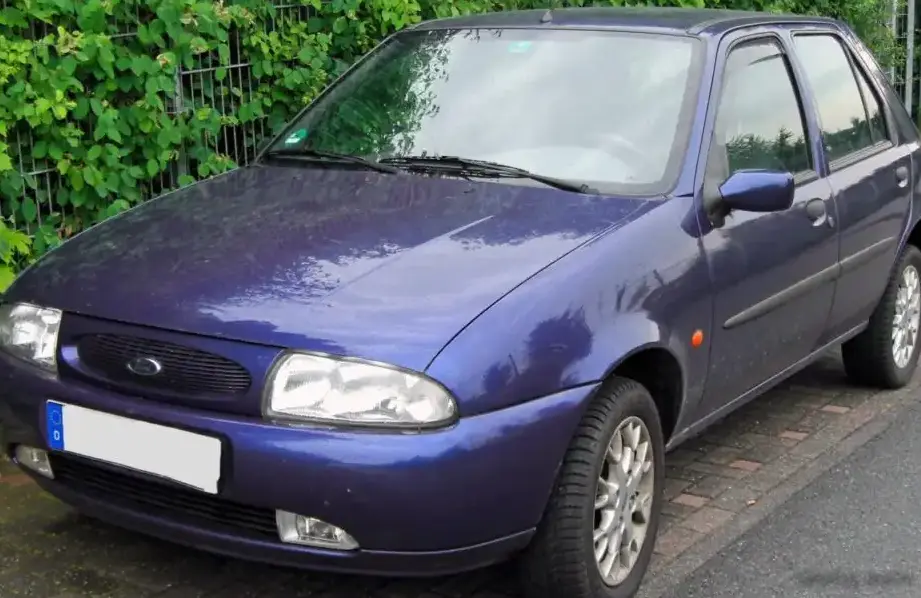
The Ford Fiesta Mk4 1.8 D, produced from 1998 to 1999, represented an interesting niche within the fourth generation Fiesta lineup. Positioned as an economy-focused option, it offered diesel power in a traditionally small petrol-dominated segment. This five-door hatchback aimed to provide practicality and fuel efficiency for buyers in European markets, where diesel engines were gaining popularity. The 1.8 D sat at the lower end of the Fiesta Mk4 range, offering a more affordable entry point compared to the higher-specification petrol variants. It was a relatively short-lived model, superseded by updated diesel offerings in subsequent years.
Technical Specifications
| Brand | Ford |
| Model | Fiesta |
| Generation | Fiesta IV (Mk4) 5 door |
| Type (Engine) | 1.8 D (60 Hp) |
| Start of production | 1998 |
| End of production | 1999 |
| Powertrain Architecture | Internal Combustion engine |
| Body type | Hatchback |
| Seats | 5 |
| Doors | 5 |
| Fuel consumption (combined) | 6.1 l/100 km (38.6 US mpg, 46.3 UK mpg, 16.4 km/l) |
| CO2 emissions | 161 g/km |
| Fuel Type | Diesel |
| Acceleration 0 – 100 km/h | 17.6 sec |
| Acceleration 0 – 62 mph | 17.6 sec |
| Acceleration 0 – 60 mph | 16.7 sec |
| Maximum speed | 155 km/h (96.31 mph) |
| Weight-to-power ratio | 18.8 kg/Hp, 53.3 Hp/tonne |
| Weight-to-torque ratio | 10.7 kg/Nm, 93.3 Nm/tonne |
| Power | 60 Hp @ 4800 rpm |
| Power per litre | 34.2 Hp/l |
| Torque | 105 Nm @ 2500 rpm (77.44 lb.-ft. @ 2500 rpm) |
| Engine layout | Front, Transverse |
| Engine Model/Code | RTJ, RTK |
| Engine displacement | 1753 cm3 (106.97 cu. in.) |
| Number of cylinders | 4 |
| Engine configuration | Inline |
| Cylinder Bore | 82.5 mm (3.25 in.) |
| Piston Stroke | 82 mm (3.23 in.) |
| Compression ratio | 21.5:1 |
| Number of valves per cylinder | 2 |
| Fuel injection system | Precombustion chamber injection |
| Engine aspiration | Naturally aspirated engine |
| Valvetrain | OHC |
| Engine oil capacity | 5 l (5.28 US qt | 4.4 UK qt) |
| Coolant | 9.3 l (9.83 US qt | 8.18 UK qt) |
| Kerb Weight | 1125 kg (2480.2 lbs.) |
| Max. weight | 1550 kg (3417.17 lbs.) |
| Max load | 425 kg (936.96 lbs.) |
| Trunk (boot) space – minimum | 250 l (8.83 cu. ft.) |
| Trunk (boot) space – maximum | 930 l (32.84 cu. ft.) |
| Fuel tank capacity | 42 l (11.1 US gal | 9.24 UK gal) |
| Max. roof load | 75 kg (165.35 lbs.) |
| Permitted trailer load with brakes (12%) | 900 kg (1984.16 lbs.) |
| Permitted trailer load without brakes | 310 kg (683.43 lbs.) |
| Length | 3828 mm (150.71 in.) |
| Width | 1634 mm (64.33 in.) |
| Height | 1334 mm (52.52 in.) |
| Wheelbase | 2446 mm (96.3 in.) |
| Front track | 1429 mm (56.26 in.) |
| Rear (Back) track | 1384 mm (54.49 in.) |
| Minimum turning circle | 9.9 m (32.48 ft.) |
| Drivetrain Architecture | The Internal combustion engine (ICE) drives the front wheels of the vehicle. |
| Drive wheel | Front wheel drive |
| Number of gears and type of gearbox | 5 gears, manual transmission |
| Front suspension | Coil spring |
| Rear suspension | Coil spring |
| Front brakes | Disc |
| Rear brakes | Drum |
| Assisting systems | ABS (Anti-lock braking system) |
| Steering type | Steering rack and pinion |
| Power steering | Hydraulic Steering |
| Tires size | 165/70 R13 |
Powertrain & Engine Architecture
The heart of the Fiesta 1.8 D was the RTJ or RTK diesel engine, a 1.8-liter inline-four cylinder unit. This engine utilized precombustion chamber injection, a common diesel technology of the era. This system involved injecting fuel into a precombustion chamber connected to the main cylinder, promoting more complete combustion. The engine produced 60 horsepower at 4800 rpm and 105 Nm (77.44 lb-ft) of torque at 2500 rpm. The engine featured an overhead camshaft (OHC) valvetrain with two valves per cylinder. The 1.8 D was paired with a five-speed manual transmission, which was the only transmission option available for this variant. The engine’s relatively low compression ratio of 21.5:1 was typical for indirect injection diesel engines of the time.
Driving Characteristics
The Fiesta 1.8 D was not designed for outright performance. Its 0-60 mph time of around 16.7 seconds and top speed of 155 km/h (96.31 mph) reflected its focus on fuel economy rather than speed. The five-speed manual transmission helped to maximize efficiency, but the engine lacked the responsiveness of the petrol variants. The gear ratios were optimized for low-end torque, making it reasonably tractable around town. However, overtaking required careful planning. Compared to the more powerful petrol engines in the Fiesta Mk4 range, the 1.8 D felt significantly slower, but it offered a noticeable improvement in fuel economy.
Equipment & Trim Levels
The 1.8 D trim level was fairly basic, reflecting its position as the entry-level diesel offering. Standard equipment typically included power steering, central locking, and an adjustable steering column. Interior upholstery was typically cloth, and the dashboard featured a simple, functional design. Optional extras included electric front windows, a radio/cassette player, and alloy wheels. The overall interior ambiance was practical and durable, prioritizing functionality over luxury.
Chassis & Braking
The Fiesta Mk4 1.8 D utilized a relatively simple chassis setup. Front suspension consisted of coil springs, while the rear employed a coil spring setup. The front brakes were discs, providing adequate stopping power, while the rear brakes were drums, a cost-saving measure common in this segment. ABS (Anti-lock Braking System) was often included as standard equipment, enhancing safety. The suspension was tuned for comfort, providing a reasonably compliant ride, although it could feel somewhat wallowy when fully loaded. The steering was hydraulic, making it relatively light and easy to maneuver.
Market Reception & Comparison
The Fiesta 1.8 D received mixed reviews. Critics acknowledged its fuel efficiency and practicality, but often criticized its lack of performance. Compared to the 1.4 and 1.6-liter petrol engines, the 1.8 D felt sluggish and noisy. However, it offered a significant advantage in fuel economy, making it an attractive option for drivers covering long distances. The 1.8 D was generally considered a more sensible choice than the higher-performance petrol variants for those prioritizing economy and practicality. Its reliability was generally good, although diesel engines of this era required regular maintenance to prevent issues with the fuel injection system.
Legacy
The Ford Fiesta Mk4 1.8 D, while not a particularly memorable model, played a role in popularizing diesel engines in the small hatchback segment. Its fuel efficiency and affordability made it a popular choice for budget-conscious buyers. Today, these cars are relatively rare, and well-maintained examples are sought after by enthusiasts and collectors. The RTJ/RTK engine, while simple in design, proved to be reasonably durable, and many examples are still on the road. However, potential buyers should be aware of the potential for issues with the fuel injection system and the need for regular maintenance. The Fiesta 1.8 D represents a snapshot of a time when diesel power was becoming increasingly viable in smaller vehicles.