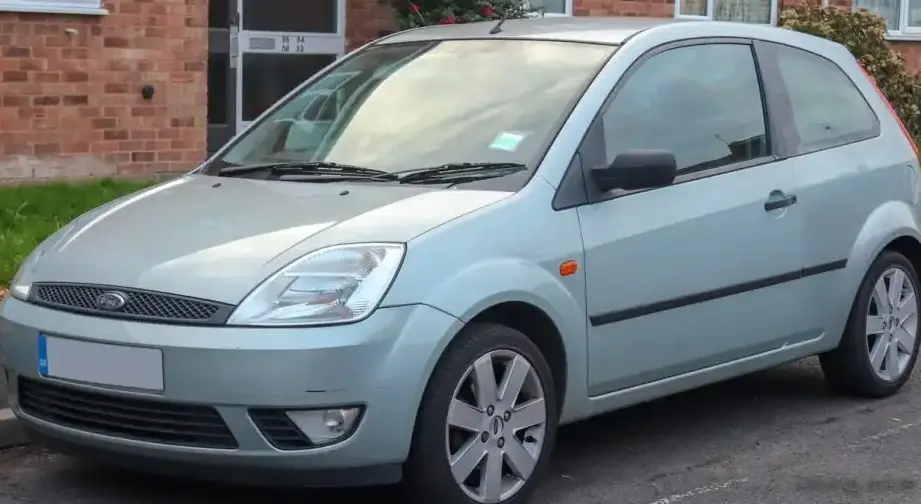
The Ford Fiesta Mk6, produced from 2002 to 2008, represented a significant step forward for Ford’s supermini. The 3-door variant, particularly when equipped with the 1.3-liter Duratec 8V engine producing 60 horsepower, served as the entry point into the Mk6 Fiesta range. This configuration was primarily aimed at first-time drivers, those seeking economical transportation, and buyers for whom outright performance was less of a priority. Production of this specific trim ran from 2002 through 2005, coinciding with the initial phase of the Mk6’s lifecycle. It occupied a crucial position in the lineup, offering affordability and practicality within the broader Fiesta family.
Technical Specifications
| Brand | Ford |
| Model | Fiesta |
| Generation | Fiesta VI (Mk6) 3 door |
| Type (Engine) | 1.3 Duratec 8V (60 Hp) |
| Start of production | 2002 |
| End of production | 2005 |
| Powertrain Architecture | Internal Combustion engine |
| Body type | Hatchback |
| Seats | 5 |
| Doors | 3 |
| Fuel consumption (urban) | 8.3 l/100 km (28.3 US mpg, 34 UK mpg, 12 km/l) |
| Fuel consumption (extra urban) | 5 l/100 km (47 US mpg, 56.5 UK mpg, 20 km/l) |
| Fuel consumption (combined) | 6.2 l/100 km (37.9 US mpg, 45.6 UK mpg, 16.1 km/l) |
| CO2 emissions | 147 g/km |
| Fuel Type | Petrol (Gasoline) |
| Acceleration 0 – 100 km/h | 18.9 sec |
| Acceleration 0 – 62 mph | 18.9 sec |
| Acceleration 0 – 60 mph | 18 sec |
| Maximum speed | 151 km/h (93.83 mph) |
| Emission standard | Euro 4 |
| Weight-to-power ratio | 17.4 kg/Hp |
| Weight-to-torque ratio | 10.5 kg/Nm |
| Power | 60 Hp @ 5000 rpm |
| Torque | 99 Nm @ 2500 rpm (73.02 lb.-ft. @ 2500 rpm) |
| Engine layout | Front, Transverse |
| Engine Model/Code | BAJA, A9JA |
| Engine displacement | 1299 cm3 (79.27 cu. in.) |
| Number of cylinders | 4 |
| Engine configuration | Inline |
| Cylinder Bore | 74 mm (2.91 in.) |
| Piston Stroke | 75.5 mm (2.97 in.) |
| Number of valves per cylinder | 2 |
| Fuel injection system | Multi-port manifold injection |
| Engine aspiration | Naturally aspirated |
| Valvetrain | SOHC |
| Engine oil capacity | 4.35 l (4.6 US qt | 3.83 UK qt) |
| Coolant capacity | 5 l (5.28 US qt | 4.4 UK qt) |
| Kerb Weight | 1042 kg (2297.22 lbs.) |
| Max. weight | 1520 kg (3351.03 lbs.) |
| Max load | 478 kg (1053.81 lbs.) |
| Trunk (boot) space – minimum | 268 l (9.46 cu. ft.) |
| Trunk (boot) space – maximum | 945 l (33.37 cu. ft.) |
| Fuel tank capacity | 45 l (11.89 US gal | 9.9 UK gal) |
| Length | 3917 mm (154.21 in.) |
| Width | 1683 mm (66.26 in.) |
| Width including mirrors | 1905 mm (75 in.) |
| Height | 1467 mm (57.76 in.) |
| Wheelbase | 2487 mm (97.91 in.) |
| Front track | 1474 mm (58.03 in.) |
| Rear track | 1444 mm (56.85 in.) |
| Minimum turning circle | 9.8 m (32.15 ft.) |
| Drivetrain | Front wheel drive |
| Number of gears | 5 gears, manual transmission |
| Front suspension | Independent type McPherson, Transverse stabilizer |
| Rear suspension | Coil spring, Torsion |
| Front brakes | Disc |
| Rear brakes | Drum |
| Assisting systems | ABS (Anti-lock braking system) |
| Steering type | Steering rack and pinion |
| Power steering | Hydraulic |
| Tires size | 175/65 R14 |
| Wheel rims size | 5.5J x 14 |
Powertrain & Engine Architecture
The heart of this Fiesta variant is the 1.3-liter Duratec 8V engine, identified by engine codes BAJA and A9JA. This engine is a naturally aspirated, inline-four cylinder unit utilizing a single overhead camshaft (SOHC) valvetrain. The Duratec engine family was designed to be modular and cost-effective, and the 1.3L version represented the smallest displacement within the range. Fuel delivery is managed by a multi-port fuel injection system, providing adequate, though not exceptional, combustion control. The engine’s 8 valves (two per cylinder) contribute to its simplicity and reliability, but also limit its potential for high-end power. The engine is transversely mounted in the front of the vehicle, driving the front wheels. The transmission is a standard five-speed manual gearbox, chosen for its affordability and efficiency. While an automatic transmission was offered on other Fiesta Mk6 models, it was not paired with the 1.3L engine.
Driving Characteristics
The 1.3L Fiesta Mk6 with the five-speed manual transmission delivers modest performance. With 60 horsepower and 99 Nm (73 lb-ft) of torque, acceleration is leisurely, taking approximately 18.9 seconds to reach 62 mph (100 km/h). The engine feels most comfortable in the mid-range, with peak torque arriving at 2500 rpm. The gear ratios are relatively long, prioritizing fuel economy over rapid acceleration. Compared to the more powerful 1.6L or even the diesel variants, this Fiesta feels significantly slower. However, the light weight of the vehicle (around 1042 kg or 2297 lbs) helps to mitigate the lack of power. The steering is light and precise, making it easy to maneuver in urban environments. The suspension provides a comfortable ride, although it can feel somewhat soft and prone to body roll during more spirited driving.
Equipment & Trim Levels
The 1.3L Fiesta Mk6 typically came with a basic level of equipment. Standard features generally included power steering, central locking, an adjustable steering column, and front airbags. Interior upholstery was typically cloth, with a simple dashboard layout. Air conditioning, alloy wheels, and electric windows were usually optional extras, often bundled into higher trim levels like ‘Style’ or ‘Zetec’. The base model focused on providing essential transportation without unnecessary frills. The interior plastics were durable but not particularly luxurious, reflecting the car’s budget-oriented positioning.
Chassis & Braking
The Fiesta Mk6 utilizes an independent McPherson strut suspension setup at the front, providing decent handling and ride comfort. The rear suspension employs a torsion beam arrangement, which is a cost-effective solution that offers adequate stability. Braking is handled by disc brakes at the front and drum brakes at the rear. Anti-lock Braking System (ABS) was standard, enhancing safety. The relatively light weight of the 1.3L model meant that the braking system was generally adequate for its performance level. Stabilizer bars were fitted to both the front and rear axles to reduce body roll.
Market Reception & Comparison
The 1.3L Fiesta Mk6 was generally well-received as an affordable and reliable city car. Critics acknowledged its fuel efficiency and ease of driving, but often noted its lack of power. Compared to the 1.6L models, the 1.3L offered significantly lower performance but also lower running costs. The diesel variants provided better fuel economy and more torque, but at a higher purchase price. The 1.3L appealed to buyers who prioritized economy and practicality over performance, such as students, commuters, and those on a tight budget.
Legacy
The 1.3L Duratec engine, while not known for its performance, proved to be a reliable and durable unit. Fiesta Mk6 models equipped with this engine are still relatively common on the used car market today. Maintenance is generally straightforward and affordable, thanks to the engine’s simple design. However, potential buyers should be aware of common issues such as oil leaks and corrosion. The 1.3L Fiesta Mk6 remains a popular choice for those seeking a cheap and cheerful first car or a dependable runabout.