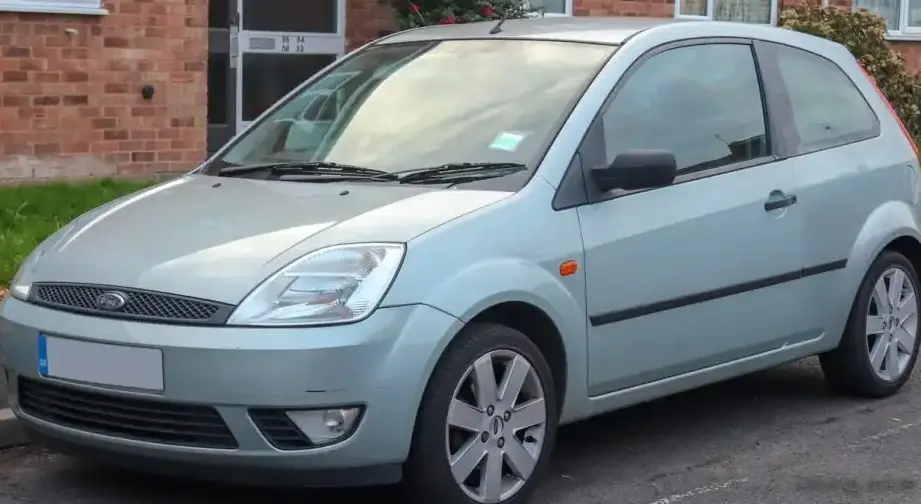
The Ford Fiesta Mk6, produced from 2002 to 2008, represented a significant step forward for Ford’s supermini. The 3-door variant, particularly the 1.4 Duratorq TDCi model with 68 horsepower, was a popular choice in the European market, offering a blend of affordability, fuel efficiency, and practicality. This version occupied the entry-level position within the Mk6 Fiesta range, aimed at buyers prioritizing economy and low running costs. Production of this specific configuration ran from 2002 to 2005, before being superseded by later revisions within the Mk6 lifecycle.
Technical Specifications
| Brand | Ford |
| Model | Fiesta |
| Generation | Fiesta VI (Mk6) 3 door |
| Type (Engine) | 1.4 Duratorq TDCi (68 Hp) |
| Start of production | 2002 |
| End of production | 2005 |
| Powertrain Architecture | Internal Combustion engine |
| Body type | Hatchback |
| Seats | 5 |
| Doors | 3 |
| Fuel consumption (urban) | 5.3 l/100 km (44.4 US mpg, 53.3 UK mpg, 18.9 km/l) |
| Fuel consumption (extra urban) | 3.7 l/100 km (63.6 US mpg, 76.3 UK mpg, 27 km/l) |
| Fuel consumption (combined) | 4.3 l/100 km (54.7 US mpg, 65.7 UK mpg, 23.3 km/l) |
| CO2 emissions | 114 g/km |
| Fuel Type | Diesel |
| Acceleration 0 – 100 km/h | 14.9 sec |
| Acceleration 0 – 62 mph | 14.9 sec |
| Acceleration 0 – 60 mph | 14.2 sec |
| Maximum speed | 163 km/h (101.28 mph) |
| Emission standard | Euro 3 |
| Weight-to-power ratio | 15.6 kg/Hp |
| Weight-to-torque ratio | 6.6 kg/Nm |
| Power | 68 Hp @ 4000 rpm |
| Torque | 160 Nm @ 2000 rpm (118.01 lb.-ft. @ 2000 rpm) |
| Engine layout | Front, Transverse |
| Engine Model/Code | F6JA |
| Engine displacement | 1399 cm3 (85.37 cu. in.) |
| Number of cylinders | 4 |
| Engine configuration | Inline |
| Cylinder Bore | 73.7 mm (2.9 in.) |
| Piston Stroke | 82 mm (3.23 in.) |
| Compression ratio | 18:1 |
| Number of valves per cylinder | 2 |
| Fuel injection system | Diesel Commonrail |
| Engine aspiration | Turbocharger, Intercooler |
| Valvetrain | SOHC |
| Engine oil capacity | 3.8 l (4.02 US qt | 3.34 UK qt) |
| Coolant capacity | 5.5 l (5.81 US qt | 4.84 UK qt) |
| Kerb Weight | 1063 kg (2343.51 lbs.) |
| Max. weight | 1560 kg (3439.21 lbs.) |
| Max load | 497 kg (1095.7 lbs.) |
| Trunk (boot) space – minimum | 268 l (9.46 cu. ft.) |
| Trunk (boot) space – maximum | 945 l (33.37 cu. ft.) |
| Fuel tank capacity | 45 l (11.89 US gal | 9.9 UK gal) |
| Permitted trailer load (braked) | 750 kg (1653.47 lbs.) |
| Permitted trailer load (unbraked) | 500 kg (1102.31 lbs.) |
| Length | 3917 mm (154.21 in.) |
| Width | 1683 mm (66.26 in.) |
| Width (including mirrors) | 1905 mm (75 in.) |
| Height | 1467 mm (57.76 in.) |
| Wheelbase | 2487 mm (97.91 in.) |
| Front track | 1474 mm (58.03 in.) |
| Rear track | 1444 mm (56.85 in.) |
| Turning circle | 9.8 m (32.15 ft.) |
| Drivetrain | Front wheel drive |
| Number of gears | 5 |
| Gearbox type | Manual transmission |
| Front suspension | Independent type McPherson, Transverse stabilizer |
| Rear suspension | Coil spring, Torsion |
| Front brakes | Disc |
| Rear brakes | Drum |
| Assisting systems | ABS (Anti-lock braking system) |
| Steering type | Steering rack and pinion |
| Power steering | Hydraulic |
| Tires size | 175/65 R14 |
| Wheel rims size | 5.5J x 14 |
INTRODUCTION
The Ford Fiesta Mk6, launched in 2002, was a crucial model for Ford in Europe, designed to compete with increasingly sophisticated rivals like the Renault Clio and Volkswagen Polo. The 3-door body style offered a sportier aesthetic, appealing to younger buyers. The 1.4 Duratorq TDCi engine, a common-rail direct injection diesel, was introduced to provide a fuel-efficient and affordable option. This 68 horsepower variant was positioned as the entry point to the Mk6 Fiesta range, prioritizing economy over outright performance. It was a popular choice for city driving and commuting, offering a practical and economical solution for everyday transportation.
Powertrain & Engine Architecture
The heart of this Fiesta variant is the 1.4-liter Duratorq TDCi engine, designated with the engine code F6JA. This engine is a four-cylinder, inline diesel utilizing a common-rail direct injection system. This system, supplied by Bosch, allowed for precise fuel delivery and improved combustion efficiency. The engine features a single overhead camshaft (SOHC) operating two valves per cylinder. A turbocharger with an intercooler was employed to boost power and torque, mitigating the typical lag associated with smaller diesel engines. The 1.4 Duratorq TDCi produced 68 horsepower at 4000 rpm and 160 Nm (118 lb-ft) of torque at 2000 rpm. The engine was paired with a five-speed manual transmission, chosen for its simplicity and efficiency. The transmission’s gear ratios were optimized for fuel economy, with a relatively long final drive.
Driving Characteristics
The 1.4 Duratorq TDCi-equipped Fiesta Mk6 offered a decidedly economical driving experience. Acceleration was modest, taking approximately 14.9 seconds to reach 62 mph (100 km/h). However, the engine’s torque delivery made it surprisingly capable in everyday driving situations. The turbocharger provided a noticeable boost in power at lower engine speeds, making overtaking and hill climbing manageable. Compared to the higher-output 1.6-liter petrol versions, the 1.4 TDCi lacked outright performance, but it excelled in fuel efficiency. The manual transmission, while not particularly sporty, was precise and easy to use. The relatively soft suspension setup prioritized comfort over handling, resulting in a compliant ride quality, although body roll was noticeable during cornering.
Equipment & Trim Levels
The 1.4 Duratorq TDCi Fiesta Mk6 typically came with a basic level of equipment, reflecting its entry-level positioning. Standard features generally included power steering, central locking, and an adjustable steering column. Interior upholstery was typically cloth, with a simple dashboard layout. Air conditioning, alloy wheels, and electric windows were often offered as optional extras. Higher trim levels, such as Zetec, added features like sports seats, upgraded audio systems, and body-colored bumpers. The overall interior design was functional and durable, prioritizing practicality over luxury.
Chassis & Braking
The Fiesta Mk6 utilized a McPherson strut front suspension with a transverse stabilizer bar, providing a reasonable balance of comfort and handling. The rear suspension employed a torsion beam setup, which was cost-effective and space-efficient. Braking duties were handled by disc brakes at the front and drum brakes at the rear. Anti-lock Braking System (ABS) was standard, enhancing safety. The chassis was relatively lightweight, contributing to the car’s fuel efficiency. The steering was hydraulic, providing a light and easy driving experience.
Market Reception & Comparison
The 1.4 Duratorq TDCi Fiesta Mk6 was generally well-received by critics for its fuel economy and affordability. However, its performance was often criticized as being underwhelming. Compared to the petrol-powered versions, the diesel offered significantly better fuel economy but lacked the same level of responsiveness. Against competitors like the Renault Clio dCi and Volkswagen Polo TDI, the Fiesta offered a competitive package, but often lagged behind in terms of refinement and perceived quality. The diesel engine, while economical, was known to be slightly noisier than its petrol counterparts.
Legacy
The 1.4 Duratorq TDCi engine proved to be relatively reliable, although regular maintenance is crucial. Common issues include injector problems and turbocharger wear, particularly on higher-mileage examples. Today, the Fiesta Mk6 1.4 TDCi represents an affordable and economical used car option. Its fuel efficiency and low running costs continue to appeal to budget-conscious buyers. While not a performance car, it remains a practical and dependable choice for city driving and commuting. The engine’s simplicity makes it relatively easy and inexpensive to repair, contributing to its enduring appeal in the used car market.