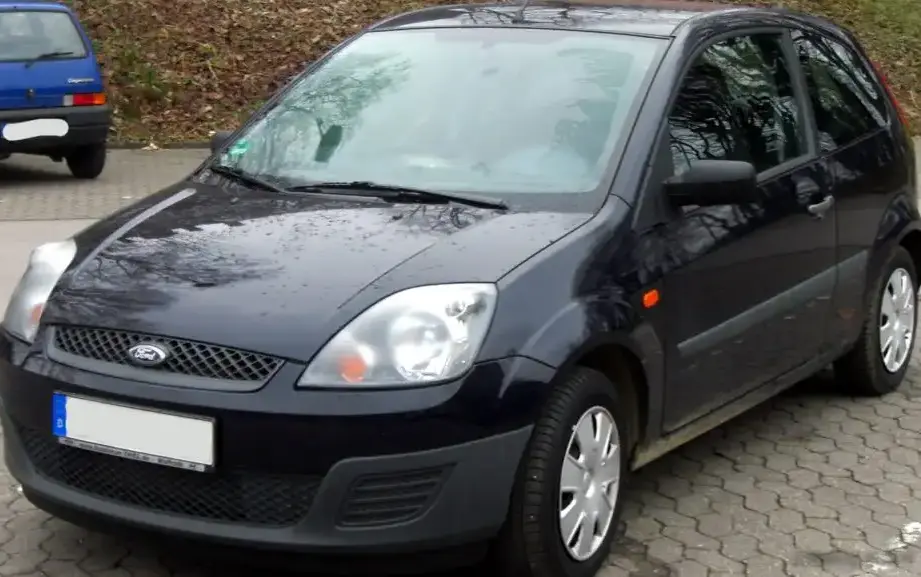
The Ford Fiesta Mk6, specifically the 3-door model equipped with the 1.4-liter Duratec engine producing 80 horsepower and paired with the Durashift EST automatic transmission, was a significant offering in the European small car market from 2005 to 2008. This variant represented an entry-level option within the Mk6 Fiesta range, positioned below the more powerful 1.6-liter and performance-oriented ST models. It aimed to provide affordable and practical transportation with a degree of convenience offered by the automatic gearbox. The Mk6 Fiesta itself was a facelift of the fifth-generation model (Mk5), bringing updated styling and improved features to Ford’s popular supermini.
Technical Specifications
| Brand | Ford |
| Model | Fiesta |
| Generation | Fiesta VI (Mk6, facelift 2005) 3 door |
| Type (Engine) | 1.4 Duratec (80 Hp) Durashift EST |
| Start of production | 2005 |
| End of production | 2008 |
| Powertrain Architecture | Internal Combustion engine |
| Body type | Hatchback |
| Seats | 5 |
| Doors | 3 |
| Fuel consumption (urban) | 7.7 l/100 km (30.5 US mpg, 36.7 UK mpg, 13 km/l) |
| Fuel consumption (extra urban) | 4.9 l/100 km (48 US mpg, 57.6 UK mpg, 20.4 km/l) |
| Fuel consumption (combined) | 6 l/100 km (39.2 US mpg, 47.1 UK mpg, 16.7 km/l) |
| CO2 emissions | 142 g/km |
| Fuel Type | Petrol (Gasoline) |
| Acceleration 0 – 100 km/h | 14.6 sec |
| Acceleration 0 – 62 mph | 14.6 sec |
| Acceleration 0 – 60 mph | 13.7 sec |
| Maximum speed | 166 km/h (103.15 mph) |
| Emission standard | Euro 4 |
| Weight-to-power ratio | 12.9 kg/Hp, 77.4 Hp/tonne |
| Weight-to-torque ratio | 8.3 kg/Nm, 120 Nm/tonne |
| Power | 80 Hp @ 5700 rpm |
| Power per litre | 57.6 Hp/l |
| Torque | 124 Nm @ 3500 rpm (91.46 lb.-ft. @ 3500 rpm) |
| Engine layout | Front, Transverse |
| Engine Model/Code | FXJA |
| Engine displacement | 1388 cm3 (84.7 cu. in.) |
| Number of cylinders | 4 |
| Engine configuration | Inline |
| Number of valves per cylinder | 4 |
| Fuel injection system | Multi-port manifold injection |
| Engine aspiration | Naturally aspirated |
| Engine oil capacity | 3.8 l (4.02 US qt | 3.34 UK qt) |
| Coolant capacity | 5 l (5.28 US qt | 4.4 UK qt) |
| Kerb Weight | 1033 kg (2277.38 lbs.) |
| Max. weight | 1525 kg (3362.05 lbs.) |
| Max load | 492 kg (1084.67 lbs.) |
| Trunk (boot) space – minimum | 268 l (9.46 cu. ft.) |
| Trunk (boot) space – maximum | 945 l (33.37 cu. ft.) |
| Fuel tank capacity | 45 l (11.89 US gal | 9.9 UK gal) |
| Max. roof load | 75 kg (165.35 lbs.) |
| Permitted trailer load with brakes (12%) | 500 kg (1102.31 lbs.) |
| Length | 3918 mm (154.25 in.) |
| Width | 1685 mm (66.34 in.) |
| Width including mirrors | 1907 mm (75.08 in.) |
| Height | 1468 mm (57.8 in.) |
| Wheelbase | 2486 mm (97.87 in.) |
| Front track | 1464-1477 mm (57.64 – 58.15 in.) |
| Rear track | 1434-1444 mm (56.46 – 56.85 in.) |
| Minimum turning circle | 9.3 m (30.51 ft.) |
| Drivetrain | Front wheel drive |
| Number of gears | 5 |
| Gearbox type | Durashift EST automatic |
| Front suspension | Independent type McPherson, Transverse stabilizer |
| Rear suspension | Coil spring, Elastic beam |
| Front brakes | Disc |
| Rear brakes | Drum |
| Assisting systems | ABS (Anti-lock braking system) |
| Steering type | Steering rack and pinion |
| Power steering | Hydraulic |
| Tires size | 195/50 R 15 |
| Wheel rims size | 15 |
INTRODUCTION
The 2005-2008 Ford Fiesta Mk6 1.4 Duratec 80 hp with Durashift EST automatic transmission was a key model in Ford of Europe’s lineup. Built on the B3 platform (shared with the Mazda 2), the Mk6 aimed to improve upon the already successful Mk5 Fiesta with enhanced refinement and a more modern interior. This particular variant was designed to appeal to buyers seeking a convenient and economical city car, particularly those who preferred the ease of an automatic transmission. It occupied the lower end of the Fiesta range, offering a more affordable entry point compared to the higher-specification models.
Powertrain & Engine Architecture
The heart of this Fiesta variant is the 1.4-liter Duratec engine, designated FXJA. This engine is a naturally aspirated, inline-four cylinder unit featuring a double overhead camshaft (DOHC) valvetrain and multi-port fuel injection. The Duratec series was known for its relatively simple design and focus on fuel efficiency. While not a powerhouse, the 1.4-liter engine provided adequate performance for urban driving and shorter journeys. The Durashift EST automatic transmission is a four-speed unit. It was designed to provide smooth gear changes and enhance driving comfort. Unlike some contemporary automatic transmissions, the Durashift EST lacked a manual shift mode, focusing solely on automatic operation. The engine’s relatively low output meant the transmission didn’t need to handle significant torque loads.
Driving Characteristics
The 1.4-liter Duratec engine with the Durashift EST automatic transmission delivered a comfortable, but not particularly sporty, driving experience. Acceleration was modest, with a 0-60 mph time of around 13.7 seconds. The automatic transmission, while convenient, did contribute to some power loss compared to the manual version. Gear ratios were optimized for fuel economy rather than outright performance. The transmission tended to hold onto gears for longer to maximize efficiency, which could sometimes feel sluggish during overtaking maneuvers. The steering was light and easy, making it well-suited for navigating city streets. Overall, the driving experience was geared towards practicality and ease of use.
Equipment & Trim Levels
The 1.4 Duratec automatic Fiesta typically came with a reasonable level of standard equipment. This included central locking, power steering, electric front windows, and an AM/FM radio. Higher trim levels, such as Style or Zetec, added features like alloy wheels, air conditioning, and upgraded interior trim. Interior upholstery was typically cloth, with a relatively simple dashboard layout. Optional extras included a CD player, metallic paint, and parking sensors. The 3-door body style emphasized a slightly sportier aesthetic compared to the 5-door version.
Chassis & Braking
The Fiesta Mk6 utilized a McPherson strut front suspension and an elastic beam rear suspension. This setup provided a good balance between ride comfort and handling. The front brakes were disc brakes, while the rear brakes were drum brakes – a cost-saving measure common in this segment. ABS (Anti-lock Braking System) was standard, enhancing safety. The suspension was tuned for comfort, absorbing bumps and imperfections in the road reasonably well. Stabilizer bars were fitted to both the front and rear axles to reduce body roll during cornering.
Market Reception & Comparison
The 1.4 Duratec automatic Fiesta received mixed reviews. Critics generally praised its fuel economy and ease of driving, but noted its lack of performance. Compared to the 1.6-liter versions, the 1.4 felt noticeably slower. The 1.4 also lagged behind the diesel-powered models in terms of torque and fuel efficiency. However, the 1.4 offered a lower purchase price and potentially lower maintenance costs. It appealed to buyers who prioritized affordability and convenience over performance.
Legacy
The 1.4 Duratec engine, while not known for its longevity or high performance, proved to be generally reliable. The Durashift EST automatic transmission also had a reasonable reputation for durability, provided it was serviced regularly. Today, these Fiesta variants are relatively affordable on the used car market. They represent a practical and economical option for those seeking a small city car. However, potential buyers should be aware of the age-related issues common to older vehicles, such as corrosion and wear and tear on suspension components. The 1.4 Duratec automatic Fiesta remains a testament to Ford’s commitment to providing accessible and practical transportation.