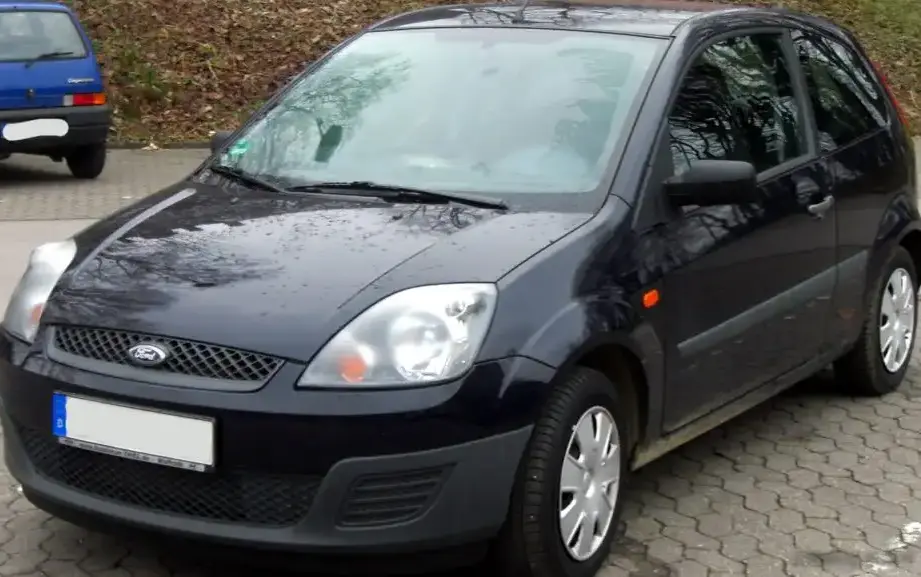
The Ford Fiesta Mk6, specifically the 3-door hatchback powered by the 1.4 Duratorq TDCi engine producing 68 horsepower, was a significant offering in the European small car market from 2005 to 2008. This variant represented an entry-level diesel option within the Mk6 Fiesta range, which itself was a facelift of the fifth-generation Fiesta introduced in 2002. Positioned below the more powerful TDCi variants and the petrol-powered models, the 1.4 TDCi aimed to provide economical motoring for budget-conscious buyers. It played a key role in Ford’s strategy to offer a diverse range of Fiesta models catering to various customer needs and preferences.
Technical Specifications
| Brand | Ford |
| Model | Fiesta |
| Generation | Fiesta VI (Mk6, facelift 2005) 3 door |
| Type (Engine) | 1.4 Duratorq TDCi (68 Hp) |
| Start of production | 2005 |
| End of production | 2008 |
| Powertrain Architecture | Internal Combustion engine |
| Body type | Hatchback |
| Seats | 5 |
| Doors | 3 |
| Fuel consumption (urban) | 5.8 l/100 km (40.6 US mpg, 48.7 UK mpg, 17.2 km/l) |
| Fuel consumption (extra urban) | 3.8 l/100 km (61.9 US mpg, 74.3 UK mpg, 26.3 km/l) |
| Fuel consumption (combined) | 4.5 l/100 km (52.3 US mpg, 62.8 UK mpg, 22.2 km/l) |
| CO2 emissions | 119 g/km |
| Fuel Type | Diesel |
| Acceleration 0 – 100 km/h | 15.5 sec |
| Acceleration 0 – 62 mph | 15.5 sec |
| Acceleration 0 – 60 mph | 14.4 sec |
| Maximum speed | 163 km/h (101.28 mph) |
| Emission standard | Euro 4 |
| Weight-to-power ratio | 15.5 kg/Hp |
| Weight-to-torque ratio | 6.6 kg/Nm |
| Power | 68 Hp @ 4000 rpm |
| Power per litre | 48.6 Hp/l |
| Torque | 160 Nm @ 2000 rpm (118.01 lb.-ft. @ 2000 rpm) |
| Engine layout | Front, Transverse |
| Engine Model/Code | F6JA |
| Engine displacement | 1399 cm3 (85.37 cu. in.) |
| Number of cylinders | 4 |
| Engine configuration | Inline |
| Number of valves per cylinder | 2 |
| Fuel injection system | Diesel Commonrail |
| Engine aspiration | Turbocharger, Intercooler |
| Valvetrain | SOHC |
| Engine oil capacity | 3.8 l (4.02 US qt, 3.34 UK qt) |
| Coolant capacity | 5.5 l (5.81 US qt, 4.84 UK qt) |
| Kerb Weight | 1057 kg (2330.29 lbs) |
| Max. weight | 1560 kg (3439.21 lbs) |
| Max load | 503 kg (1108.93 lbs) |
| Trunk (boot) space – minimum | 268 l (9.46 cu. ft.) |
| Trunk (boot) space – maximum | 945 l (33.37 cu. ft.) |
| Fuel tank capacity | 43 l (11.36 US gal, 9.46 UK gal) |
| Max. roof load | 75 kg (165.35 lbs) |
| Permitted trailer load with brakes (12%) | 750 kg (1653.47 lbs) |
| Length | 3918 mm (154.25 in) |
| Width | 1685 mm (66.34 in) |
| Width including mirrors | 1907 mm (75.08 in) |
| Height | 1468 mm (57.8 in) |
| Wheelbase | 2486 mm (97.87 in) |
| Front track | 1464-1477 mm (57.64 – 58.15 in) |
| Rear track | 1434-1444 mm (56.46 – 56.85 in) |
| Minimum turning circle | 9.3 m (30.51 ft) |
| Drivetrain | Front wheel drive |
| Number of gears | 5 |
| Gearbox type | Manual transmission |
| Front suspension | Independent type McPherson, Transverse stabilizer |
| Rear suspension | Coil spring, Elastic beam |
| Front brakes | Disc |
| Rear brakes | Drum |
| Assisting systems | ABS (Anti-lock braking system) |
| Steering type | Steering rack and pinion |
| Power steering | Hydraulic |
| Tires size | 195/50 R 15 |
| Wheel rims size | 15 |
INTRODUCTION
The Ford Fiesta Mk6, launched in 2002 and facelifted in 2005, was a crucial model for Ford in Europe, competing directly with rivals like the Renault Clio, Volkswagen Polo, and Opel Corsa. The 3-door hatchback body style was particularly popular, appealing to younger buyers and those seeking a more sporty aesthetic. The 1.4 Duratorq TDCi 68 hp variant, introduced with the facelift, offered a fuel-efficient diesel option for customers prioritizing economy over outright performance. This model sat at the base of the diesel range, offering a more affordable entry point compared to the 1.6 TDCi versions.
Powertrain & Engine Architecture
The heart of this Fiesta variant is the 1.4-liter Duratorq TDCi engine, identified by the engine code F6JA. This engine is a four-cylinder, inline diesel featuring a turbocharger and intercooler to enhance power and efficiency. It utilizes a common rail direct injection system, delivering fuel directly into the combustion chamber at high pressure for improved combustion and reduced emissions. The engine employs a single overhead camshaft (SOHC) valvetrain with two valves per cylinder. The 5-speed manual transmission was standard, chosen for its simplicity and contribution to fuel economy. The Duratorq engine family was known for its robust construction and relatively straightforward maintenance.
Driving Characteristics
The 1.4 TDCi 68 hp Fiesta was not designed for rapid acceleration. With a 0-60 mph time of around 14.4 seconds and a top speed of 101 mph, performance was adequate for urban and suburban driving but felt strained on motorways or when fully loaded. The engine produced a respectable 160 Nm (118 lb-ft) of torque at 2000 rpm, providing sufficient pulling power for everyday driving situations. The gear ratios were optimized for fuel efficiency rather than performance, meaning the engine often needed to be revved to maintain speed, especially when overtaking. Compared to the more powerful 1.6 TDCi or petrol-powered Fiestas, this variant offered a more relaxed and economical driving experience, but at the expense of outright speed.
Equipment & Trim Levels
The 1.4 TDCi Fiesta typically came with a basic level of equipment, reflecting its position as an entry-level model. Standard features generally included power steering, central locking, electric front windows, and an ABS anti-lock braking system. Interior upholstery was typically cloth, and the dashboard featured a functional but relatively simple design. Optional extras included air conditioning, alloy wheels, and a CD player. Higher trim levels, such as Zetec, offered additional features like sports suspension, upgraded interior trim, and body-colored bumpers.
Chassis & Braking
The Fiesta Mk6 utilized a McPherson strut independent suspension system at the front, providing a comfortable ride and decent handling. The rear suspension employed a semi-independent elastic beam setup, which was cost-effective but less sophisticated than a fully independent system. Front brakes were disc brakes, offering good stopping power, while rear brakes were drum brakes, a cost-saving measure common in this segment. The steering was a hydraulic rack and pinion system, providing a reasonably direct and responsive feel. The 195/50 R15 tires offered a good balance of grip and rolling resistance.
Market Reception & Comparison
The 1.4 TDCi Fiesta was generally well-received by critics for its fuel economy and low running costs. However, its performance was often criticized as being underwhelming, particularly when compared to its more powerful siblings. Fuel economy figures of around 52.3 US mpg combined were a major selling point, making it an attractive option for drivers covering high mileages. Reliability was generally good, although the diesel particulate filter (DPF) could be a potential issue on older models, particularly if primarily used for short journeys. Compared to the 1.6 TDCi, the 1.4 offered lower purchase price and running costs, but sacrificed performance. Compared to the petrol models, the 1.4 TDCi provided superior fuel economy but came with a higher initial cost.
Legacy
The 1.4 Duratorq TDCi engine proved to be a reliable and durable unit, and many examples are still on the road today. While not known for its blistering performance, it offered a practical and economical solution for everyday motoring. In the used car market, these Fiestas represent an affordable and fuel-efficient option, particularly for first-time drivers or those seeking a low-cost runabout. However, potential buyers should be aware of the potential for DPF issues and ensure the vehicle has been properly maintained. The Fiesta Mk6, in all its variants, remains a popular and well-regarded small car, and the 1.4 TDCi version played a significant role in its success.