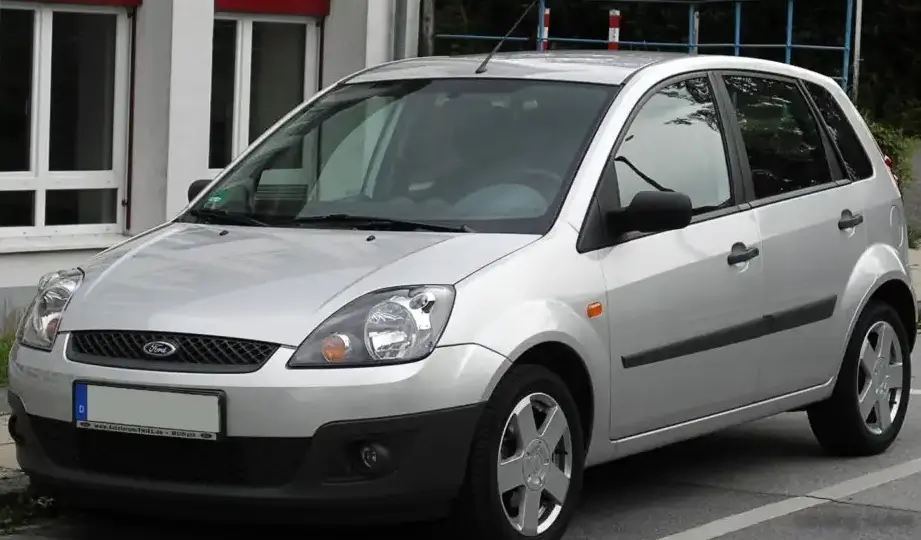
The Ford Fiesta Mk6, specifically the 5-door hatchback variant equipped with the 1.4-liter Duratec engine producing 80 horsepower and paired with the Durashift EST automatic transmission, was a significant offering in the European small car market from 2005 to 2008. This version represented an entry-level option within the Mk6 Fiesta range, positioned below the more powerful 1.6-liter and performance-oriented ST models. It aimed to provide affordable and practical transportation with a degree of convenience offered by the automatic gearbox. The facelifted Mk6, introduced in 2005, brought styling updates and minor mechanical revisions to the already popular Fiesta platform.
Technical Specifications
| Brand | Ford |
| Model | Fiesta |
| Generation | Fiesta VI (Mk6, facelift 2005) 5 door |
| Type (Engine) | 1.4 Duratec (80 Hp) Durashift EST |
| Start of production | 2005 |
| End of production | 2008 |
| Powertrain Architecture | Internal Combustion engine |
| Body type | Hatchback |
| Seats | 5 |
| Doors | 5 |
| Fuel consumption (urban) | 7.7 l/100 km (30.5 US mpg, 36.7 UK mpg, 13 km/l) |
| Fuel consumption (extra urban) | 4.9 l/100 km (48 US mpg, 57.6 UK mpg, 20.4 km/l) |
| Fuel consumption (combined) | 6 l/100 km (39.2 US mpg, 47.1 UK mpg, 16.7 km/l) |
| CO2 emissions | 142 g/km |
| Fuel Type | Petrol (Gasoline) |
| Acceleration 0 – 100 km/h | 14.6 sec |
| Acceleration 0 – 62 mph | 14.6 sec |
| Acceleration 0 – 60 mph | 13.7 sec |
| Maximum speed | 168 km/h (104.39 mph) |
| Emission standard | Euro 4 |
| Weight-to-power ratio | 13 kg/Hp, 77 Hp/tonne |
| Weight-to-torque ratio | 8.4 kg/Nm, 119.3 Nm/tonne |
| Power | 80 Hp @ 5700 rpm |
| Power per litre | 57.6 Hp/l |
| Torque | 124 Nm @ 3500 rpm (91.46 lb.-ft. @ 3500 rpm) |
| Engine layout | Front, Transverse |
| Engine Model/Code | FXJA |
| Engine displacement | 1388 cm3 (84.7 cu. in.) |
| Number of cylinders | 4 |
| Engine configuration | Inline |
| Number of valves per cylinder | 4 |
| Fuel injection system | Multi-port manifold injection |
| Engine aspiration | Naturally aspirated |
| Valvetrain | DOHC |
| Engine oil capacity | 3.8 l (4.02 US qt | 3.34 UK qt) |
| Coolant capacity | 5 l (5.28 US qt | 4.4 UK qt) |
| Kerb Weight | 1039 kg (2290.6 lbs.) |
| Max. weight | 1540 kg (3395.12 lbs.) |
| Max load | 501 kg (1104.52 lbs.) |
| Trunk (boot) space – minimum | 284 l (10.03 cu. ft.) |
| Trunk (boot) space – maximum | 947 l (33.44 cu. ft.) |
| Fuel tank capacity | 45 l (11.89 US gal | 9.9 UK gal) |
| Max. roof load | 75 kg (165.35 lbs.) |
| Permitted trailer load with brakes (12%) | 500 kg (1102.31 lbs.) |
| Length | 3918 mm (154.25 in.) |
| Width | 1685 mm (66.34 in.) |
| Width including mirrors | 1907 mm (75.08 in.) |
| Height | 1464 mm (57.64 in.) |
| Wheelbase | 2486 mm (97.87 in.) |
| Front track | 1464-1474 mm (57.64 – 58.03 in.) |
| Rear track | 1435-1444 mm (56.5 – 56.85 in.) |
| Minimum turning circle | 9.3 m (30.51 ft.) |
| Drivetrain | Front wheel drive |
| Number of gears | 5 |
| Gearbox type | Durashift EST automatic |
| Front suspension | Independent type McPherson, Transverse stabilizer |
| Rear suspension | Coil spring, Elastic beam |
| Front brakes | Disc |
| Rear brakes | Drum |
| Assisting systems | ABS (Anti-lock braking system) |
| Steering type | Steering rack and pinion |
| Power steering | Hydraulic |
| Tires size | 195/50 R 15 |
| Wheel rims size | 15 |
INTRODUCTION
The Ford Fiesta Mk6, launched in 2002 and facelifted in 2005, was a crucial model for Ford in Europe, representing their entry into the supermini segment. The 1.4-liter Duratec engine with 80 horsepower, coupled with the Durashift EST automatic transmission, was introduced as a more accessible and convenient option for buyers who preferred the ease of an automatic gearbox. This configuration aimed to broaden the Fiesta’s appeal, attracting customers who prioritized comfort and simplicity over outright performance. The facelift brought subtle cosmetic changes, including revised headlights and grilles, and minor improvements to the interior.
Powertrain & Engine Architecture
The heart of this Fiesta variant is the FXJA 1.4-liter Duratec inline-four cylinder engine. This engine utilizes a naturally aspirated configuration with multi-port fuel injection and a double overhead camshaft (DOHC) valvetrain. The Duratec series was designed to be a modular engine family, offering a balance of efficiency and reliability. The 1.4-liter version, while not particularly powerful, was known for its smooth operation and reasonable fuel economy. The Durashift EST automatic transmission is a four-speed unit designed for smooth and comfortable shifting. It features electronic control for optimized gear selection based on driving conditions. Unlike some more advanced automatic transmissions, the Durashift EST lacks a manual shift mode.
Driving Characteristics
The 1.4-liter Fiesta Automatic offered a comfortable, if not particularly exhilarating, driving experience. With 80 horsepower and 124 Nm of torque, acceleration was modest, taking around 14.6 seconds to reach 62 mph. The automatic transmission, while convenient, did impact performance, as it resulted in some power loss compared to the manual transmission versions. Gear ratios were optimized for fuel efficiency and everyday drivability rather than sporty performance. The car felt most at home in urban environments, where its compact size and easy-to-use transmission were advantageous. On highways, the engine could feel strained when overtaking or climbing hills.
Equipment & Trim Levels
The 1.4-liter automatic Fiesta typically came with a reasonable level of standard equipment. This included central locking, power steering, electric front windows, and an AM/FM radio. Higher trim levels, such as Style or Zetec, added features like alloy wheels, air conditioning, and upgraded interior trim. Interior upholstery was typically cloth, with a relatively simple dashboard layout. Optional extras included a CD player, metallic paint, and parking sensors.
Chassis & Braking
The Fiesta Mk6 utilized a McPherson strut front suspension and an elastic beam rear suspension. This setup provided a good balance of ride comfort and handling. The front brakes were disc brakes, while the rear brakes were drum brakes – a common configuration for this class of vehicle and weight category. Anti-lock Braking System (ABS) was standard, enhancing safety. The steering was a hydraulic rack and pinion system, offering precise and responsive control.
Market Reception & Comparison
The 1.4-liter automatic Fiesta was generally well-received as a practical and affordable small car. Critics noted its comfortable ride and ease of use, but also pointed out its lack of performance compared to the 1.6-liter and ST models. Compared to the 1.6-liter version, the 1.4 offered lower running costs but significantly less power. The 1.6-liter provided a more engaging driving experience, while the 1.4 prioritized fuel economy and convenience. The Durashift EST automatic transmission, while smooth, was not as sophisticated as some of the continuously variable transmissions (CVTs) that were beginning to appear in the market.
Legacy
The 1.4-liter Duratec engine and Durashift EST transmission combination proved to be relatively reliable. While not known for exceptional longevity, these components generally held up well with regular maintenance. Today, these Fiesta variants are relatively affordable on the used car market. They represent a good option for buyers seeking a cheap and cheerful runabout for city driving. However, potential buyers should be aware of the age-related issues common to older vehicles, such as corrosion and wear and tear on suspension components. The simplicity of the powertrain makes it relatively easy and inexpensive to maintain, contributing to its continued appeal as a budget-friendly transportation option.