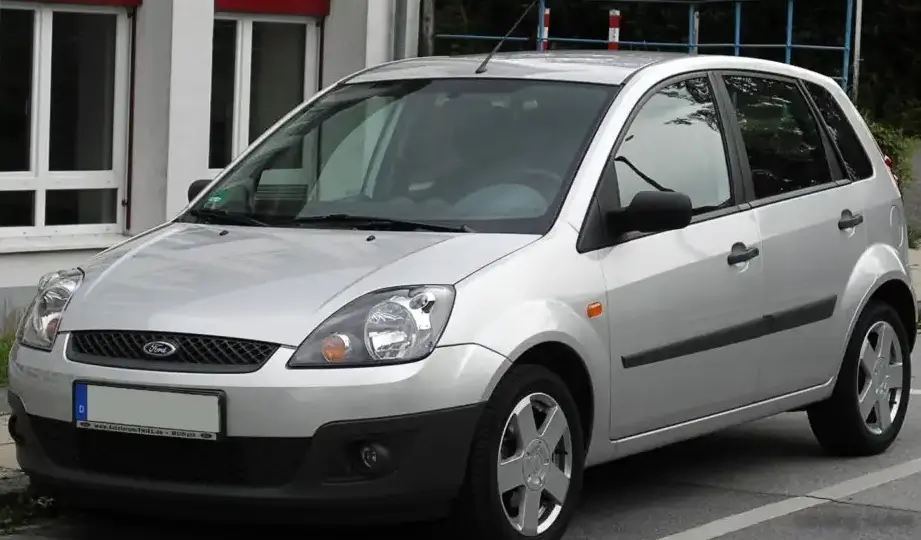
The Ford Fiesta Mk6, specifically the five-door 1.4 Duratorq TDCi variant produced from 2005 to 2008, represented an entry-level diesel option within the facelifted sixth generation of Ford’s popular supermini. This model, powered by the 68 horsepower Duratorq engine, was aimed at buyers prioritizing fuel efficiency and low running costs. It occupied the lower end of the Fiesta Mk6 range, positioned below higher-powered diesel and petrol variants like the 1.6L petrol and the 1.6L TDCi. The facelift, introduced in 2005, brought revised styling, improved interior materials, and updated safety features to the Fiesta lineup.
Technical Specifications
| Brand | Ford |
| Model | Fiesta |
| Generation | Fiesta VI (Mk6, facelift 2005) 5 door |
| Type (Engine) | 1.4 Duratorq TDCi (68 Hp) |
| Start of production | 2005 |
| End of production | 2008 |
| Powertrain Architecture | Internal Combustion engine |
| Body type | Hatchback |
| Seats | 5 |
| Doors | 5 |
| Fuel consumption (urban) | 5.8 l/100 km (40.6 US mpg, 48.7 UK mpg, 17.2 km/l) |
| Fuel consumption (extra urban) | 3.8 l/100 km (61.9 US mpg, 74.3 UK mpg, 26.3 km/l) |
| Fuel consumption (combined) | 4.5 l/100 km (52.3 US mpg, 62.8 UK mpg, 22.2 km/l) |
| CO2 emissions | 119 g/km |
| Fuel Type | Diesel |
| Acceleration 0 – 100 km/h | 15.5 sec |
| Acceleration 0 – 62 mph | 15.5 sec |
| Acceleration 0 – 60 mph | 14.4 sec |
| Maximum speed | 164 km/h (101.9 mph) |
| Emission standard | Euro 4 |
| Weight-to-power ratio | 15.7 kg/Hp |
| Weight-to-torque ratio | 6.7 kg/Nm |
| Power | 68 Hp @ 4000 rpm |
| Power per litre | 48.6 Hp/l |
| Torque | 160 Nm @ 2000 rpm (118.01 lb.-ft. @ 2000 rpm) |
| Engine layout | Front, Transverse |
| Engine Model/Code | F6JA |
| Engine displacement | 1399 cm3 (85.37 cu. in.) |
| Number of cylinders | 4 |
| Engine configuration | Inline |
| Number of valves per cylinder | 2 |
| Fuel injection system | Diesel Commonrail |
| Engine aspiration | Turbocharger, Intercooler |
| Valvetrain | SOHC |
| Engine oil capacity | 3.8 l (4.02 US qt, 3.34 UK qt) |
| Coolant capacity | 5.5 l (5.81 US qt, 4.84 UK qt) |
| Kerb Weight | 1070 kg (2358.95 lbs) |
| Max. weight | 1570 kg (3461.26 lbs) |
| Max load | 500 kg (1102.31 lbs) |
| Trunk (boot) space – minimum | 284 l (10.03 cu. ft.) |
| Trunk (boot) space – maximum | 947 l (33.44 cu. ft.) |
| Fuel tank capacity | 43 l (11.36 US gal, 9.46 UK gal) |
| Max. roof load | 75 kg (165.35 lbs) |
| Permitted trailer load with brakes (12%) | 750 kg (1653.47 lbs) |
| Length | 3918 mm (154.25 in) |
| Width | 1685 mm (66.34 in) |
| Width including mirrors | 1907 mm (75.08 in) |
| Height | 1464 mm (57.64 in) |
| Wheelbase | 2486 mm (97.87 in) |
| Front track | 1464-1474 mm (57.64 – 58.03 in) |
| Rear track | 1435-1444 mm (56.5 – 56.85 in) |
| Minimum turning circle | 9.3 m (30.51 ft) |
| Drivetrain | Front wheel drive |
| Number of gears | 5 |
| Gearbox type | Manual transmission |
| Front suspension | Independent type McPherson, Transverse stabilizer |
| Rear suspension | Coil spring, Elastic beam |
| Front brakes | Disc |
| Rear brakes | Drum |
| Assisting systems | ABS (Anti-lock braking system) |
| Steering type | Steering rack and pinion |
| Power steering | Hydraulic |
| Tires size | 195/50 R 15 |
| Wheel rims size | 15 |
INTRODUCTION
The 1.4 Duratorq TDCi five-door Fiesta, introduced as part of the Mk6 facelift in 2005, was a key model for Ford in Europe, particularly in markets where diesel fuel was favored and tax incentives existed for lower-emission vehicles. It aimed to provide an affordable and economical option for urban commuters and small families. The Mk6 Fiesta, built on the B3 platform, was a significant step forward for Ford in terms of build quality and refinement compared to its predecessor. This variant remained in production until 2008, superseded by later iterations of the Fiesta with updated engines and technology.
Powertrain & Engine Architecture
The heart of this Fiesta variant is the 1.4-liter Duratorq TDCi engine, identified by the engine code F6JA. This engine is a four-cylinder, inline diesel featuring a turbocharger with intercooler and a common rail direct injection system. The common rail system, operating at high pressure, allows for precise fuel delivery and contributes to improved fuel efficiency and reduced emissions. The engine utilizes a single overhead camshaft (SOHC) valvetrain with two valves per cylinder. The 1.4 Duratorq TDCi produced 68 horsepower at 4000 rpm and 160 Nm (118 lb-ft) of torque at 2000 rpm. The engine is transversely mounted in the front of the vehicle. The five-speed manual transmission was the standard offering for this model, providing a balance between fuel economy and drivability. The gearbox ratios were geared towards maximizing fuel efficiency rather than outright performance.
Driving Characteristics
The 1.4 Duratorq TDCi Fiesta offered a practical, if not particularly exciting, driving experience. Acceleration was modest, taking around 15.5 seconds to reach 62 mph (100 km/h). The engine’s torque, however, was readily available from low engine speeds, making it suitable for navigating urban traffic. The five-speed manual transmission allowed for reasonable control, but the gear ratios were spaced to prioritize fuel economy over spirited driving. Compared to the 1.6L petrol version, the 1.4 TDCi offered significantly better fuel economy but lacked the petrol engine’s responsiveness. Against the higher-output 1.6L TDCi, the 1.4 felt noticeably slower, but the 1.4 was more affordable to purchase and operate.
Equipment & Trim Levels
The 1.4 Duratorq TDCi Fiesta typically came equipped with basic, but functional, features. Standard equipment generally included power steering, central locking, electric front windows, and an adjustable steering column. Interior upholstery was typically cloth, and the dashboard featured a simple, straightforward design. Optional extras included air conditioning, alloy wheels, and a CD player. Trim levels varied slightly depending on the market, but the 1.4 TDCi generally represented the entry-level diesel offering, with fewer standard features than higher-spec models.
Chassis & Braking
The Fiesta Mk6 utilized a McPherson strut independent suspension setup at the front, providing a comfortable ride and decent handling. The rear suspension employed a semi-independent elastic beam configuration, which was a cost-effective solution for the rear axle. Braking was handled by disc brakes at the front and drum brakes at the rear. Anti-lock Braking System (ABS) was standard, enhancing safety during emergency braking situations. The chassis was tuned to prioritize ride comfort and stability, rather than sporty handling. Stabilizer bars were fitted to both the front and rear axles to reduce body roll.
Market Reception & Comparison
The 1.4 Duratorq TDCi Fiesta was generally well-received by critics as an economical and practical city car. Its fuel efficiency was a major selling point, and its low running costs appealed to budget-conscious buyers. However, some reviewers criticized its lack of power and relatively slow acceleration. Compared to other superminis in its class, such as the Renault Clio and Volkswagen Polo, the Fiesta offered a competitive level of equipment and fuel economy. The 1.4 TDCi consistently achieved better fuel economy than the petrol-powered Fiesta variants, making it a popular choice for high-mileage drivers.
Legacy
The 1.4 Duratorq TDCi engine, while not known for being particularly powerful, proved to be relatively reliable. Common issues included occasional turbocharger problems and potential issues with the fuel injection system, but these were not widespread. Today, used examples of the 1.4 TDCi Fiesta are relatively affordable and can represent a good value for buyers seeking an economical and practical city car. However, potential buyers should be aware of the age-related wear and tear and ensure that the vehicle has been properly maintained. The engine’s simplicity and relatively low maintenance requirements contribute to its continued appeal in the used car market.