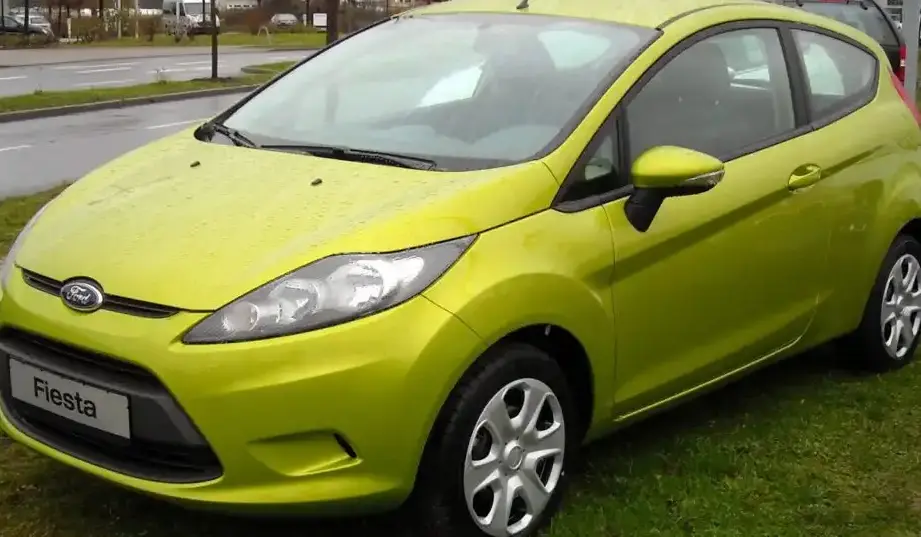
The Ford Fiesta Mk7, produced from 2008 to 2012, represented a significant step forward for Ford’s supermini. The 3-door 1.25-liter variant, outputting 82 horsepower, served as a key entry point into the Mk7 Fiesta range, particularly in European markets. Positioned below the more powerful 1.6-liter models and the diesel options, it aimed to provide affordable and economical transportation for urban drivers and first-time car buyers. This model was a cornerstone of Ford’s strategy to offer a diverse Fiesta lineup catering to a broad spectrum of customer needs.
Technical Specifications
| Brand | Ford |
| Model | Fiesta |
| Generation | Fiesta VII (Mk7) 3 door |
| Type (Engine) | 1.25 (82 Hp) |
| Start of production | 2008 |
| End of production | 2012 |
| Powertrain Architecture | Internal Combustion engine |
| Body type | Hatchback |
| Seats | 5 |
| Doors | 3 |
| Fuel consumption (urban) | 7.5 l/100 km (31.4 US mpg) |
| Fuel consumption (extra urban) | 4.6 l/100 km (51.1 US mpg) |
| Fuel consumption (combined) | 5.7 l/100 km (41.3 US mpg) |
| CO2 emissions | 133 g/km |
| Fuel Type | Petrol (Gasoline) |
| Acceleration 0 – 100 km/h | 13.3 sec |
| Acceleration 0 – 62 mph | 13.3 sec |
| Acceleration 0 – 60 mph | 12.6 sec |
| Maximum speed | 168 km/h (104.39 mph) |
| Emission standard | Euro 4 |
| Weight-to-power ratio | 13.4 kg/Hp |
| Weight-to-torque ratio | 9.6 kg/Nm |
| Power | 82 Hp @ 5800 rpm |
| Torque | 114 Nm @ 4200 rpm (84.08 lb.-ft. @ 4200 rpm) |
| Engine layout | Front, Transverse |
| Engine Model/Code | SNJA, SNJB |
| Engine displacement | 1242 cm3 (75.79 cu. in.) |
| Number of cylinders | 4 |
| Engine configuration | Inline |
| Cylinder Bore | 71.9 mm (2.83 in.) |
| Piston Stroke | 76.5 mm (3.01 in.) |
| Number of valves per cylinder | 4 |
| Fuel injection system | Multi-port manifold injection |
| Engine aspiration | Naturally aspirated engine |
| Valvetrain | OHC |
| Engine oil capacity | 3.8 l (4.02 US qt | 3.34 UK qt) |
| Coolant capacity | 5.5 l (5.81 US qt | 4.84 UK qt) |
| Kerb Weight | 1098 kg (2420.68 lbs.) |
| Max. weight | 1490 kg (3284.89 lbs.) |
| Max load | 392 kg (864.21 lbs.) |
| Trunk (boot) space – minimum | 295 l (10.42 cu. ft.) |
| Trunk (boot) space – maximum | 979 l (34.57 cu. ft.) |
| Fuel tank capacity | 45 l (11.89 US gal | 9.9 UK gal) |
| Length | 3950 mm (155.51 in.) |
| Width | 1722 mm (67.8 in.) |
| Width including mirrors | 1973 mm (77.68 in.) |
| Height | 1481 mm (58.31 in.) |
| Wheelbase | 2489 mm (97.99 in.) |
| Front track | 1493 mm (58.78 in.) |
| Rear track | 1480 mm (58.27 in.) |
| Minimum turning circle | 10.2 m (33.46 ft.) |
| Drivetrain | Front wheel drive |
| Number of gears | 5 gears, manual transmission |
| Front suspension | Independent, type McPherson with coil spring and anti-roll bar |
| Rear suspension | Coil spring, Torsion |
| Front brakes | Ventilated discs |
| Rear brakes | Drum |
| Assisting systems | ABS (Anti-lock braking system) |
| Steering type | Steering rack and pinion |
| Power steering | Electric Steering |
| Tires size | 175/65 R 14 |
| Wheel rims size | 5.5J x 14 |
INTRODUCTION
The Ford Fiesta Mk7, launched in 2008, represented a significant redesign of Ford’s popular supermini. Built on the global B-platform (shared with the Ford Focus Mk3), the Mk7 aimed to improve upon its predecessor in terms of styling, interior quality, and driving dynamics. The 3-door 1.25-liter model, producing 82 horsepower, was a mainstay of the range, particularly in Europe where smaller-engined cars were favored due to tax regulations and fuel costs. It offered a balance between affordability and practicality, targeting young drivers, city commuters, and those seeking a low-cost-to-run vehicle.
Powertrain & Engine Architecture
The heart of this Fiesta variant is the Duratec 1.25-liter inline-four cylinder engine, designated with engine codes SNJA or SNJB. This engine is a naturally aspirated unit featuring multi-point fuel injection and an overhead camshaft (OHC) valvetrain. While relatively simple in design, it proved to be a reliable powerplant. The 1.25L engine produces 82 horsepower at 5800 rpm and 114 Nm (84 lb-ft) of torque at 4200 rpm. The engine’s modest output is delivered through a five-speed manual transmission, which was the standard offering for this trim level. The transmission is known for its light shift action, but its ratios are geared towards fuel efficiency rather than outright performance. The engine’s design prioritized fuel economy and low emissions, making it compliant with Euro 4 standards.
Driving Characteristics
The 1.25-liter Fiesta Mk7 is not a performance-oriented vehicle. Acceleration from 0-60 mph takes around 12.6 seconds, and top speed is limited to 104 mph. However, it provides adequate power for urban driving and short highway trips. The engine feels somewhat strained when pushed hard, particularly when fully loaded or climbing hills. The five-speed gearbox is well-matched to the engine’s characteristics, offering smooth shifts and reasonable spacing between gears. The steering is light and precise, making it easy to maneuver in tight spaces. The suspension provides a comfortable ride, absorbing bumps and imperfections in the road surface effectively. Compared to the 1.6-liter variants, the 1.25 feels noticeably slower, but it offers superior fuel economy.
Equipment & Trim Levels
The 1.25-liter Fiesta Mk7 typically came equipped with a basic but functional level of standard equipment. This included central locking, power steering, electric front windows, and an ABS anti-lock braking system. Air conditioning was often an optional extra, as were alloy wheels and a CD player with auxiliary input. Interior trim was typically cloth upholstery in a dark color scheme. Higher trim levels, such as Style or Zetec, added features like alloy wheels, body-colored bumpers, and upgraded interior trim. The base 1.25 model focused on providing essential features at an affordable price point.
Chassis & Braking
The Fiesta Mk7 utilizes a McPherson strut front suspension and a torsion beam rear suspension. This setup provides a good balance between ride comfort and handling. The front brakes are ventilated discs, while the rear brakes are drums. This configuration was typical for vehicles in this weight class and price range. The steering is a rack and pinion system with electric power assistance, providing light and precise steering feel. The chassis is relatively lightweight, contributing to the car’s nimble handling characteristics. The ABS system provides enhanced braking performance and stability, particularly on slippery surfaces.
Market Reception & Comparison
The 1.25-liter Fiesta Mk7 was generally well-received by critics as an affordable and economical city car. It was praised for its fuel efficiency, comfortable ride, and nimble handling. However, it was also criticized for its lack of power, particularly when compared to the 1.6-liter models. In terms of fuel economy, the 1.25-liter variant consistently outperformed the larger-engined versions, achieving around 41.3 US mpg on the combined cycle. Reliability was generally good, with few major issues reported. Compared to rivals like the Volkswagen Polo and Renault Clio, the Fiesta offered a competitive package in terms of price, features, and driving dynamics.
Legacy
The 1.25-liter Fiesta Mk7 remains a popular choice in the used car market, particularly for first-time drivers and those seeking a low-cost-to-run vehicle. The Duratec 1.25-liter engine is known for its reliability and durability, although regular maintenance is essential. Common issues include occasional oil leaks and wear on the timing chain. Overall, the 1.25-liter Fiesta Mk7 represents a practical and affordable option for those seeking a reliable and economical supermini. Its enduring popularity is a testament to its well-rounded design and proven mechanicals.