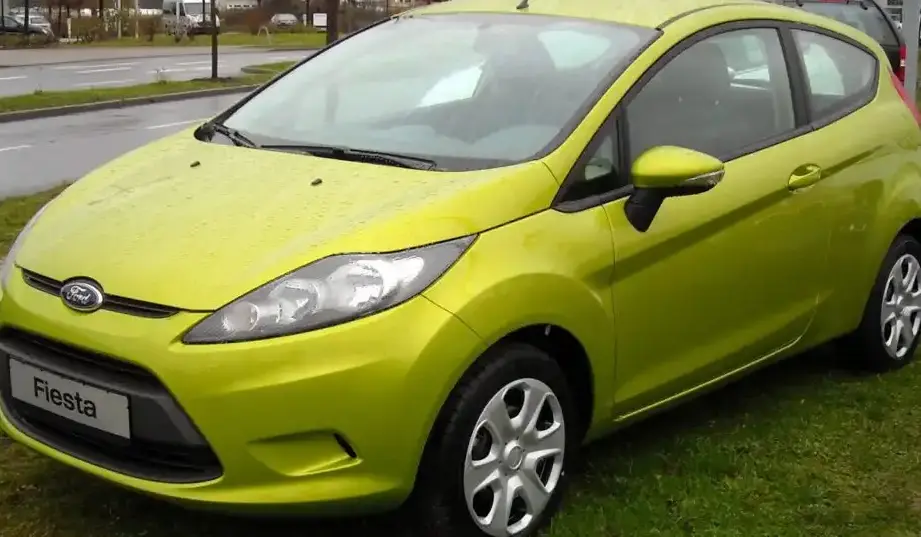
The Ford Fiesta Mk7, produced from 2008 to 2012, represented a significant step forward for Ford’s supermini. The 3-door hatchback configuration, particularly when equipped with the 1.4-liter 96 horsepower engine, offered an accessible entry point into the Mk7 range. This variant occupied a mid-range position within the lineup, slotting below the more powerful 1.6-liter models and above the base 1.25-liter engine. It was primarily aimed at buyers seeking a balance between affordability, fuel efficiency, and reasonable performance for everyday driving. The Mk7 Fiesta was a crucial model for Ford in Europe, competing directly with vehicles like the Volkswagen Polo, Renault Clio, and Opel Corsa.
Technical Specifications
| Brand | Ford |
| Model | Fiesta |
| Generation | Fiesta VII (Mk7) 3 door |
| Type (Engine) | 1.4 (96 Hp) |
| Start of production | 2008 |
| End of production | 2012 |
| Powertrain Architecture | Internal Combustion engine |
| Body type | Hatchback |
| Seats | 5 |
| Doors | 3 |
| Fuel consumption (urban) | 7.5 l/100 km (31.4 US mpg) |
| Fuel consumption (extra urban) | 4.6 l/100 km (51.1 US mpg) |
| Fuel consumption (combined) | 5.7 l/100 km (41.3 US mpg) |
| CO2 emissions | 133 g/km |
| Fuel Type | Petrol (Gasoline) |
| Acceleration 0 – 100 km/h | 12.2 sec |
| Acceleration 0 – 62 mph | 12.2 sec |
| Acceleration 0 – 60 mph | 11.6 sec |
| Maximum speed | 175 km/h (108.74 mph) |
| Emission standard | Euro 4 |
| Weight-to-power ratio | 10.1 kg/Hp |
| Weight-to-torque ratio | 7.7 kg/Nm |
| Power | 96 Hp @ 5750 rpm |
| Torque | 125 Nm @ 4200 rpm (92.2 lb.-ft. @ 4200 rpm) |
| Engine layout | Front, Transverse |
| Engine displacement | 1392 cm3 (84.95 cu. in.) |
| Number of cylinders | 4 |
| Engine configuration | Inline |
| Cylinder Bore | 77.2 mm (3.04 in.) |
| Piston Stroke | 74.3 mm (2.93 in.) |
| Compression ratio | 8.5:1 |
| Number of valves per cylinder | 2 |
| Fuel injection system | Single-point injection |
| Engine aspiration | Naturally aspirated |
| Valvetrain | OHC |
| Engine oil capacity | 3.8 l (4.02 US qt | 3.34 UK qt) |
| Coolant capacity | 5.5 l (5.81 US qt | 4.84 UK qt) |
| Kerb Weight | 966 kg (2129.67 lbs.) |
| Max. weight | 1495 kg (3295.91 lbs.) |
| Max load | 529 kg (1166.25 lbs.) |
| Trunk (boot) space – minimum | 295 l (10.42 cu. ft.) |
| Trunk (boot) space – maximum | 979 l (34.57 cu. ft.) |
| Fuel tank capacity | 45 l (11.89 US gal | 9.9 UK gal) |
| Length | 3950 mm (155.51 in.) |
| Width | 1722 mm (67.8 in.) |
| Width including mirrors | 1973 mm (77.68 in.) |
| Height | 1481 mm (58.31 in.) |
| Wheelbase | 2489 mm (97.99 in.) |
| Front track | 1493 mm (58.78 in.) |
| Rear track | 1480 mm (58.27 in.) |
| Minimum turning circle | 10.2 m (33.46 ft.) |
| Drivetrain | Front wheel drive |
| Number of gears | 5 |
| Gearbox type | Manual transmission |
| Front suspension | Independent, McPherson with coil spring and anti-roll bar |
| Rear suspension | Coil spring, Torsion |
| Front brakes | Ventilated discs |
| Rear brakes | Drum |
| Assisting systems | ABS (Anti-lock braking system) |
| Steering type | Steering rack and pinion |
| Power steering | Electric |
| Tires size | 175/65 R14 |
| Wheel rims size | 5.5J x 14 |
Powertrain & Engine Architecture
The 1.4-liter engine in the Fiesta Mk7, typically identified by engine codes like RTQA, is a naturally aspirated, inline-four cylinder petrol engine. It utilizes a single overhead camshaft (SOHC) valvetrain with two valves per cylinder. The engine employed a multi-point fuel injection system, a step up from earlier single-point systems, contributing to improved fuel efficiency and smoother operation. While not a particularly high-tech engine, it was known for its relative simplicity and durability. The 96 horsepower output was achieved at 5750 rpm, with peak torque of 125 Nm (92.2 lb-ft) delivered at 4200 rpm. The engine’s design prioritized fuel economy and low emissions, meeting Euro 4 standards at the time. The standard transmission for this variant was a five-speed manual gearbox, although a four-speed automatic transmission was also available, albeit less common. The automatic transmission, while offering convenience, did impact fuel economy and acceleration compared to the manual version.
Driving Characteristics
The 1.4-liter Fiesta Mk7 with the manual transmission offered adequate, if not exhilarating, performance. Acceleration from 0-60 mph took around 11.6 seconds, and top speed was approximately 108.74 mph. The engine felt relatively responsive in the lower and mid-range, making it suitable for urban driving and everyday commuting. However, it did require downshifting for overtaking maneuvers or when climbing hills. The automatic transmission version suffered from noticeable performance degradation, with slower acceleration and a less engaging driving experience. The gear ratios were tuned for fuel efficiency rather than outright speed. The steering was light and precise, typical of Ford’s handling characteristics, making the Fiesta easy to maneuver in tight spaces. The suspension provided a comfortable ride, although it could feel a bit soft during more spirited driving.
Equipment & Trim Levels
The 1.4-liter Fiesta Mk7 was typically offered in base or mid-range trim levels, such as ‘Style’ or ‘Zetec’. Standard equipment generally included power steering, central locking, electric front windows, and an ABS anti-lock braking system. Higher trim levels added features like air conditioning, alloy wheels, a CD player with auxiliary input, and front fog lights. Interior upholstery was typically cloth, with a relatively simple dashboard layout. Optional extras included a sunroof, upgraded audio systems, and parking sensors. The 3-door configuration emphasized a sportier aesthetic, appealing to younger buyers or those prioritizing a more compact footprint.
Chassis & Braking
The Fiesta Mk7 utilized a McPherson strut front suspension and a torsion beam rear suspension. This setup provided a good balance between ride comfort and handling. The front brakes were ventilated discs, offering adequate stopping power, while the rear brakes were drums, a cost-saving measure common in this segment. The electric power steering provided light and precise steering feel. The chassis was relatively lightweight, contributing to the car’s agility. Stabilizer bars were fitted to both the front and rear axles to reduce body roll during cornering.
Market Reception & Comparison
The 1.4-liter Fiesta Mk7 was generally well-received by automotive critics as a practical and affordable supermini. It was praised for its fuel efficiency, comfortable ride, and nimble handling. However, some reviewers noted that the engine lacked outright power, particularly when compared to the 1.6-liter variants. The automatic transmission was often criticized for its sluggish performance. Compared to rivals like the Volkswagen Polo and Renault Clio, the Fiesta offered a more engaging driving experience and a slightly more affordable price point. The 1.6-liter models offered significantly more performance but came at a higher cost and with slightly lower fuel economy.
Legacy
The 1.4-liter Fiesta Mk7 has proven to be a relatively reliable powertrain in the used car market. The engine is known for its durability, and maintenance costs are generally reasonable. Common issues include occasional oil leaks and wear on the suspension components. The availability of spare parts is good, and the car’s simple design makes it relatively easy to repair. Today, the Fiesta Mk7 1.4 remains a popular choice for first-time car buyers and those seeking an affordable and economical city car. Its blend of practicality, fuel efficiency, and Ford’s renowned driving dynamics continue to make it a compelling option in the used car market.