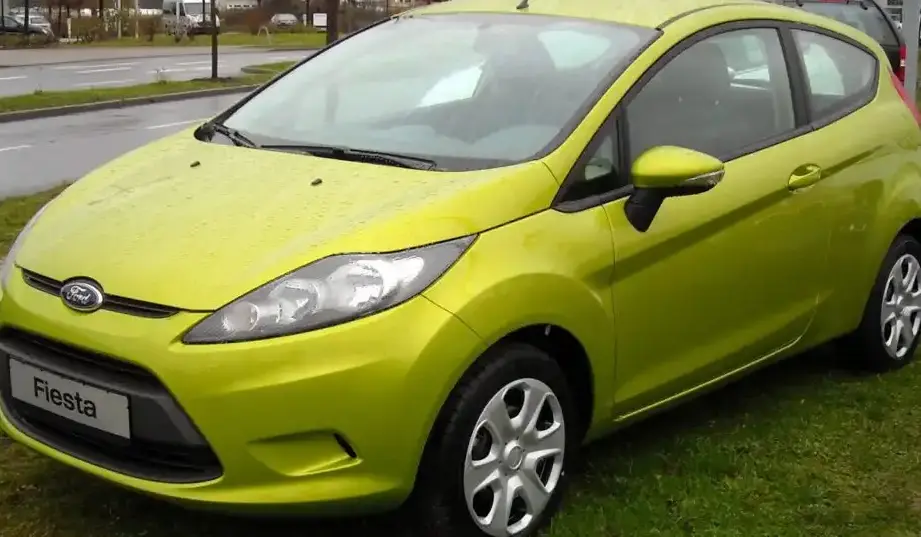
The Ford Fiesta Mk7, produced from 2008 to 2012, represented a significant step forward for Ford’s supermini. The 3-door variant, particularly when equipped with the 1.4-liter engine producing 96 horsepower and paired with a four-speed automatic transmission, occupied a specific niche within the Fiesta lineup. This configuration was aimed at buyers prioritizing ease of use and affordability over outright performance, offering a comfortable and practical option for urban driving. It was positioned as an entry-level to mid-range trim, bridging the gap between the base 1.25L models and the more powerful, and often more expensive, 1.6-liter variants.
Technical Specifications
| Brand | Ford |
| Model | Fiesta |
| Generation | Fiesta VII (Mk7) 3 door |
| Type (Engine) | 1.4 (96 Hp) Automatic |
| Start of production | 2008 |
| End of production | 2012 |
| Powertrain Architecture | Internal Combustion engine |
| Body type | Hatchback |
| Seats | 5 |
| Doors | 3 |
| Fuel consumption (urban) | 8.9 l/100 km (26.4 US mpg, 31.7 UK mpg, 11.2 km/l) |
| Fuel consumption (extra urban) | 5.1 l/100 km (46.1 US mpg, 55.4 UK mpg, 19.6 km/l) |
| Fuel consumption (combined) | 6.5 l/100 km (36.2 US mpg, 43.5 UK mpg, 15.4 km/l) |
| CO2 emissions | 154 g/km |
| Fuel Type | Petrol (Gasoline) |
| Acceleration 0 – 100 km/h | 13.9 sec |
| Acceleration 0 – 62 mph | 13.9 sec |
| Acceleration 0 – 60 mph | 13.2 sec |
| Maximum speed | 166 km/h (103.15 mph) |
| Emission standard | Euro 4 |
| Weight-to-power ratio | 11.4 kg/Hp, 87.4 Hp/tonne |
| Weight-to-torque ratio | 8.6 kg/Nm, 116.6 Nm/tonne |
| Power | 96 Hp @ 5750 rpm |
| Power per litre | 69.2 Hp/l |
| Torque | 128 Nm @ 4200 rpm (94.41 lb.-ft. @ 4200 rpm) |
| Engine layout | Front, Transverse |
| Engine Model/Code | RTJA, SPJA, RTJB, SPJC |
| Engine displacement | 1388 cm3 (84.7 cu. in.) |
| Number of cylinders | 4 |
| Engine configuration | Inline |
| Cylinder Bore | 77.2 mm (3.04 in.) |
| Piston Stroke | 74.3 mm (2.93 in.) |
| Compression ratio | 8.5:1 |
| Number of valves per cylinder | 2 |
| Fuel injection system | Single-point injection |
| Engine aspiration | Naturally aspirated engine |
| Valvetrain | OHC |
| Engine oil capacity | 3.8 l (4.02 US qt | 3.34 UK qt) |
| Coolant | 5.5 l (5.81 US qt | 4.84 UK qt) |
| Kerb Weight | 1098 kg (2420.68 lbs.) |
| Max. weight | 1495 kg (3295.91 lbs.) |
| Max load | 397 kg (875.24 lbs.) |
| Trunk (boot) space – minimum | 295 l (10.42 cu. ft.) |
| Trunk (boot) space – maximum | 979 l (34.57 cu. ft.) |
| Fuel tank capacity | 45 l (11.89 US gal | 9.9 UK gal) |
| Length | 3950 mm (155.51 in.) |
| Width | 1722 mm (67.8 in.) |
| Width including mirrors | 1973 mm (77.68 in.) |
| Height | 1481 mm (58.31 in.) |
| Wheelbase | 2489 mm (97.99 in.) |
| Front track | 1493 mm (58.78 in.) |
| Rear (Back) track | 1480 mm (58.27 in.) |
| Minimum turning circle | 10.2 m (33.46 ft.) |
| Drivetrain Architecture | The Internal combustion engine (ICE) drives the front wheels of the vehicle. |
| Drive wheel | Front wheel drive |
| Number of gears and type of gearbox | 4 gears, automatic transmission |
| Front suspension | Independent, type McPherson with coil spring and anti-roll bar |
| Rear suspension | Coil spring, Torsion |
| Front brakes | Ventilated discs |
| Rear brakes | Drum |
| Assisting systems | ABS (Anti-lock braking system) |
| Steering type | Steering rack and pinion |
| Power steering | Electric Steering |
| Tires size | 175/65 R14 |
| Wheel rims size | 5.5J x 14 |
Powertrain & Engine Architecture
The heart of this Fiesta variant is the Duratec 1.4-liter inline-four cylinder engine, specifically identified by engine codes RTJA, SPJA, RTJB, or SPJC. This engine utilizes a single-point fuel injection system, a relatively simple setup compared to the multi-point injection found in some of its siblings. The overhead camshaft (OHC) valvetrain operates two valves per cylinder. The engine’s 8.5:1 compression ratio was a compromise between efficiency and performance. Paired with this engine is a four-speed automatic transmission. This transmission, while providing convenience, was known for its relatively slow shift times and limited gear selection compared to more modern automatics or manual transmissions. It was a common automatic option in the European market at the time, prioritizing affordability over cutting-edge technology.
Driving Characteristics
The 1.4L automatic Fiesta offered a decidedly relaxed driving experience. Acceleration from 0-60 mph took around 13.2 seconds, and 0-100 km/h in 13.9 seconds, making it noticeably slower than the manual transmission versions or those equipped with the 1.6-liter engine. The four-speed automatic transmission contributed to this, with wider gear ratios that didn’t always keep the engine in its optimal power band. However, for everyday urban driving, the automatic provided a smooth and effortless experience. The relatively light weight of the Fiesta (around 1098 kg / 2420.68 lbs) helped mitigate the lack of outright power, making it feel reasonably nimble in city traffic. Fuel economy was a strong point, with combined figures around 36.2 US mpg.
Equipment & Trim Levels
The 1.4 Automatic Fiesta typically came with a base level of equipment, including power steering, ABS brakes, and a basic audio system. Interior upholstery was usually cloth, and the dashboard featured a functional, if somewhat basic, design. Optional extras included air conditioning, alloy wheels, and upgraded audio systems. Higher trim levels, such as the Zetec, offered more standard features and styling enhancements, but these generally came with a higher-output engine and/or a manual transmission. The focus of this trim was practicality and affordability, offering essential features without the added cost of luxury items.
Chassis & Braking
The Fiesta Mk7 utilized an independent McPherson strut front suspension and a torsion beam rear suspension. This setup provided a reasonable balance between ride comfort and handling. Front brakes were ventilated discs, offering adequate stopping power, while the rear brakes were drums, a cost-saving measure common in this segment. The electric power steering provided light and easy steering, making it ideal for maneuvering in tight spaces. Stabilizer bars were fitted to both the front and rear axles to reduce body roll during cornering.
Market Reception & Comparison
The 1.4L automatic Fiesta received mixed reviews. Critics generally praised its fuel efficiency and ease of use, but often criticized its lack of performance. Compared to the 1.6-liter models, it felt significantly underpowered. The manual transmission versions of the 1.4 were also considered more engaging to drive. However, the automatic version appealed to buyers who prioritized convenience and low running costs. Its reliability was generally good, although the automatic transmission could be prone to issues if not properly maintained. The 1.9 TDI diesel variants offered superior fuel economy, but at a higher purchase price and with potentially higher maintenance costs.
Legacy
The 1.4L automatic Fiesta Mk7 remains a relatively common sight on used car lots today. The Duratec engine is known for its durability, and with regular maintenance, it can provide many years of reliable service. The four-speed automatic transmission, while not the most sophisticated, is generally robust. These cars represent an affordable and practical entry point into Fiesta ownership, appealing to first-time drivers or those seeking a dependable city car. While not a performance icon, the 1.4 automatic Fiesta Mk7 played a valuable role in making the Fiesta accessible to a wider range of buyers.