Technical Specifications
| Brand | Ford |
| Model | Fiesta |
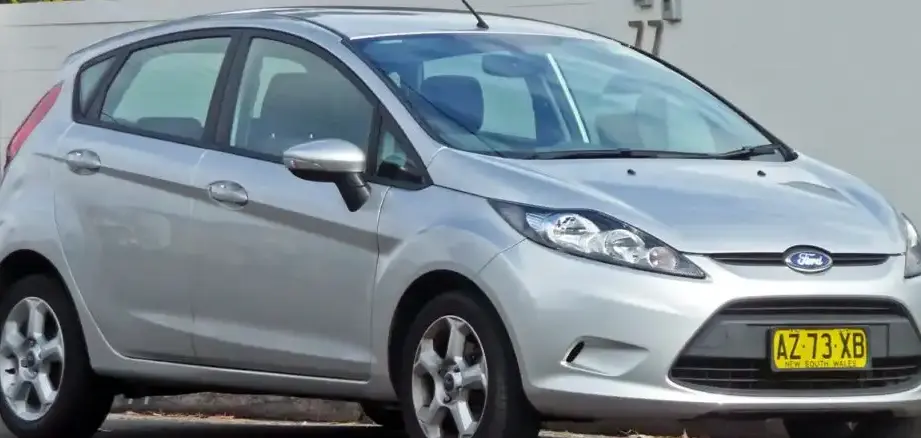
| Generation | Fiesta VII (Mk7) 5 door |
| Type (Engine) | 1.25 (82 Hp) |
| Start of production | 2008 |
| End of production | 2012 |
| Powertrain Architecture | Internal Combustion engine |
| Body type | Hatchback |
| Seats | 5 |
| Doors | 5 |
| Fuel consumption (urban) | 7.5 l/100 km (31.4 US mpg) |
| Fuel consumption (extra urban) | 4.6 l/100 km (51.1 US mpg) |
| Fuel consumption (combined) | 5.7 l/100 km (41.3 US mpg) |
| CO2 emissions | 133 g/km |
| Fuel Type | Petrol (Gasoline) |
| Acceleration 0 – 100 km/h | 13.3 sec |
| Acceleration 0 – 62 mph | 13.3 sec |
| Acceleration 0 – 60 mph | 12.6 sec |
| Maximum speed | 168 km/h (104.39 mph) |
| Emission standard | Euro 4 |
| Weight-to-power ratio | 13.5 kg/Hp |
| Weight-to-torque ratio | 9.7 kg/Nm |
| Power | 82 Hp @ 5800 rpm |
| Torque | 114 Nm @ 4200 rpm (84.08 lb.-ft. @ 4200 rpm) |
| Engine layout | Front, Transverse |
| Engine Model/Code | SNJA, SNJB |
| Engine displacement | 1242 cm3 (75.79 cu. in.) |
| Number of cylinders | 4 |
| Engine configuration | Inline |
| Cylinder Bore | 71.9 mm (2.83 in.) |
| Piston Stroke | 76.5 mm (3.01 in.) |
| Number of valves per cylinder | 4 |
| Fuel injection system | Multi-port manifold injection |
| Engine aspiration | Naturally aspirated engine |
| Valvetrain | OHC |
| Engine oil capacity | 3.8 l (4.02 US qt | 3.34 UK qt) |
| Coolant capacity | 5.5 l (5.81 US qt | 4.84 UK qt) |
| Kerb Weight | 1109 kg (2444.93 lbs.) |
| Max. weight | 1495 kg (3295.91 lbs.) |
| Max load | 386 kg (850.98 lbs.) |
| Trunk (boot) space – minimum | 295 l (10.42 cu. ft.) |
| Trunk (boot) space – maximum | 979 l (34.57 cu. ft.) |
| Fuel tank capacity | 45 l (11.89 US gal | 9.9 UK gal) |
| Length | 3950 mm (155.51 in.) |
| Width | 1722 mm (67.8 in.) |
| Width including mirrors | 1973 mm (77.68 in.) |
| Height | 1481 mm (58.31 in.) |
| Wheelbase | 2489 mm (97.99 in.) |
| Front track | 1493 mm (58.78 in.) |
| Rear track | 1480 mm (58.27 in.) |
| Minimum turning circle | 10.2 m (33.46 ft.) |
| Drivetrain Architecture | Front wheel drive |
| Number of gears | 5 |
| Gearbox type | Manual transmission |
| Front suspension | Independent, McPherson with coil spring and anti-roll bar |
| Rear suspension | Coil spring, Torsion |
| Front brakes | Ventilated discs |
| Rear brakes | Drum |
| Assisting systems | ABS (Anti-lock braking system) |
| Steering type | Steering rack and pinion |
| Power steering | Electric |
| Tires size | 175/65 R14 |
| Wheel rims size | 5.5J x 14 |
The Ford Fiesta Mk7, produced from 2008 to 2012, marked a significant evolution for Ford’s popular supermini. The 1.25-liter, 82-horsepower five-door variant held a crucial position in the lineup as an entry-level option, appealing to buyers who prioritized affordability and fuel efficiency. This model, identified by engine codes SNJA or SNJB, was a common sight on European roads and provided a practical and economical solution for daily commutes and first-time car owners. It sat below the more powerful 1.6-liter versions and the diesel offerings, striking a balance between cost and usability within the broader Mk7 Fiesta range, which was built on the 1HX0/A3 platform.
Powertrain & Engine Architecture
At the core of this Fiesta variant lies the Duratec 1.25-liter inline-four cylinder engine, designated with the SNJA or SNJB code. This engine is a naturally aspirated design featuring a single overhead camshaft (OHC) and multi-point fuel injection. The engine’s development focused on maximizing fuel economy and delivering smooth operation rather than peak performance. The 1.25L engine generates 82 horsepower at 5800 rpm and 114 Nm (84 lb-ft) of torque at 4200 rpm. Its relatively low compression ratio and conservative engine mapping contributed to its inherent reliability. While a five-speed manual transmission was the most common pairing, a four-speed automatic transmission was also available, though less frequently chosen. The automatic transmission, while offering convenience, did result in a slight decrease in fuel economy and acceleration compared to the manual counterpart.
Driving Characteristics
The 1.25-liter Fiesta equipped with the manual transmission offered adequate, though not particularly exciting, performance. Acceleration from 0-60 mph took approximately 12.6 seconds, with a top speed around 104 mph. The automatic version experienced noticeably slower acceleration times. The engine performed best in urban environments, providing sufficient power for navigating city streets and merging into traffic. Highway driving, however, demanded more effort to maintain speed, especially when the vehicle was fully loaded. The five-speed manual gearbox offered a reasonable range of ratios, allowing the driver to keep the engine within its optimal power band. The automatic transmission, while smooth in operation, lacked the responsiveness of more modern units and could feel hesitant during overtaking maneuvers. The gear ratios were tuned for economy rather than spirited driving.
Equipment & Trim Levels
The 1.25-liter Fiesta typically came standard with essential features. These included power steering, central locking, electric front windows, and an ABS anti-lock braking system. Higher trim levels, such as Style or Zetec, added enhancements like alloy wheels, air conditioning, a CD player, and upgraded interior trim. Interior upholstery was generally cloth, with a relatively straightforward dashboard layout. Optional extras available for this trim included a sunroof, parking sensors, and enhanced audio systems. The base models were intentionally kept simple to maintain a competitive price point.
Chassis & Braking
The Fiesta Mk7 employed a McPherson strut front suspension and a torsion beam rear suspension. This configuration prioritized ride comfort, although it didn’t deliver a particularly sporty handling experience. The front brakes were ventilated discs, while the rear brakes utilized drum brakes. This setup was standard for vehicles in this weight class and price bracket. Electric power steering provided light and effortless steering, making it well-suited for city driving. The car’s relatively low weight – around 1109 kg (2445 lbs) – helped to compensate for the engine’s modest power output.
Market Reception & Comparison
The 1.25-liter Fiesta was generally well-received by automotive critics as a practical and affordable supermini. It earned praise for its fuel efficiency, comfortable ride quality, and ease of driving. However, it also faced criticism for its limited power and somewhat basic interior appointments. When compared to the 1.6-liter models, the 1.25 offered significantly less performance but at a lower purchase price. The diesel variants provided superior fuel economy but came with a higher initial cost. The 1.25L automatic was often viewed as a compromise, offering convenience at the expense of both performance and fuel efficiency. It appealed to drivers who prioritized ease of use over driving dynamics.
Legacy
The 1.25-liter Fiesta Mk7 has proven to be a relatively reliable vehicle, with the Duratec engine known for its durability. Common maintenance issues typically involve wear-and-tear components, such as exhaust system parts and suspension elements. In the used car market, these models are frequently sought after by budget-conscious buyers seeking a dependable and economical city car. While not a performance icon, the 1.25 Fiesta Mk7 continues to be a popular choice for those prioritizing a practical and affordable supermini. Its simplicity and robust engine contribute to its ongoing appeal as a value-oriented transportation option.