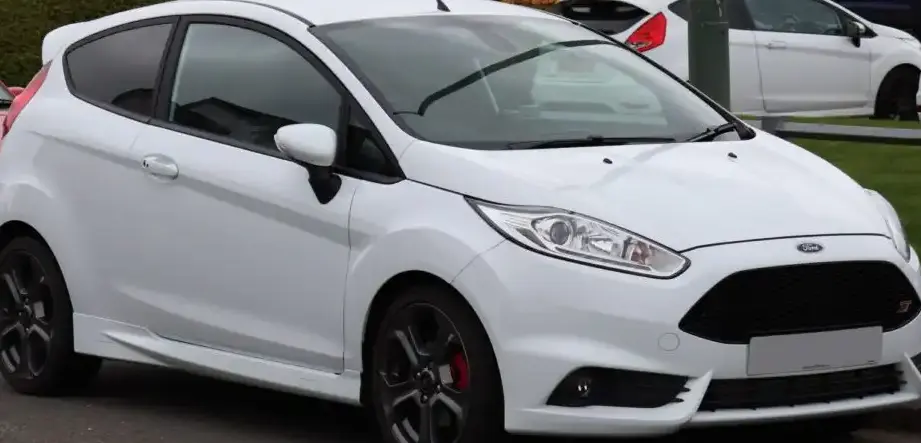
The Ford Fiesta ST, specifically the 3-door variant powered by the 1.6-liter EcoBoost engine producing 182 horsepower, was a performance-oriented subcompact car produced from 2013 to 2017. This model represented a significant step up in driving dynamics for the Fiesta line, transforming the traditionally economical hatchback into a genuinely engaging and capable hot hatch. It was part of the Mk7 Fiesta generation, benefitting from a 2013 facelift that brought styling updates and revised interior features. The ST trim occupied the top performance tier of the Fiesta range, positioned above the standard Fiesta models and offering a more focused driving experience than other engine options.
Technical Specifications
| Brand | Ford |
| Model | Fiesta |
| Generation | Fiesta VII (Mk7, facelift 2013) 3 door |
| Type (Engine) | ST 1.6 EcoBoost (182 Hp) |
| Start of production | 2013 |
| End of production | 2017 |
| Powertrain Architecture | Internal Combustion engine |
| Body type | Hatchback |
| Seats | 5 |
| Doors | 3 |
| Fuel consumption (urban) | 7.9 l/100 km (29.8 US mpg, 35.8 UK mpg, 12.7 km/l) |
| Fuel consumption (extra urban) | 4.8 l/100 km (49 US mpg, 58.9 UK mpg, 20.8 km/l) |
| Fuel consumption (combined) | 5.9 l/100 km (39.9 US mpg, 47.9 UK mpg, 16.9 km/l) |
| CO2 emissions | 138 g/km |
| Fuel Type | Petrol (Gasoline) |
| Acceleration 0 – 100 km/h | 6.9 sec |
| Acceleration 0 – 62 mph | 6.9 sec |
| Acceleration 0 – 60 mph | 6.6 sec |
| Maximum speed | 223 km/h (138.57 mph) |
| Emission standard | Euro 5 |
| Weight-to-power ratio | 6 kg/Hp, 167.3 Hp/tonne |
| Weight-to-torque ratio | 4.5 kg/Nm, 220.6 Nm/tonne |
| Power | 182 Hp @ 5700 rpm |
| Power per litre | 114 Hp/l |
| Torque | 240 Nm @ 1600-5000 rpm (177.01 lb.-ft. @ 1600-5000 rpm) |
| Engine layout | Front, Transverse |
| Engine Model/Code | JTJA |
| Engine displacement | 1596 cm3 (97.39 cu. in.) |
| Number of cylinders | 4 |
| Engine configuration | Inline |
| Cylinder Bore | 79 mm (3.11 in.) |
| Piston Stroke | 81.4 mm (3.2 in.) |
| Compression ratio | 10.1:1 |
| Number of valves per cylinder | 4 |
| Fuel injection system | Direct injection |
| Engine aspiration | Turbocharger, Intercooler |
| Valvetrain | DOHC |
| Engine oil capacity | 4.05 l (4.28 US qt | 3.56 UK qt) |
| Coolant | 6.2 l (6.55 US qt | 5.46 UK qt) |
| Kerb Weight | 1088 kg (2398.63 lbs.) |
| Max. weight | 1575 kg (3472.28 lbs.) |
| Max load | 487 kg (1073.65 lbs.) |
| Trunk (boot) space – minimum | 281 l (9.92 cu. ft.) |
| Trunk (boot) space – maximum | 965 l (34.08 cu. ft.) |
| Fuel tank capacity | 42 l (11.1 US gal | 9.24 UK gal) |
| Length | 3982 mm (156.77 in.) |
| Width | 1709 mm (67.28 in.) |
| Width with mirrors folded | 1778 mm (70 in.) |
| Width including mirrors | 1987 mm (78.23 in.) |
| Height | 1456 mm (57.32 in.) |
| Wheelbase | 2489 mm (97.99 in.) |
| Front track | 1492 mm (58.74 in.) |
| Rear (Back) track | 1481 mm (58.31 in.) |
| Minimum turning circle | 11.2 m (36.75 ft.) |
| Drivetrain Architecture | Front wheel drive |
| Drive wheel | Front wheel drive |
| Number of gears and type of gearbox | 6 gears, manual transmission |
| Front suspension | Independent type McPherson |
| Rear suspension | Semi-independent, coil spring |
| Front brakes | Ventilated discs |
| Rear brakes | Disc |
| Assisting systems | ABS (Anti-lock braking system) |
| Steering type | Steering rack and pinion |
| Power steering | Electric Steering |
| Tires size | 205/40 R17 |
| Wheel rims size | 7.5J x 17 |
Powertrain & Engine Architecture
The heart of the Fiesta ST is the 1.6-liter EcoBoost inline-four cylinder engine, designated JTJA. This engine is a direct-injected, turbocharged powerplant that was part of Ford’s EcoBoost family, known for combining performance with fuel efficiency. The engine features a twin-independent variable camshaft timing (Ti-VCT) system and a low-inertia turbocharger, contributing to its responsive nature. The direct injection system allows for precise fuel delivery, optimizing combustion and power output. The engine produces 182 horsepower at 5700 rpm and 240 Nm (177 lb-ft) of torque between 1600 and 5000 rpm. The engine’s architecture is relatively simple, aiding in reliability and ease of maintenance. The Fiesta ST exclusively came with a 6-speed manual transmission, chosen for its driver engagement and suitability for the car’s performance intentions.
Driving Characteristics
The Fiesta ST’s driving experience is characterized by its agility and responsiveness. The 182 hp engine, while not overwhelming, provides ample power for spirited driving, especially considering the car’s light weight. The turbocharger provides a noticeable boost in power, but the engine remains relatively linear in its power delivery. The 6-speed manual transmission features close ratios, keeping the engine in its optimal power band. The steering is quick and precise, providing excellent feedback to the driver. The suspension is firm, but not overly harsh, offering a good balance between handling and ride comfort. Compared to lower-powered Fiesta variants, the ST offers a significantly more engaging and dynamic driving experience. The manual transmission is a key differentiator, as it provides a level of control and involvement that is not available with the automatic transmissions found in other Fiesta models.
Equipment & Trim Levels
The Fiesta ST came reasonably well-equipped as standard. Key features included air conditioning, power windows and mirrors, a basic audio system, and alloy wheels. Sport seats with enhanced bolstering were standard, providing good support during cornering. Optional extras included a Sony sound system, heated front seats, automatic headlights and rain-sensing wipers, and various styling packages. The interior featured a sporty theme with unique trim elements and ST-branded accents. The three-door body style emphasized the car’s sporty intentions, although a five-door version was also available in some markets.
Chassis & Braking
The Fiesta ST’s chassis was specifically tuned for performance. It featured a lowered ride height and stiffer springs and dampers compared to standard Fiesta models. The front suspension utilized an independent McPherson strut setup, while the rear suspension employed a semi-independent twist beam configuration. The braking system consisted of ventilated front discs and solid rear discs. Anti-lock Braking System (ABS) was standard. The car’s relatively light weight contributed to its agile handling and braking performance. The steering system was an electric power-assisted rack and pinion system, providing precise and responsive steering feel.
Market Reception & Comparison
The Fiesta ST was widely praised by automotive critics for its engaging driving dynamics and affordability. It was often compared favorably to more expensive hot hatches, such as the Volkswagen Polo GTI and the Renault Clio RS. Critics noted the car’s responsive engine, precise steering, and well-balanced chassis. Fuel economy was also considered to be good for a performance car. Compared to the standard Fiesta models, the ST offered a significantly more rewarding driving experience, but at the expense of some ride comfort. The manual transmission was a key selling point for enthusiasts, while some buyers may have preferred the convenience of an automatic transmission.
Legacy
The Fiesta ST has established itself as a popular and reliable performance car in the used car market. The 1.6-liter EcoBoost engine is generally considered to be durable, although regular maintenance is essential. Common issues include occasional turbocharger problems and oil leaks. The manual transmission is also known to be reliable. The Fiesta ST’s combination of performance, affordability, and practicality has made it a favorite among driving enthusiasts. It remains a sought-after model for those looking for a fun and engaging hot hatch.