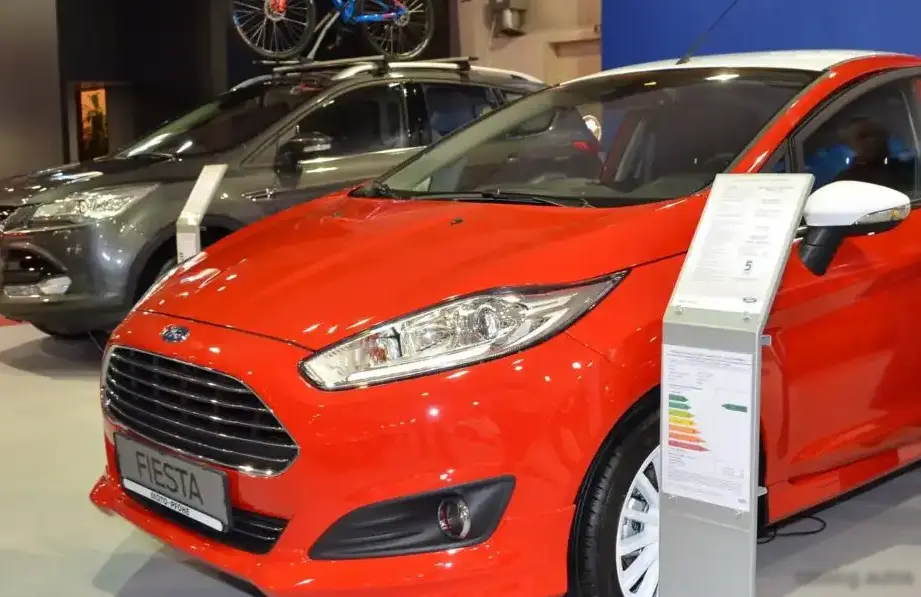
The Ford Fiesta VII, specifically the facelifted model introduced in 2013, represented a significant evolution of Ford’s popular supermini. Produced from 2013 to 2017, the 1.0 Duratec 80 horsepower, five-door hatchback with Start&Stop technology occupied an important position in the Fiesta lineup as an entry-level offering focused on fuel efficiency and affordability. This variant was part of the Mk7 generation (platform B285), which aimed to balance practicality, driving dynamics, and modern technology within the competitive European small car segment. The Fiesta, a mainstay of Ford’s European and increasingly North American offerings, continued its tradition of providing accessible transportation with this iteration.
Technical Specifications
| Brand | Ford |
| Model | Fiesta |
| Generation | Fiesta VII (Mk7, facelift 2013) 5 door |
| Type (Engine) | 1.0 Duratec (80 Hp) Start&Stop |
| Start of production | 2013 |
| End of production | 2017 |
| Powertrain Architecture | Internal Combustion engine |
| Body type | Hatchback |
| Seats | 5 |
| Doors | 5 |
| Fuel consumption (urban) | 5.1 l/100 km (46.1 US mpg, 55.4 UK mpg, 19.6 km/l) |
| Fuel consumption (extra urban) | 3.8 l/100 km (61.9 US mpg, 74.3 UK mpg, 26.3 km/l) |
| Fuel consumption (combined) | 4.3 l/100 km (54.7 US mpg, 65.7 UK mpg, 23.3 km/l) |
| CO2 emissions | 99 g/km |
| Fuel Type | Petrol (Gasoline) |
| Acceleration 0 – 100 km/h | 14.9 sec |
| Acceleration 0 – 62 mph | 14.9 sec |
| Acceleration 0 – 60 mph | 14.2 sec |
| Maximum speed | 165 km/h (102.53 mph) |
| Emission standard | Euro 5 |
| Weight-to-power ratio | 12.1 kg/Hp, 82.5 Hp/tonne |
| Weight-to-torque ratio | 9.2 kg/Nm, 108.2 Nm/tonne |
| Power | 80 Hp @ 6300 rpm |
| Power per litre | 80.2 Hp/l |
| Torque | 105 Nm @ 4100 rpm (77.44 lb.-ft. @ 4100 rpm) |
| Engine layout | Front, Transverse |
| Engine Model/Code | P4JA, P4JB, P4JC, P4JD |
| Engine displacement | 998 cm3 (60.9 cu. in.) |
| Number of cylinders | 3 |
| Engine configuration | Inline |
| Number of valves per cylinder | 4 |
| Fuel injection system | Direct injection |
| Engine aspiration | Naturally aspirated engine, Intercooler |
| Engine oil capacity | 4.1 l (4.33 US qt | 3.61 UK qt) |
| Coolant | 5.8 l (6.13 US qt | 5.1 UK qt) |
| Kerb Weight | 970 kg (2138.48 lbs.) |
| Max. weight | 1530 kg (3373.07 lbs.) |
| Max load | 560 kg (1234.59 lbs.) |
| Trunk (boot) space – minimum | 281 l (9.92 cu. ft.) |
| Trunk (boot) space – maximum | 965 l (34.08 cu. ft.) |
| Fuel tank capacity | 42 l (11.1 US gal | 9.24 UK gal) |
| Permitted trailer load with brakes (8%) | 750 kg (1653.47 lbs.) |
| Permitted trailer load with brakes (12%) | 650 kg (1433 lbs.) |
| Permitted trailer load without brakes | 525 kg (1157.43 lbs.) |
| Length | 3969 mm (156.26 in.) |
| Width | 1722 mm (67.8 in.) |
| Width with mirrors folded | 1787 mm (70.35 in.) |
| Width including mirrors | 1973 mm (77.68 in.) |
| Height | 1495 mm (58.86 in.) |
| Wheelbase | 2489 mm (97.99 in.) |
| Minimum turning circle | 10.2 m (33.46 ft.) |
| Drivetrain Architecture | The Internal combustion engine (ICE) drives the front wheels of the vehicle. |
| Drive wheel | Front wheel drive |
| Number of gears and type of gearbox | 5 gears, manual transmission |
| Front suspension | Independent, type McPherson with coil spring and anti-roll bar |
| Rear suspension | Coil spring, Torsion |
| Front brakes | Ventilated discs |
| Rear brakes | Drum |
| Assisting systems | ABS (Anti-lock braking system) |
| Steering type | Steering rack and pinion |
| Power steering | Electric Steering |
| Tires size | 175/65 R14; 195/55 R15 |
| Wheel rims size | 5.5J x 14; 6J x 15 |
INTRODUCTION
The 2013-2017 Ford Fiesta VII 1.0 Duratec 80 hp represents a key offering in Ford’s strategy to provide affordable and fuel-efficient transportation. Positioned as the entry-level engine option within the Mk7 Fiesta range, it targeted buyers prioritizing economy and practicality over outright performance. The introduction of the Start&Stop system further emphasized its eco-conscious design. This variant was particularly popular in Europe, where smaller, fuel-efficient cars are highly valued, but also gained traction in North America as Ford expanded the Fiesta’s availability. The facelifted Mk7, launched in 2013, brought revised styling and improved interior materials, enhancing the Fiesta’s overall appeal.
Powertrain & Engine Architecture
At the heart of this Fiesta variant lies the Ford 1.0-liter Duratec three-cylinder engine, specifically the P4JA, P4JB, P4JC, or P4JD engine code depending on the specific market and year. This engine is a marvel of downsizing technology, utilizing direct fuel injection and a single scroll turbocharger (though this specific 80hp version is naturally aspirated). The engine features a cast iron block with an aluminum cylinder head, incorporating four valves per cylinder. The direct injection system, operating at pressures up to 200 bar, ensures precise fuel delivery for optimal combustion. The engine’s compact size and lightweight construction contribute to the Fiesta’s nimble handling. Paired with this engine is a five-speed manual transmission, chosen for its simplicity and efficiency. The transmission’s gear ratios are tuned to maximize fuel economy and provide adequate acceleration for everyday driving.
Driving Characteristics
The 1.0 Duratec 80 hp Fiesta delivers a driving experience focused on efficiency and ease of use. Acceleration is modest, taking approximately 14.9 seconds to reach 62 mph (100 km/h), and a calculated 14.2 seconds to 60 mph. However, the engine is surprisingly responsive at lower RPMs, making it well-suited for urban driving. The five-speed manual transmission provides adequate control, although drivers accustomed to quicker cars may find the gear ratios somewhat spaced apart. The Fiesta’s light weight and well-tuned suspension contribute to its agile handling, making it enjoyable to drive on winding roads. Compared to higher-output Fiesta variants, such as those equipped with the 1.0 EcoBoost or 1.6-liter engines, this version prioritizes fuel economy over outright performance. The manual transmission offers a more engaging driving experience than the optional automatic, which was available in some markets, but at the cost of some fuel efficiency.
Equipment & Trim Levels
The 1.0 Duratec 80 hp Fiesta typically came equipped with a reasonable level of standard features. These generally included air conditioning, power steering, electric front windows, a basic audio system with USB connectivity, and ABS brakes. Interior upholstery was typically cloth, with a functional but not luxurious design. Higher trim levels, such as Zetec or Titanium, offered additional features like alloy wheels, upgraded audio systems, cruise control, and automatic headlights. Optional extras included a rear parking sensor, heated front seats, and a panoramic sunroof. The Start&Stop system was a key feature, automatically shutting off the engine when the vehicle came to a stop to reduce fuel consumption and emissions.
Chassis & Braking
The Fiesta VII utilized a McPherson strut front suspension and a torsion beam rear suspension. This setup provided a good balance between ride comfort and handling precision. The front brakes were ventilated discs, offering adequate stopping power, while the rear brakes were drums, a cost-saving measure common in entry-level models. ABS (Anti-lock Braking System) was standard, enhancing safety during emergency braking. The Fiesta’s relatively light weight contributed to its nimble handling and reduced braking distances. Stabilizer bars were fitted to both the front and rear axles to minimize body roll during cornering.
Market Reception & Comparison
The 1.0 Duratec 80 hp Fiesta was generally well-received by critics as a practical and economical choice. Its fuel economy of around 54.7 US mpg (combined) was a major selling point, particularly in Europe where fuel prices are high. However, some reviewers noted its lack of outright performance, especially when fully loaded with passengers and luggage. Compared to the more powerful Fiesta variants, this version offered a lower price point and lower running costs. The 1.0 EcoBoost engine, while more expensive, provided a significant performance boost without sacrificing fuel economy. The 1.6-liter engine offered even more power but at the expense of fuel efficiency. In terms of reliability, the 1.0 Duratec engine proved to be generally robust, although regular maintenance is essential to prevent issues.
Legacy
The 1.0 Duratec 80 hp Fiesta remains a popular choice in the used car market, particularly for buyers seeking an affordable and fuel-efficient city car. Its simple mechanical design and readily available parts contribute to its relatively low maintenance costs. While not the most exciting Fiesta variant, it offers a reliable and practical transportation solution. The engine’s durability and fuel efficiency have ensured its continued relevance in the years since its production ended. The Fiesta VII, in general, cemented Ford’s reputation for building well-rounded and affordable small cars, and this 1.0-liter variant played a crucial role in that success.