Technical Specifications
| Brand | Ford |
| Model | Flex |
| Generation | Flex |
| Type (Engine) | 3.5 V6 (355 Hp) AWD Automatic |
| Start of production | 2009 |
| End of production | 2012 |
| Powertrain Architecture | Internal Combustion engine |
| Body type | SUV |
| Seats | 6-7 |
| Doors | 5 |
| Fuel consumption (economy) – urban (EPA) | 14.7 l/100 km (16 US mpg, 19.2 UK mpg, 6.8 km/l) |
| Fuel consumption (economy) – extra urban (EPA) | 10.7-11.2 l/100 km (22 – 21 US mpg, 26.4 – 25.2 UK mpg, 9.3 – 8.9 km/l) |
| Fuel Type | Petrol (Gasoline) |
| Emission standard | LEV II |
| Weight-to-power ratio | 6.1 kg/Hp, 163.6 Hp/tonne |
| Weight-to-torque ratio | 4.6 kg/Nm, 218.9 Nm/tonne |
| Power | 355 Hp @ 5700 rpm |
| Power per litre | 101.5 Hp/l |
| Torque | 475 Nm @ 3500 rpm (350.34 lb.-ft. @ 3500 rpm) |
| Maximum engine speed | 6200 rpm |
| Engine layout | Front, Transverse |
| Engine Model/Code | EcoBoost |
| Engine displacement | 3496 cm3 (213.34 cu. in.) |
| Number of cylinders | 6 |
| Engine configuration | V-engine |
| Cylinder Bore | 92.5 mm (3.64 in.) |
| Piston Stroke | 86.7 mm (3.41 in.) |
| Compression ratio | 10:1 |
| Number of valves per cylinder | 4 |
| Fuel injection system | Direct injection |
| Engine aspiration | Twin-Turbo, Intercooler |
| Valvetrain | DOHC |
| Engine oil capacity | 5.2 l (5.49 US qt | 4.58 UK qt) |
| Coolant | 12.5 l (13.21 US qt | 11 UK qt) |
| Kerb Weight | 2170-2195 kg (4784.03 – 4839.15 lbs.) |
| Trunk (boot) space – minimum | 566 l (19.99 cu. ft.) |
| Trunk (boot) space – maximum | 2356 l (83.2 cu. ft.) |
| Fuel tank capacity | 70 l (18.49 US gal | 15.4 UK gal) |
| Permitted trailer load with brakes (12%) | 2041 kg (4499.63 lbs.) |
| Length | 5126 mm (201.81 in.) |
| Width with mirrors folded | 2035 mm (80.12 in.) |
| Width including mirrors | 2256 mm (88.82 in.) |
| Height | 1727 mm (67.99 in.) |
| Wheelbase | 2995 mm (117.91 in.) |
| Front track | 1661 mm (65.39 in.) |
| Rear (Back) track | 1661 mm (65.39 in.) |
| Minimum turning circle (turning diameter) | 12.4 m (40.68 ft.) |
| Drivetrain Architecture | All wheel drive (4×4) |
| Number of gears and type of gearbox | 6 gears, automatic transmission |
| Front suspension | Independent, type McPherson with coil spring and anti-roll bar |
| Rear suspension | Independent multi-link spring suspension with stabilizer |
| Front brakes | Ventilated discs |
| Rear brakes | Disc |
| Assisting systems | ABS (Anti-lock braking system) |
| Steering type | Steering rack and pinion |
| Power steering | Electric Steering |
| Tires size | 235/60 R18; 235/55 R19; 255/45 R20 |
| Wheel rims size | 18; 19; 20 |
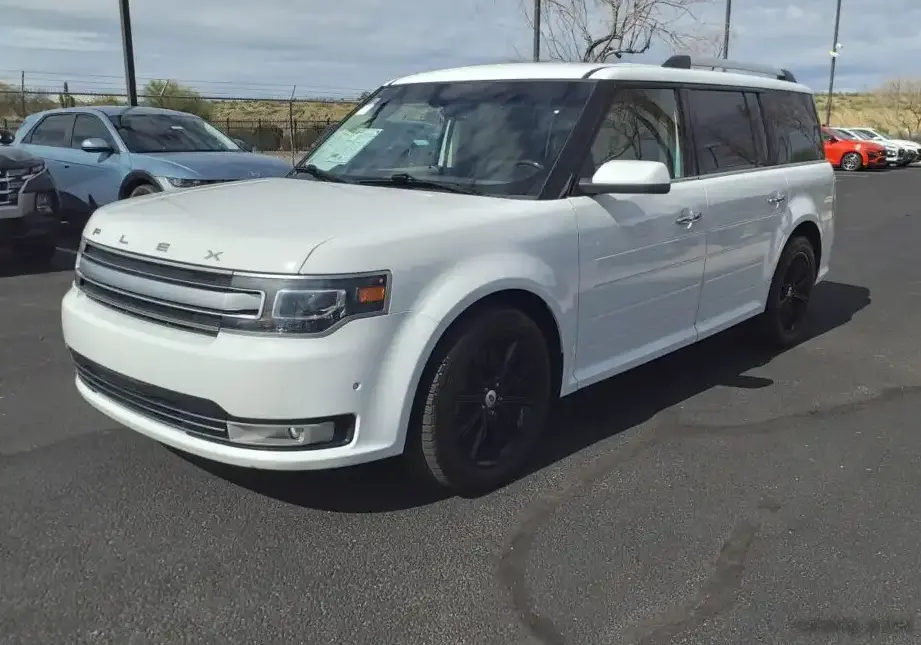
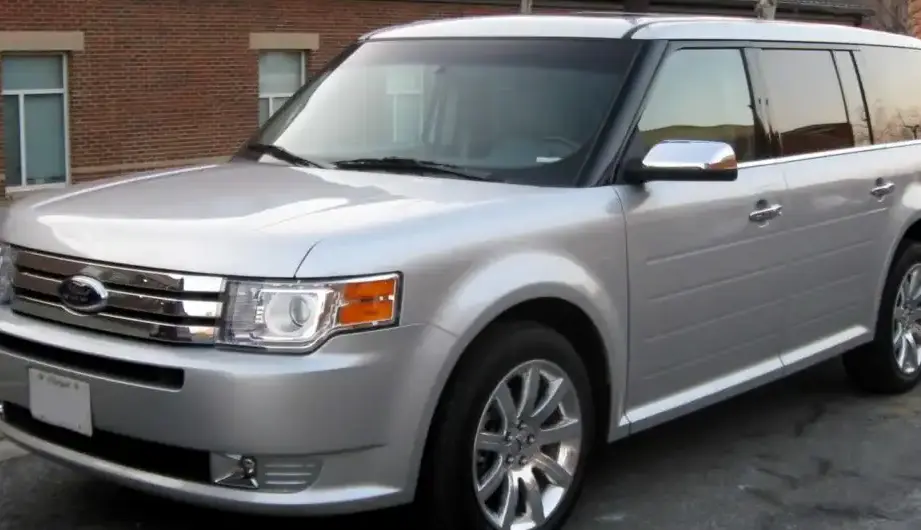
The Ford Flex 3.5L EcoBoost AWD Automatic, launched in 2009, was a key component of Ford’s strategy to offer distinctive and capable vehicles. Built on the D3 platform (shared with the Lincoln MKT and Ford Taurus), the Flex aimed to provide a spacious alternative to traditional minivans, appealing to families who desired a more rugged and stylish aesthetic. The 3.5L EcoBoost engine, a twin-turbocharged V6, was a relatively new addition to Ford’s lineup, representing a significant leap in power and efficiency compared to naturally aspirated engines. This particular configuration, paired with the six-speed automatic transmission and all-wheel drive, was positioned as a premium offering, slotting above the base 3.5L V6 models.
Powertrain & Engine Architecture
At the heart of this Flex variant lies the 3.5L EcoBoost V6 engine, designated as the 3.5L GTDI (Gasoline Turbocharged Direct Injection). This engine, part of Ford’s EcoBoost family, utilizes a compact graphite iron cylinder block and aluminum cylinder heads. The key feature is its twin-turbocharger setup, employing two Mitsubishi TD03H turbochargers to deliver increased power and torque. Direct fuel injection, operating at pressures up to 2,100 psi, ensures precise fuel delivery and optimized combustion. The engine also incorporates variable valve timing (VVT) on both intake and exhaust camshafts, further enhancing efficiency and performance. The six-speed 6F55 automatic transmission, sourced from Aisin, was chosen for its smooth shifting and ability to handle the engine’s substantial torque output. This transmission features a wide gear ratio spread, optimizing both acceleration and fuel economy.
Driving Characteristics
The 3.5L EcoBoost-equipped Flex delivers a markedly different driving experience compared to the base V6 models. The twin-turbochargers provide a significant boost in power, resulting in brisk acceleration and effortless highway cruising. While not a sports car, the Flex 3.5 EcoBoost feels surprisingly agile for its size. The automatic transmission is generally smooth and responsive, although some drivers noted occasional hesitation during downshifts. The all-wheel-drive system provides enhanced traction in various weather conditions, making it a capable vehicle for year-round use. The gear ratios are tuned for a balance between performance and fuel efficiency, with a focus on providing ample torque for towing and hauling. Compared to the manual transmission options available on other Flex trims, the automatic prioritizes convenience and ease of use.
Equipment & Trim Levels
The 3.5L EcoBoost AWD Flex typically came well-equipped, often featuring leather upholstery, heated front seats, a power-adjustable driver’s seat, and a premium audio system. Standard features also included tri-zone automatic climate control, a rearview camera, and Ford’s Sync infotainment system. Optional extras included a power moonroof, navigation system, and a rear-seat entertainment system. The Flex offered a spacious and comfortable interior, with seating for up to seven passengers. The third-row seats were relatively accessible and comfortable, making it a practical choice for families. Interior trim levels varied, with higher trims offering more luxurious materials and finishes.
Chassis & Braking
The Flex utilizes an independent front suspension with McPherson struts and a multi-link independent rear suspension. This setup provides a comfortable ride and good handling characteristics. Stabilizer bars are fitted to both the front and rear axles to reduce body roll during cornering. The braking system consists of ventilated discs at all four wheels, providing ample stopping power. Anti-lock brakes (ABS) and electronic stability control (ESC) are standard features, enhancing safety and control. The Flex’s relatively heavy curb weight necessitates a robust braking system to ensure confident stopping performance.
Market Reception & Comparison
The Ford Flex 3.5L EcoBoost AWD Automatic received generally positive reviews from automotive critics. The engine was praised for its power and efficiency, while the spacious interior and distinctive styling were also well-received. However, some critics noted the Flex’s large size and somewhat cumbersome handling. Compared to other trims in the Flex lineup, the 3.5L EcoBoost offered a significant performance upgrade, but at a higher price point. Fuel economy was comparable to other V6-powered SUVs, but slightly lower than the base 3.5L V6 model. Reliability was generally good, although some owners reported minor issues with the infotainment system and turbochargers.
Legacy
The Ford Flex, and particularly the 3.5L EcoBoost variant, has developed a loyal following among owners who appreciate its unique styling, spacious interior, and capable performance. While production ended in 2012, the Flex remains a relatively common sight on used car lots. The 3.5L EcoBoost engine has proven to be a durable and reliable powertrain, although regular maintenance is essential to ensure long-term performance. The Flex’s distinctive design and practical features continue to appeal to buyers seeking an alternative to traditional SUVs and minivans. The EcoBoost engine itself became a cornerstone of Ford’s powertrain strategy, appearing in a wide range of vehicles and establishing a reputation for performance and efficiency.