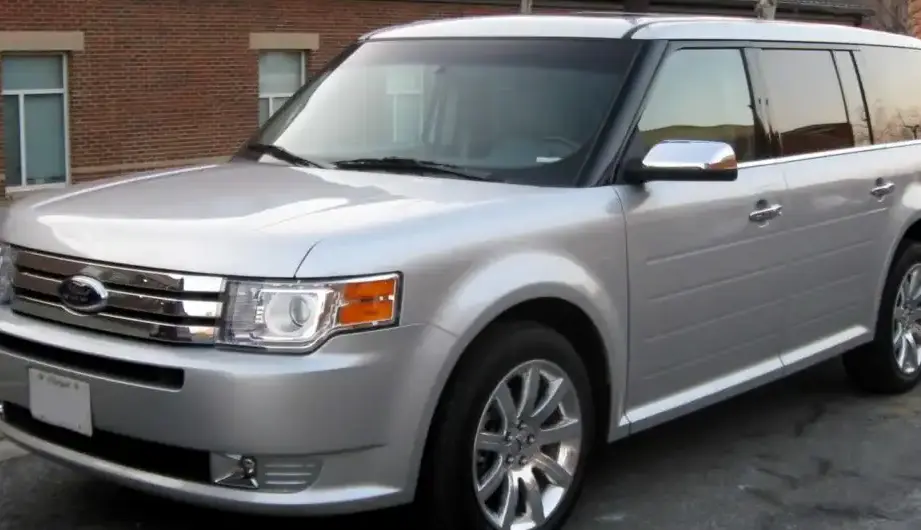
The Ford Flex, particularly the facelifted version produced from 2013 to 2019, represented a unique offering in the American automotive landscape. This boxy, three-row SUV aimed to blend the practicality of a minivan with the styling of a traditional SUV. The 3.5-liter V6 engine paired with an all-wheel-drive system and a six-speed automatic transmission was a popular configuration, positioned as a mid-range option within the Flex lineup, offering a balance of power, space, and capability. It served as a direct competitor to vehicles like the Honda Pilot, Toyota Highlander, and Chevrolet Traverse, though its distinctive styling set it apart.
Technical Specifications
| Brand | Ford |
| Model | Flex |
| Generation | Flex (facelift 2013) |
| Type (Engine) | 3.5 V6 (286 Hp) AWD Automatic |
| Start of production | 2013 |
| End of production | 2019 |
| Powertrain Architecture | Internal Combustion engine |
| Body type | SUV |
| Seats | 6-7 |
| Doors | 5 |
| Fuel consumption (economy) – urban | 13.8 l/100 km (17 US mpg, 20.5 UK mpg, 7.2 km/l) |
| Fuel consumption (economy) – extra urban | 10.2 l/100 km (23.1 US mpg, 27.7 UK mpg, 9.8 km/l) |
| Fuel consumption (economy) – combined | 12.4 l/100 km (19 US mpg, 22.8 UK mpg, 8.1 km/l) |
| Fuel Type | Petrol (Gasoline) |
| Maximum speed | 185 km/h (114.95 mph) |
| Power | 286 Hp @ 6500 rpm |
| Power per litre | 81.8 Hp/l |
| Torque | 343 Nm @ 4000 rpm (252.98 lb.-ft. @ 4000 rpm) |
| Engine layout | Front, Transverse |
| Engine Model/Code | Duratec 35 |
| Engine displacement | 3496 cm3 (213.34 cu. in.) |
| Number of cylinders | 6 |
| Engine configuration | V-engine |
| Cylinder Bore | 92.5 mm (3.64 in.) |
| Piston Stroke | 86.7 mm (3.41 in.) |
| Compression ratio | 10.3:1 |
| Number of valves per cylinder | 4 |
| Fuel injection system | Multi-port manifold injection |
| Engine aspiration | Naturally aspirated engine |
| Engine oil capacity | 5.7 l (6.02 US qt | 5.02 UK qt) |
| Coolant | 12.5 l (13.21 US qt | 11 UK qt) |
| Trunk (boot) space – minimum | 566 l (19.99 cu. ft.) |
| Fuel tank capacity | 71 l (18.76 US gal | 15.62 UK gal) |
| Length | 5130 mm (201.97 in.) |
| Width | 1930 mm (75.98 in.) |
| Height | 1727 mm (67.99 in.) |
| Wheelbase | 2995 mm (117.91 in.) |
| Front track | 1661 mm (65.39 in.) |
| Rear (Back) track | 1661 mm (65.39 in.) |
| Ride height (ground clearance) | 150 mm (5.91 in.) |
| Drive wheel | All wheel drive (4×4) |
| Number of gears and type of gearbox | 6 gears, automatic transmission |
| Front brakes | Ventilated discs |
| Rear brakes | Disc |
| Assisting systems | ABS (Anti-lock braking system) |
| Tires size | 235/60 R17 |
| Wheel rims size | 17 |
Powertrain & Engine Architecture
The heart of this Flex variant is Ford’s Duratec 35 engine, a 3.5-liter naturally aspirated V6. This engine, part of Ford’s Duratec family, utilizes a 60-degree V-angle configuration. It features a cast aluminum engine block with cast iron cylinder liners, and aluminum cylinder heads. The engine employs multi-port fuel injection, delivering fuel directly into the intake ports. The valvetrain consists of four valves per cylinder, operated by dual overhead camshafts (DOHC). This configuration allows for efficient cylinder filling and exhaust scavenging, contributing to the engine’s power output. The 3.5L Duratec 35 produces 286 horsepower at 6500 rpm and 253 lb-ft of torque at 4000 rpm. The engine is paired with a six-speed automatic transmission, specifically the 6F55, known for its smooth shifting and reliability. The all-wheel-drive system is an on-demand system, primarily operating in front-wheel drive but engaging the rear wheels when traction is lost.
Driving Characteristics
The 3.5-liter V6 and six-speed automatic combination in the Flex provided adequate, though not exhilarating, performance. Acceleration from 0 to 60 mph typically took around 7.5-8.5 seconds. The automatic transmission was tuned for comfort and efficiency, with gear changes being relatively smooth and unobtrusive. Compared to the more powerful 3.5L EcoBoost variant, this engine felt less responsive, particularly during overtaking maneuvers. However, it offered a more relaxed driving experience. The all-wheel-drive system provided enhanced stability and traction in inclement weather conditions. The Flex’s substantial weight (over 4,500 lbs) was noticeable, impacting handling and braking performance. The gear ratios were optimized for cruising, making it a comfortable highway vehicle, but less engaging on twisty roads.
Equipment & Trim Levels
The 3.5L AWD Flex typically came standard with features like tri-zone automatic climate control, a rearview camera, Ford’s Sync infotainment system, and a power liftgate. Higher trim levels, such as the Limited, added features like leather upholstery, heated front seats, a premium sound system, and power-adjustable pedals. Optional extras included a panoramic sunroof, navigation system, and a rear-seat entertainment system. Interior upholstery was typically cloth on the base models, upgrading to leather on higher trims. The dashboard layout was functional and straightforward, with easy-to-use controls. The Flex’s spacious interior was a key selling point, offering ample room for passengers and cargo.
Chassis & Braking
The Ford Flex utilized a unibody construction, providing a good balance of strength and rigidity. The front suspension consisted of independent MacPherson struts, while the rear suspension employed an independent multi-link setup. This configuration aimed to provide a comfortable ride and decent handling. The Limited trim often included a slightly stiffer suspension tuning for improved handling. Braking duties were handled by ventilated discs at the front and solid discs at the rear. Anti-lock brakes (ABS) were standard, along with electronic stability control. The Flex’s relatively heavy weight required a robust braking system to provide adequate stopping power.
Market Reception & Comparison
The Ford Flex, and specifically the 3.5L V6 AWD variant, received generally positive reviews for its spacious interior, comfortable ride, and unique styling. Critics praised its practicality and versatility, making it a good choice for families. However, some reviewers noted its lackluster fuel economy (around 19 mpg combined) and somewhat uninspired driving dynamics compared to sportier SUVs. Compared to the EcoBoost variant, the 3.5L V6 offered a lower price point but sacrificed performance. The 3.5L V6 was generally considered more reliable than the EcoBoost, as it had fewer potential issues related to turbocharging systems.
Legacy
The Ford Flex was discontinued in 2019, but it has gained a cult following among those who appreciate its distinctive design and practicality. The 3.5-liter V6 and six-speed automatic transmission combination proved to be relatively reliable, with few widespread mechanical issues reported. On the used car market, the Flex remains a relatively affordable option for those seeking a spacious and versatile SUV. While not known for its sporty performance, the 3.5L V6 AWD Flex offers a comfortable and capable driving experience, making it a solid choice for families and those who prioritize space and practicality over outright speed.