
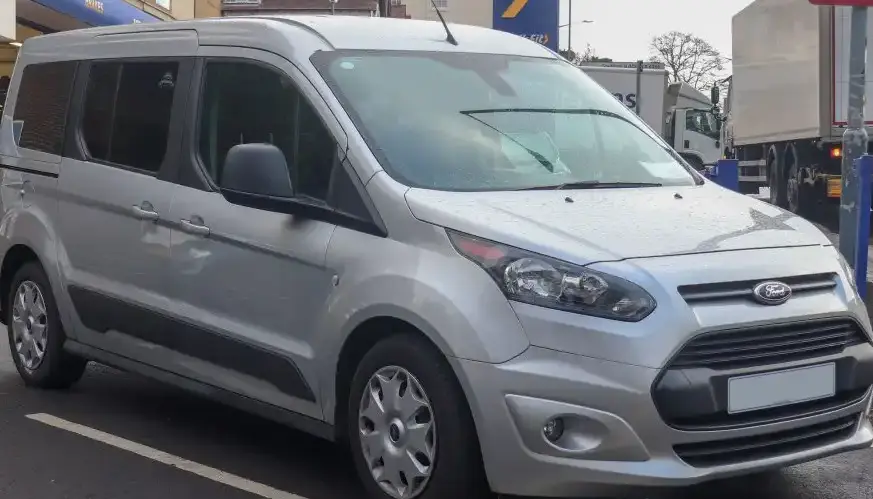
The Ford Grand Tourneo Connect II 1.6 Duratorq TDCi (115 hp) was a popular configuration of Ford’s compact people carrier, produced from 2013 to 2015. Positioned as a mid-range offering within the second generation Tourneo Connect lineup, it aimed to balance fuel efficiency, practicality, and affordability for families and commercial users. This variant was primarily sold in the European market, where compact vans and multi-purpose vehicles (MPVs) hold a significant share of the automotive landscape. It represented Ford’s attempt to cater to buyers needing a versatile vehicle for both passenger and light cargo duties.
Technical Specifications
| Brand | Ford |
| Model | Tourneo Connect |
| Generation | Grand Tourneo Connect II |
| Type (Engine) | 1.6 Duratorq TDCi (115 Hp) |
| Start of production | 2013 |
| End of production | 2015 |
| Powertrain Architecture | Internal Combustion engine |
| Body type | Minivan |
| Seats | 5 |
| Doors | 5 |
| Fuel consumption (urban) | 5.6 l/100 km (42 US mpg, 50.4 UK mpg, 17.9 km/l) |
| Fuel consumption (extra urban) | 4.6 l/100 km (51.1 US mpg, 61.4 UK mpg, 21.7 km/l) |
| Fuel consumption (combined) | 4.9 l/100 km (48 US mpg, 57.6 UK mpg, 20.4 km/l) |
| CO2 emissions | 130 g/km |
| Fuel Type | Diesel |
| Acceleration 0 – 100 km/h | 14.1 sec |
| Acceleration 0 – 62 mph | 14.1 sec |
| Acceleration 0 – 60 mph | 13.4 sec |
| Maximum speed | 165 km/h (102.53 mph) |
| Emission standard | Euro 5 |
| Power | 115 Hp @ 3600 rpm |
| Power per litre | 73.7 Hp/l |
| Torque | 270 Nm @ 1750-2500 rpm (199.14 lb.-ft. @ 1750-2500 rpm) |
| Engine layout | Front, Transverse |
| Engine Model/Code | T1GA |
| Engine displacement | 1560 cm3 (95.2 cu. in.) |
| Number of cylinders | 4 |
| Engine configuration | Inline |
| Cylinder Bore | 75 mm (2.95 in.) |
| Piston Stroke | 88.3 mm (3.48 in.) |
| Compression ratio | 16:1 |
| Number of valves per cylinder | 2 |
| Fuel injection system | Diesel Commonrail |
| Engine aspiration | Turbocharger, Intercooler |
| Valvetrain | SOHC |
| Engine oil capacity | 6.2 l (6.55 US qt | 5.46 UK qt) |
| Coolant | 7.3 l (7.71 US qt | 6.42 UK qt) |
| Trunk (boot) space – minimum | 1529 l (54 cu. ft.) |
| Trunk (boot) space – maximum | 2761 l (97.5 cu. ft.) |
| Length | 4818 mm (189.69 in.) |
| Width | 1835 mm (72.24 in.) |
| Width with mirrors folded | 1966 mm (77.4 in.) |
| Width including mirrors | 2137 mm (84.13 in.) |
| Height | 1845 mm (72.64 in.) |
| Wheelbase | 2662 mm (104.8 in.) |
| Front track | 1568 mm (61.73 in.) |
| Rear (Back) track | 1584 mm (62.36 in.) |
| Minimum turning circle | 12.2 m (40.03 ft.) |
| Drivetrain Architecture | Front wheel drive |
| Number of gears | 6 gears, manual transmission |
| Front suspension | Independent, type McPherson with coil spring and anti-roll bar |
| Rear suspension | Semi-dependent beam with stabilizer lateral stability |
| Front brakes | Ventilated discs, 320 mm |
| Rear brakes | Disc, 280 mm |
| Assisting systems | ABS (Anti-lock braking system) |
| Steering type | Steering rack and pinion |
| Tires size | 205/60 R16 |
| Wheel rims size | 6.5J x 16 |
INTRODUCTION
The Ford Grand Tourneo Connect II, launched in 2013, was a re-engineered and rebranded version of the previous generation, developed in collaboration with Volkswagen. Based on the Volkswagen Caddy platform (1HX0/A3), the Grand Tourneo Connect offered a larger, more practical alternative to traditional MPVs. The 1.6 Duratorq TDCi 115 hp variant was a key model in the range, targeting buyers who prioritized fuel economy and everyday usability over outright performance. It served as a workhorse for families, small businesses, and tradespeople needing a versatile vehicle capable of carrying passengers and cargo.
Powertrain & Engine Architecture
The heart of this variant was Ford’s 1.6-liter Duratorq TDCi diesel engine, specifically the T1GA code. This engine was a four-cylinder, inline configuration, utilizing a single overhead camshaft (SOHC) valvetrain with two valves per cylinder. A turbocharger with an intercooler was employed to boost power and efficiency. The engine featured a common rail direct fuel injection system, delivering fuel at high pressure for optimized combustion. The 115 hp output was achieved at 3600 rpm, while peak torque of 270 Nm (199 lb-ft) was available between 1750 and 2500 rpm. This broad torque curve provided good low-end responsiveness, making it suitable for everyday driving. The engine was paired with a six-speed manual transmission, chosen for its fuel efficiency and relatively low cost. While an automatic transmission was offered on other Tourneo Connect models, it wasn’t available with this specific 115 hp engine.
Driving Characteristics
The 1.6 Duratorq TDCi 115 hp engine, coupled with the manual transmission, provided adequate, but not exhilarating, performance. Acceleration from 0-60 mph took around 13.4 seconds, and top speed was limited to 165 km/h (102.53 mph). The focus was on usability rather than speed. The gear ratios were tuned for fuel economy, with taller gearing in higher gears. This meant that while highway cruising was comfortable, overtaking required downshifting. Compared to the more powerful 1.6 TDCi variants (typically around 125 hp) or the petrol-powered options, the 115 hp version felt noticeably slower. However, the strong low-end torque made it easy to navigate urban environments and handle moderate loads. The manual transmission offered a more engaging driving experience than an automatic, but required more driver involvement.
Equipment & Trim Levels
The 1.6 Duratorq TDCi 115 hp variant typically came with a reasonable level of standard equipment. This included power steering, electric front windows, a basic audio system with USB connectivity, and ABS brakes. Higher trim levels, such as Trend or Titanium, added features like air conditioning, alloy wheels, a more advanced audio system, and parking sensors. Interior upholstery was typically cloth, with a durable and practical design. Optional extras included a panoramic sunroof, rear parking cameras, and navigation systems. The Grand Tourneo Connect II offered a flexible seating configuration, with the rear seats capable of folding flat or being removed entirely to maximize cargo space.
Chassis & Braking
The Grand Tourneo Connect II utilized a McPherson strut front suspension with a coil spring and anti-roll bar, providing a comfortable ride and decent handling. The rear suspension employed a semi-dependent beam with a stabilizer bar, which was a cost-effective solution for maintaining stability under load. Brakes consisted of ventilated discs on the front wheels (320mm diameter) and solid discs on the rear wheels (280mm diameter). ABS (Anti-lock Braking System) was standard. The suspension setup was tuned to prioritize ride comfort over sporty handling, making it well-suited for everyday driving and carrying passengers or cargo. The relatively lightweight nature of the vehicle helped to compensate for the modest engine power.
Market Reception & Comparison
The Ford Grand Tourneo Connect II 1.6 Duratorq TDCi 115 hp was generally well-received by critics for its practicality, fuel efficiency, and competitive pricing. It was often praised for its spacious interior and versatile cargo area. However, some reviewers noted that the engine felt underpowered, especially when fully loaded. Compared to other trims in the lineup, the 115 hp version offered the best fuel economy but the slowest performance. The higher-powered 1.6 TDCi variants provided a noticeable performance boost, but at the expense of fuel efficiency. The petrol-powered options offered a smoother engine but were less economical. Against competitors like the Volkswagen Caddy, Citroën Berlingo, and Renault Kangoo, the Grand Tourneo Connect II offered a compelling package of features and value.
Legacy
The 1.6 Duratorq TDCi engine, while generally reliable, is known to require regular maintenance, particularly regarding the diesel particulate filter (DPF). Proper servicing and the use of high-quality diesel fuel are crucial for preventing DPF issues. The manual transmission is also relatively robust, but clutch wear should be monitored. Today, used examples of the Grand Tourneo Connect II 1.6 Duratorq TDCi 115 hp are readily available and represent a good value for buyers seeking a practical and economical MPV. Its reputation for reliability and versatility has ensured its continued popularity in the used car market, particularly among those needing a dependable vehicle for work or family use.
