
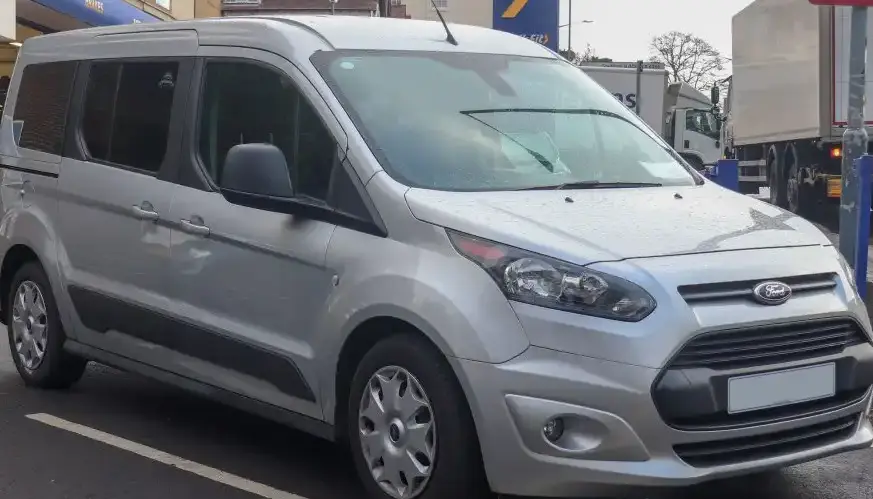
The Ford Grand Tourneo Connect II 1.6 Duratorq TDCi 7-seat model, produced from 2013 to 2015, represents a practical and versatile offering within the compact minivan segment. Based on the Ford Transit Connect platform (internally designated as the 1HX0/A3), this variant aimed to provide family-oriented transportation with a focus on fuel efficiency and interior space. It served as a mid-range option within the broader Tourneo Connect lineup, positioned between the base models and the higher-specification trims with more powerful engines. The Grand Tourneo Connect, in general, was primarily marketed in Europe and other international markets, offering a more passenger-focused alternative to the commercial-oriented Transit Connect van.
Technical Specifications
| Brand | Ford |
| Model | Tourneo Connect |
| Generation | Grand Tourneo Connect II |
| Type | 1.6 Duratorq TDCi (115 Hp) 7 Seat |
| Start of production | 2013 |
| End of production | 2015 |
| Powertrain Architecture | Internal Combustion engine |
| Body type | Minivan |
| Seats | 7 |
| Doors | 5 |
| Fuel consumption (urban) | 5.6 l/100 km (42 US mpg, 50.4 UK mpg, 17.9 km/l) |
| Fuel consumption (extra urban) | 4.6 l/100 km (51.1 US mpg, 61.4 UK mpg, 21.7 km/l) |
| Fuel consumption (combined) | 4.9 l/100 km (48 US mpg, 57.6 UK mpg, 20.4 km/l) |
| CO2 emissions | 130 g/km |
| Fuel Type | Diesel |
| Acceleration 0 – 100 km/h | 14.1 sec |
| Acceleration 0 – 62 mph | 14.1 sec |
| Acceleration 0 – 60 mph | 13.4 sec |
| Maximum speed | 165 km/h (102.53 mph) |
| Emission standard | Euro 5 |
| Weight-to-power ratio | 12.6 kg/Hp, 79.5 Hp/tonne |
| Weight-to-torque ratio | 5.4 kg/Nm, 186.7 Nm/tonne |
| Power | 115 Hp @ 3600 rpm |
| Power per litre | 73.7 Hp/l |
| Torque | 270 Nm @ 1750-2500 rpm (199.14 lb.-ft. @ 1750-2500 rpm) |
| Engine layout | Front, Transverse |
| Engine Model/Code | T1GA |
| Engine displacement | 1560 cm3 (95.2 cu. in.) |
| Number of cylinders | 4 |
| Engine configuration | Inline |
| Cylinder Bore | 75 mm (2.95 in.) |
| Piston Stroke | 88.3 mm (3.48 in.) |
| Compression ratio | 16:1 |
| Number of valves per cylinder | 2 |
| Fuel injection system | Diesel Commonrail |
| Engine aspiration | Turbocharger, Intercooler |
| Valvetrain | SOHC |
| Engine oil capacity | 6.2 l (6.55 US qt | 5.46 UK qt) |
| Coolant capacity | 7.3 l (7.71 US qt | 6.42 UK qt) |
| Kerb Weight | 1446 kg (3187.88 lbs.) |
| Max. weight | 2310 kg (5092.68 lbs.) |
| Max load | 864 kg (1904.79 lbs.) |
| Trunk (boot) space – minimum | 322 l (11.37 cu. ft.) |
| Trunk (boot) space – maximum | 2620 l (92.52 cu. ft.) |
| Permitted trailer load with brakes (12%) | 1000 kg (2204.62 lbs.) |
| Permitted trailer load without brakes | 750 kg (1653.47 lbs.) |
| Length | 4818 mm (189.69 in.) |
| Width | 1835 mm (72.24 in.) |
| Width with mirrors folded | 1966 mm (77.4 in.) |
| Width including mirrors | 2137 mm (84.13 in.) |
| Height | 1840 mm (72.44 in.) |
| Wheelbase | 2662 mm (104.8 in.) |
| Front track | 1568 mm (61.73 in.) |
| Rear track | 1584 mm (62.36 in.) |
| Minimum turning circle | 12.2 m (40.03 ft.) |
| Drivetrain | Front wheel drive |
| Number of gears | 6 |
| Gearbox type | Manual transmission |
| Front suspension | Independent, McPherson with coil spring and anti-roll bar |
| Rear suspension | Semi-dependent beam with stabilizer |
| Front brakes | Ventilated discs, 320 mm |
| Rear brakes | Disc, 280 mm |
| Assisting systems | ABS (Anti-lock braking system) |
| Steering type | Steering rack and pinion |
| Tires size | 205/60 R16 |
| Wheel rims size | 6.5J x 16 |
Powertrain & Engine Architecture
The heart of this Tourneo Connect variant is the 1.6-liter Duratorq TDCi diesel engine, specifically the T1GA engine code. This engine is a four-cylinder, inline configuration, utilizing a single overhead camshaft (SOHC) valvetrain with two valves per cylinder. A key feature is its turbocharger with intercooler, which enhances power output and efficiency. The engine employs a diesel common rail direct injection system, delivering fuel directly into the combustion chamber at high pressure for optimized combustion. The 1.6 Duratorq engine is known for its relatively simple design, contributing to its overall reliability. The engine produces 115 horsepower at 3600 rpm and 270 Nm (199 lb-ft) of torque between 1750 and 2500 rpm. This engine was paired with a six-speed manual transmission, delivering power to the front wheels.
Driving Characteristics
The 1.6 Duratorq TDCi with 115 hp and a manual transmission in the Grand Tourneo Connect II offers a practical, if not particularly sporty, driving experience. Acceleration is modest, taking around 14.1 seconds to reach 62 mph. The engine’s torque peak at relatively low RPMs provides adequate pulling power for everyday driving and carrying a full load of passengers. The six-speed gearbox is well-matched to the engine, allowing for comfortable cruising on highways. Compared to higher-output versions of the Tourneo Connect (like those with the 1.0 EcoBoost petrol engine), this diesel variant prioritizes fuel economy over outright performance. The manual transmission provides more driver engagement than the optional automatic, but also requires more effort in stop-and-go traffic.
Equipment & Trim Levels
The 1.6 Duratorq TDCi 7-seat model typically came equipped with features such as air conditioning, power steering, electric front windows, and a basic audio system. Safety features included ABS, driver and passenger airbags, and seatbelt pretensioners. Higher trim levels offered options like alloy wheels, rear parking sensors, cruise control, and upgraded infotainment systems. Interior upholstery was generally cloth, with durable plastics used throughout the cabin. The seven-seat configuration involved a flexible seating arrangement, with the rear seats capable of being folded or removed to maximize cargo space.
Chassis & Braking
The Grand Tourneo Connect II utilizes a McPherson strut independent suspension setup at the front, providing a comfortable ride. The rear suspension employs a semi-independent beam axle with a stabilizer bar, balancing ride comfort with handling stability. Braking duties are handled by ventilated discs at the front and solid discs at the rear. The ABS system provides enhanced braking control in emergency situations. The steering is a rack and pinion system, offering reasonable precision and feedback.
Market Reception & Comparison
The Ford Grand Tourneo Connect II 1.6 Duratorq TDCi was generally well-received by automotive critics as a practical and economical family vehicle. Its fuel efficiency was a major selling point, particularly in Europe where diesel engines are popular. Compared to the petrol-powered versions, the diesel offered significantly better fuel economy, but at the cost of some refinement. The 115 hp output was considered adequate for most drivers, but those requiring more performance often opted for the higher-powered engine options. Reliability was generally good, although some owners reported issues with the diesel particulate filter (DPF) system, a common concern with modern diesel engines.
Legacy
The 1.6 Duratorq TDCi engine has proven to be a relatively durable and reliable powertrain, although regular maintenance is crucial, particularly regarding the DPF system. On the used car market, Grand Tourneo Connect II models with this engine are often sought after for their practicality, fuel efficiency, and affordability. While not a performance icon, this variant represents a sensible and well-rounded choice for families needing a versatile and economical vehicle. The engine’s simplicity and relatively low running costs contribute to its continued appeal in the used car sector.
