
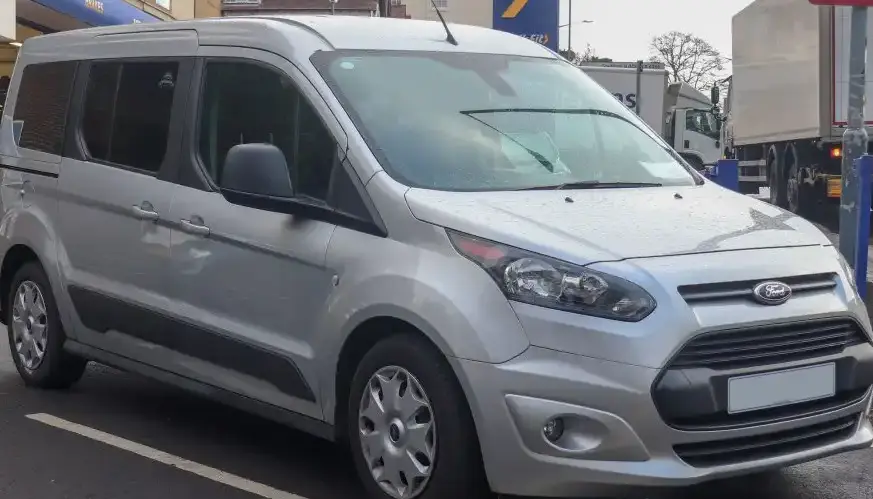
The Ford Grand Tourneo Connect II 1.6 Duratorq TDCi 75 Hp S&S 7 Seat, produced from 2014 to 2015, represents an entry-level offering within the second generation of Ford’s compact people carrier. Based on the Ford C-Max/Focus platform, the Grand Tourneo Connect aimed to provide affordable and practical transportation for families, particularly in European markets. This specific variant, equipped with the 1.6-liter Duratorq diesel engine and a five-speed manual transmission, was positioned as the most economical option in the lineup, prioritizing fuel efficiency and lower running costs over outright performance. It served as a direct competitor to vehicles like the Renault Kangoo and Citroën Berlingo, offering a versatile seven-seat configuration in a relatively compact package.
Technical Specifications
| Brand | Ford |
| Model | Tourneo Connect |
| Generation | Grand Tourneo Connect II |
| Type | 1.6 Duratorq TDCi (75 Hp) S&S 7 Seat |
| Start of production | 2014 |
| End of production | 2015 |
| Powertrain Architecture | Internal Combustion engine |
| Body type | Minivan |
| Seats | 7 |
| Doors | 5 |
| Fuel consumption (urban) | 4.9 l/100 km (48 US mpg, 57.6 UK mpg, 20.4 km/l) |
| Fuel consumption (extra urban) | 4.5 l/100 km (52.3 US mpg, 62.8 UK mpg, 22.2 km/l) |
| Fuel consumption (combined) | 4.6 l/100 km (51.1 US mpg, 61.4 UK mpg, 21.7 km/l) |
| CO2 emissions | 121 g/km |
| Fuel Type | Diesel |
| Acceleration 0 – 100 km/h | 18.3 sec |
| Acceleration 0 – 62 mph | 18.3 sec |
| Acceleration 0 – 60 mph | 17.4 sec |
| Maximum speed | 145 km/h (90.1 mph) |
| Emission standard | Euro 5 |
| Weight-to-power ratio | 19.2 kg/Hp, 52.2 Hp/tonne |
| Weight-to-torque ratio | 6.5 kg/Nm, 153.1 Nm/tonne |
| Power | 75 Hp @ 3500 rpm |
| Power per litre | 48.1 Hp/l |
| Torque | 220 Nm @ 1500 rpm (162.26 lb.-ft. @ 1500 rpm) |
| Engine layout | Front, Transverse |
| Engine Model/Code | UBGA |
| Engine displacement | 1560 cm3 (95.2 cu. in.) |
| Number of cylinders | 4 |
| Engine configuration | Inline |
| Cylinder Bore | 75 mm (2.95 in.) |
| Piston Stroke | 88.3 mm (3.48 in.) |
| Compression ratio | 16:1 |
| Number of valves per cylinder | 2 |
| Fuel injection system | Diesel Commonrail |
| Engine aspiration | Turbocharger, Intercooler |
| Valvetrain | SOHC |
| Engine oil capacity | 6.2 l (6.55 US qt | 5.46 UK qt) |
| Coolant | 7.3 l (7.71 US qt | 6.42 UK qt) |
| Kerb Weight | 1437 kg (3168.04 lbs.) |
| Max. weight | 2300 kg (5070.63 lbs.) |
| Max load | 863 kg (1902.59 lbs.) |
| Trunk (boot) space – minimum | 322 l (11.37 cu. ft.) |
| Trunk (boot) space – maximum | 2620 l (92.52 cu. ft.) |
| Permitted trailer load with brakes (12%) | 800 kg (1763.7 lbs.) |
| Permitted trailer load without brakes | 750 kg (1653.47 lbs.) |
| Length | 4818 mm (189.69 in.) |
| Width | 1835 mm (72.24 in.) |
| Width with mirrors folded | 1966 mm (77.4 in.) |
| Width including mirrors | 2137 mm (84.13 in.) |
| Height | 1840 mm (72.44 in.) |
| Wheelbase | 2662 mm (104.8 in.) |
| Front track | 1568 mm (61.73 in.) |
| Rear (Back) track | 1584 mm (62.36 in.) |
| Minimum turning circle | 12.2 m (40.03 ft.) |
| Drivetrain | Front wheel drive |
| Number of gears | 5 gears, manual transmission |
| Front suspension | Independent, type McPherson with coil spring and anti-roll bar |
| Rear suspension | Semi-dependent beam with stabilizer lateral stability |
| Front brakes | Ventilated discs, 320 mm |
| Rear brakes | Disc, 280 mm |
| Assisting systems | ABS (Anti-lock braking system) |
| Steering type | Steering rack and pinion |
| Tires size | 205/60 R16 |
| Wheel rims size | 6.5J x 16 |
INTRODUCTION
The Ford Grand Tourneo Connect II 1.6 Duratorq TDCi 75 Hp S&S 7 Seat, launched in 2014, is a compact minivan designed to cater to families needing flexible space and economical operation. It’s built on the global Ford B-platform, shared with models like the Ford C-Max and Focus, but adapted for a more utilitarian purpose. The “Grand” designation signifies the longer wheelbase version, offering seven seats as standard. The 1.6-liter Duratorq engine, coupled with a five-speed manual transmission, was the base powertrain option, aimed at buyers prioritizing fuel efficiency and affordability. The Start & Stop (S&S) system further enhanced fuel economy by automatically shutting off the engine when the vehicle was stationary.
Powertrain & Engine Architecture
The heart of this variant is the Ford 1.6-liter Duratorq TDCi diesel engine, identified by the UBGA engine code. This engine is a four-cylinder, inline configuration, featuring a turbocharger with intercooling to boost power and efficiency. It utilizes a common rail direct fuel injection system, delivering fuel directly into the combustion chamber at high pressure for improved combustion and reduced emissions. The engine employs a single overhead camshaft (SOHC) valvetrain, operating two valves per cylinder. The 16:1 compression ratio is typical for a diesel engine, contributing to its thermal efficiency. The five-speed manual transmission provides a relatively wide range of gear ratios, optimized for fuel economy rather than rapid acceleration. The transmission is a conventional setup, with synchromesh gears for smooth shifting.
Driving Characteristics
The 75 horsepower output and 220 Nm (162 lb-ft) of torque of the 1.6 Duratorq engine translate to modest performance. Acceleration from 0-60 mph takes around 17.4 seconds, and the top speed is approximately 90 mph. The focus is clearly on usability and economy rather than sporty driving. The gear ratios in the five-speed manual transmission are spaced to maximize fuel efficiency, meaning the engine can feel strained when accelerating quickly or climbing hills. Compared to higher-powered versions of the Tourneo Connect, such as those with the 1.0 EcoBoost petrol engine or the 1.6 Duratorq with increased power output, this variant feels significantly slower. However, the low-end torque of the diesel engine provides adequate pulling power for everyday driving, and the manual transmission allows for greater driver control.
Equipment & Trim Levels
The 1.6 Duratorq TDCi 75 Hp S&S 7 Seat typically came with a basic level of equipment, reflecting its position as the entry-level model. Standard features generally included power steering, ABS brakes, driver and passenger airbags, and a basic audio system. The interior upholstery was typically cloth, and the dashboard featured a functional but relatively simple design. Optional extras included air conditioning, alloy wheels, parking sensors, and a more advanced audio system with Bluetooth connectivity. The seven-seat configuration offered flexibility for families, with the rear seats capable of being folded flat to maximize cargo space.
Chassis & Braking
The Grand Tourneo Connect II utilizes an independent McPherson strut suspension setup at the front, providing a comfortable ride and decent handling. The rear suspension employs a semi-dependent beam axle with a stabilizer bar, which helps to reduce body roll and improve stability. The braking system consists of ventilated discs at the front and solid discs at the rear. ABS (Anti-lock Braking System) is standard, enhancing safety by preventing wheel lockup during hard braking. The relatively lightweight construction of the vehicle, combined with the modest engine output, contributes to reasonable braking performance.
Market Reception & Comparison
The Ford Grand Tourneo Connect II 1.6 Duratorq TDCi 75 Hp S&S 7 Seat was generally well-received by critics as a practical and economical family vehicle. Its fuel efficiency was a major selling point, and the seven-seat configuration provided valuable versatility. However, some reviewers criticized its lack of power and relatively basic interior. Compared to the higher-powered versions of the Tourneo Connect, this variant offered significantly less performance but at a lower price point. It also compared favorably to competitors like the Renault Kangoo and Citroën Berlingo in terms of fuel economy and practicality.
Legacy
The 1.6 Duratorq engine, while generally reliable, is known to require regular maintenance, particularly regarding the diesel particulate filter (DPF). The DPF can become clogged if the vehicle is primarily used for short journeys, requiring costly replacement. However, with proper maintenance, this powertrain can provide many years of reliable service. In the used car market, this variant represents an affordable option for buyers seeking a practical and economical seven-seat vehicle. Its simplicity and relatively low running costs make it an attractive choice for families on a budget.
