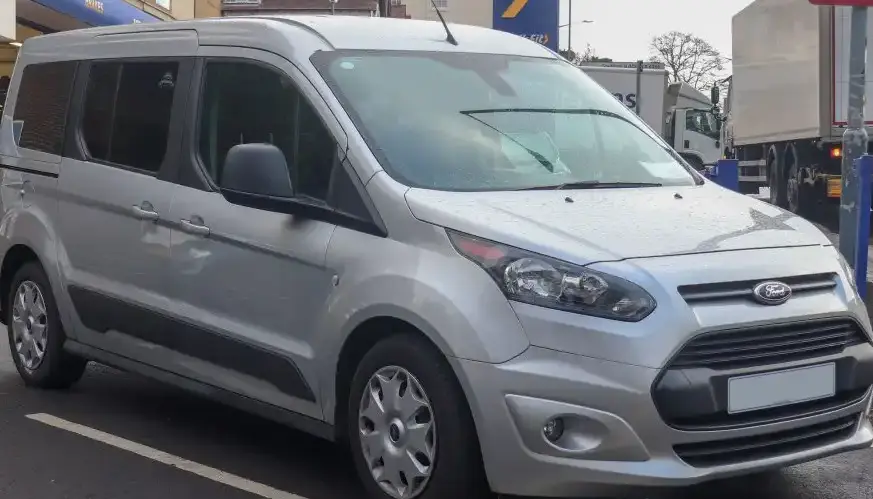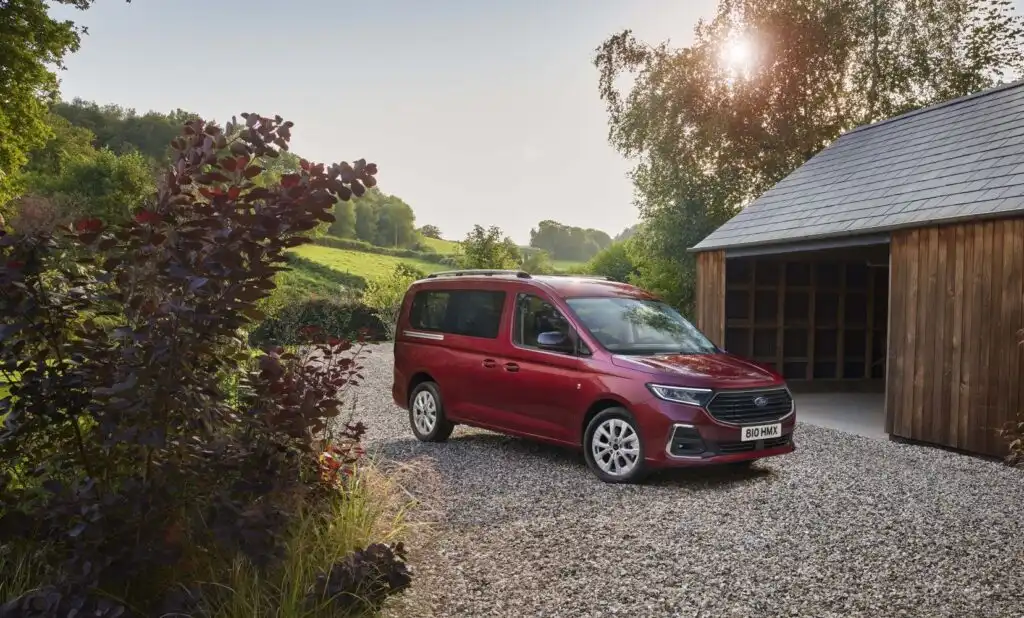
The Ford Grand Tourneo Connect III 2.0 EcoBlue (122 Hp) Powershift is a compact multi-purpose vehicle (MPV) produced by Ford starting in 2022. It represents the third generation of the Tourneo Connect line, built in collaboration with Volkswagen as part of a broader commercial vehicle partnership. This particular variant, powered by the 2.0-liter EcoBlue diesel engine paired with a six-speed Powershift dual-clutch automatic transmission, occupies a mid-range position within the Tourneo Connect III lineup, offering a balance between fuel efficiency, practicality, and reasonable performance. It’s primarily marketed towards families and businesses requiring a versatile and spacious vehicle for both passenger and cargo transport. The Grand Tourneo Connect III is based on the Volkswagen Group’s MQB platform, shared with models like the Volkswagen Caddy.
Technical Specifications
| Brand | Ford |
| Model | Tourneo Connect |
| Generation | Grand Tourneo Connect III |
| Type (Engine) | 2.0 EcoBlue (122 Hp) Powershift |
| Start of production | 2022 |
| Powertrain Architecture | Internal Combustion engine |
| Body type | MPV |
| Seats | 5-7 |
| Doors | 5 |
| Fuel consumption at Low speed (WLTP) | 7-5.9 l/100 km (33.6 – 39.9 US mpg, 40.4 – 47.9 UK mpg, 14.3 – 16.9 km/l) |
| Fuel consumption at Medium speed (WLTP) | 5.7-4.5 l/100 km (41.3 – 52.3 US mpg, 49.6 – 62.8 UK mpg, 17.5 – 22.2 km/l) |
| Fuel consumption at high speed (WLTP) | 5.7-4.1 l/100 km (41.3 – 57.4 US mpg, 49.6 – 68.9 UK mpg, 17.5 – 24.4 km/l) |
| Fuel consumption at very high speed (WLTP) | 6.2-5.1 l/100 km (37.9 – 46.1 US mpg, 45.6 – 55.4 UK mpg, 16.1 – 19.6 km/l) |
| Combined fuel consumption (WLTP) | 5.7-4.8 l/100 km (41.3 – 49 US mpg, 49.6 – 58.9 UK mpg, 17.5 – 20.8 km/l) |
| CO2 emissions (WLTP) | 126-150 g/km |
| Fuel Type | Diesel |
| Acceleration 0 – 100 km/h | 11.8 sec |
| Acceleration 0 – 62 mph | 11.8 sec |
| Acceleration 0 – 60 mph | 11.2 sec |
| Maximum speed | 186 km/h (115.58 mph) |
| Emission standard | Euro 6d-ISC-FCM |
| Weight-to-power ratio | 13.4 kg/Hp, 74.7 Hp/tonne |
| Weight-to-torque ratio | 5.1 kg/Nm, 195.8 Nm/tonne |
| Power | 122 Hp @ 2750-4250 rpm |
| Power per litre | 62 Hp/l |
| Torque | 320 Nm @ 1600-2500 rpm (236.02 lb.-ft. @ 1600-2500 rpm) |
| Engine layout | Front, Transverse |
| Engine Model/Code | DTRC |
| Engine displacement | 1968 cm3 (120.09 cu. in.) |
| Number of cylinders | 4 |
| Engine configuration | Inline |
| Cylinder Bore | 81 mm (3.19 in.) |
| Piston Stroke | 95.5 mm (3.76 in.) |
| Compression ratio | 16:1 |
| Number of valves per cylinder | 4 |
| Fuel injection system | Diesel Commonrail |
| Engine aspiration | Turbocharger, Intercooler |
| Valvetrain | DOHC |
| Kerb Weight | 1634-1885 kg (3602.35 – 4155.71 lbs.) |
| Max. weight | 2450 kg (5401.33 lbs.) |
| Max load | 565-816 kg (1245.61 – 1798.97 lbs.) |
| Trunk (boot) space – minimum | 650 l (22.95 cu. ft.) |
| Trunk (boot) space – maximum | 3105 l (109.65 cu. ft.) |
| Fuel tank capacity | 50 l (13.21 US gal | 11 UK gal) |
| AdBlue tank | 15 l (3.96 US gal | 3.3 UK gal) |
| Max. roof load | 100 kg (220.46 lbs.) |
| Permitted trailer load with brakes (12%) | 1500 kg (3306.93 lbs.) |
| Permitted trailer load without brakes | 750 kg (1653.47 lbs.) |
| Permitted towbar download | 75 kg (165.35 lbs.) |
| Length | 4868 mm (191.65 in.) |
| Width | 1855 mm (73.03 in.) |
| Width including mirrors | 2100 mm (82.68 in.) |
| Height | 1835 mm (72.24 in.) |
| Wheelbase | 2970 mm (116.93 in.) |
| Front track | 1565-1572 mm (61.61 – 61.89 in.) |
| Rear (Back) track | 1602-1606 mm (63.07 – 63.23 in.) |
| Ride height (ground clearance) | 152 mm (5.98 in.) |
| Minimum turning circle (turning diameter) | 12.1 m (39.7 ft.) |
| Drivetrain Architecture | The Internal combustion engine (ICE) drives the front wheels of the vehicle. |
| Drive wheel | Front wheel drive |
| Number of gears and type of gearbox | 7 gears, automatic transmission Powershift |
| Front suspension | Independent, type McPherson with coil spring and anti-roll bar |
| Rear suspension | Rigid axle suspension, Trailing arm, Coil spring |
| Front brakes | Ventilated discs, 288-312 mm |
| Rear brakes | Disc, 272-300 mm |
| Assisting systems | ABS (Anti-lock braking system) |
| Steering type | Steering rack and pinion |
| Power steering | Electric Steering |
| Tires size | 205/65 R15; 205/60 R16 |
| Wheel rims size | 6.0J x 15; 6.5J x 16 |
Powertrain & Engine Architecture
The heart of this Tourneo Connect variant is the 2.0-liter EcoBlue diesel engine, identified by the code DTRC. This engine is part of Ford’s EcoBlue family, known for its focus on efficiency and reduced emissions. It features a cast iron block and aluminum cylinder head, incorporating a turbocharger with intercooling to boost power output. The engine utilizes a common-rail direct fuel injection system, delivering fuel at extremely high pressure for optimized combustion. The valvetrain employs a double overhead camshaft (DOHC) configuration with four valves per cylinder, enhancing breathing and contributing to improved performance. The Powershift six-speed dual-clutch transmission (DCT) is a key component, offering smooth and rapid gear changes compared to a traditional automatic. This transmission is known for its efficiency and responsiveness, though some earlier versions experienced reliability concerns that were addressed in later iterations.
Driving Characteristics
The 122 horsepower and 320 Nm (236 lb-ft) of torque provided by the 2.0 EcoBlue engine and Powershift transmission result in adequate, but not exhilarating, performance. Acceleration from 0 to 60 mph takes around 11.2 seconds, and the top speed is 115.58 mph. The Powershift transmission is programmed for fuel efficiency, meaning gear changes occur at relatively low RPMs. This can sometimes feel slightly sluggish, particularly during overtaking maneuvers. Compared to the higher-output versions of the 2.0 EcoBlue or the petrol-powered options, this variant prioritizes fuel economy over outright speed. The gear ratios are tuned to provide a balance between usable torque for everyday driving and reasonable highway cruising ability. The front-wheel-drive configuration provides predictable handling, but it’s not designed for sporty driving.
Equipment & Trim Levels
The 2.0 EcoBlue (122 Hp) Powershift trim typically includes standard features such as air conditioning, a basic infotainment system with Bluetooth connectivity, power windows and mirrors, and a driver’s airbag. Higher trim levels, available as options, add features like a touchscreen infotainment system with navigation, rear parking sensors, cruise control, and upgraded interior upholstery. The Grand Tourneo Connect III offers flexible seating configurations, with options for five or seven seats, and the rear seats can be folded or removed to maximize cargo space. Interior materials are generally durable and practical, reflecting the vehicle’s utilitarian nature.
Chassis & Braking
The Grand Tourneo Connect III utilizes an independent McPherson strut suspension setup at the front, providing a comfortable ride quality. The rear suspension employs a rigid axle with coil springs, which is a cost-effective solution suitable for the vehicle’s weight class. Braking duties are handled by ventilated discs at the front and solid discs at the rear. Anti-lock Braking System (ABS) is standard. The suspension is tuned for comfort and practicality rather than sporty handling. Stabilizer bars are included to reduce body roll during cornering, but the vehicle’s high center of gravity limits its dynamic capabilities.
Market Reception & Comparison
The Ford Grand Tourneo Connect III 2.0 EcoBlue (122 Hp) Powershift was generally well-received by critics as a practical and fuel-efficient MPV. It was praised for its spacious interior, versatile seating configurations, and reasonable running costs. However, some reviewers noted that the engine could feel underpowered when fully loaded or when tackling steep hills. Compared to the higher-powered versions of the 2.0 EcoBlue, this variant offered a more affordable entry point into the Tourneo Connect range, but at the expense of performance. Fuel economy figures are competitive within its class, and the Powershift transmission contributes to improved efficiency compared to a traditional automatic.
Legacy
The 2.0 EcoBlue engine, in its various iterations, has proven to be a relatively reliable powertrain. The Powershift transmission, while initially prone to some issues, has been refined over time and is generally considered dependable in later models. On the used car market, the Grand Tourneo Connect III 2.0 EcoBlue (122 Hp) Powershift represents a good value proposition for buyers seeking a practical and economical MPV. Regular maintenance, including timely oil changes and transmission fluid services, is crucial to ensure the long-term reliability of this vehicle. Its collaborative development with Volkswagen has resulted in a robust and well-engineered platform that continues to be popular among families and businesses.